
Swift Medical vs Medipyxis: Imaging & Insights vs Referral-to-Billing Operations
Medipyxis vs Swift Medical explained. Discover which platform speeds referrals, protects margin, and reduces billing delays.
Caleb Ebanks
Medipyxis
Medipyxis vs Swift Medical: Choosing a Wound Platform Without Buying More Complexity
When teams compare Medipyxis to Swift Medical, they often treat it like a head-to-head between two "wound documentation apps."
It isn't.
This is usually a decision about where you want your operating system to live.
Swift Medical is widely positioned as a digital wound care management platform built around calibrated imaging, wound insights, and program dashboards. It promotes AI-powered wound care management (including marketing claims about a dataset of 32+ million calibrated wound images) and highlights a security posture that includes SOC 2 Type II certification aligned with HITRUST standards.
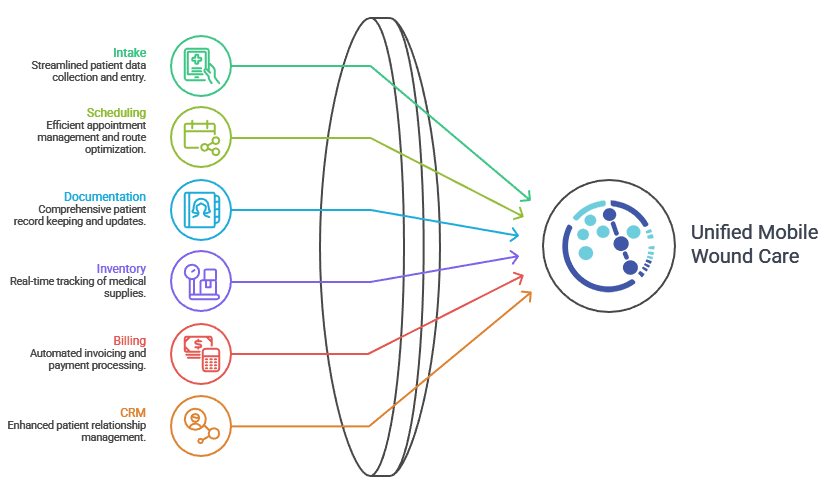
Medipyxis is positioned as an all-in-one system built specifically for mobile wound care operations—covering much more than imaging: intake & fax automation, routing & scheduling, compliance guardrails, inventory ERP + vendor portal, real-time billing capture, and referral ROI visibility in one connected model.
If you operate mobile wound care (SNFs, facilities, home settings, visiting specialist models), the practical question becomes:
Do you want to build a "stack" around a wound intelligence layer—or do you want one platform to run the full referral → route → visit → reimbursement chain?
(Everything below reflects public positioning and typical use patterns; real capabilities vary by setup and integrations.)
Two Common Purchase Paths—and What You Still Need to Operate
Path A: Buy Swift Medical as your wound intelligence layer
If you choose Swift, you're usually buying for one main reason: standardized, calibrated wound capture plus a consistent, program-level view of wound status across teams.
Swift describes a secure mobile + cloud platform used to capture wound photos and monitor wound status, along with clinical context. In many organizations, that becomes the "wound layer" everyone trusts.
What you'll still need alongside Swift in most mobile programs:
- Referral intake (fax/email → structured intake)
- Scheduling + routing to run daily field operations
- An inventory control process for advanced products/grafts
- A billing workflow that reliably turns documentation into clean, defensible claims
Swift can be excellent at what it's built for. It just typically isn't positioned as the end-to-end mobile operations backbone that replaces those adjacent systems.
Path B: Buy Medipyxis as your mobile wound care operating system
Medipyxis' pitch is basically: stop stitching tools together.
It explicitly frames itself as the OS for mobile wound care: intake/fax automation, routing & scheduling, inventory ERP + vendor portal, compliance guardrails, embedded orders, real-time billing capture, and referral ROI visibility.
What you're trying to eliminate with Medipyxis: tool sprawl, swivel-chair work, integration gaps, and the "billing archaeology" cycle that happens when field care and back office are running on different versions of the truth.
Where Swift Medical Is Genuinely Strong
To keep the comparison fair, it helps to say this plainly—because these strengths are why Swift makes the shortlist in the first place.
Swift emphasizes:
- Calibrated imaging at the point of care, designed to reduce variability across users and settings
- A large data foundation for insights (including marketing claims around 32+ million calibrated wound images)
- Program-level dashboards that are often attractive in settings like home health, where leaders need remote visibility and review
- A security posture that includes SOC 2 Type II certification aligned with HITRUST standards
If your #1 objective is improving measurement consistency and building a stronger wound intelligence layer across teams, Swift can be a very strong fit.
Where Medipyxis Tends to Have Advantages Over Swift Medical for Mobile Operators
These are "operational coverage" advantages—what determines whether your organization can move faster without breaking.
1) Medipyxis is built to run referral intake, not just document the visit
Mobile wound care doesn't break because the photos aren't good enough. It breaks when referrals sit untouched.
Medipyxis puts a lot of emphasis on the front door: converting fax/email referrals into structured intake, verifying insurance before scheduling, assigning the right clinician, and tracking referral status so nothing disappears.
Why that matters vs Swift: Swift is positioned strongest around wound capture, insights, and program-level visibility. Medipyxis is positioned as the system that turns referral demand into scheduled capacity.
2) Medipyxis treats routing and scheduling as core workflow—not a dependency
For mobile teams, routing isn't admin work. It's throughput.
Medipyxis explicitly positions routing/scheduling and route optimization as part of the platform's daily operating flow (tied to intake, clinician workload, compliance, and inventory accountability).
Why that matters vs Swift: Swift can be the wound layer you integrate into an existing workflow. Medipyxis is positioning itself as the system that runs the daily machine: who goes where, in what order, with what requirements and constraints.
3) Medipyxis connects documentation to billing as one operating model
In mobile wound care, a "great wound photo" doesn't help if the chart still gets stuck before billing.
Medipyxis is explicit that documentation and billing are connected—designed so when the visit is done, billing has what it needs, rather than treating billing as a downstream scavenger hunt.
Why that matters vs Swift: Swift speaks to documentation, program outcomes, and operational visibility. Medipyxis differentiates by how tightly the workflow is wired to billing-ready output inside the same chain.
4) Medipyxis has graft/advanced products ERP positioning with Medicare guardrails and traceability
Once advanced products enter the picture, inventory becomes margin, compliance, and audit readiness—not just supply tracking.
Medipyxis is unusually direct in its positioning here: graft inventory governance tied to LCD coverage rules (configurable by Medicare region) and audit-ready traceability logs (who had it, who used it, which patient, when), with lot/expiry tracking as part of the workflow.
Why that matters vs Swift: Swift is strong on imaging and program analytics. Medipyxis positions advanced product traceability + reimbursement alignment as a first-class operational workflow.
5) Medipyxis is trying to replace multiple tools, not become another tool
This sounds subtle until you live it.
Medipyxis repeatedly frames the value as replacing operational sprawl (intake, scheduling, inventory, compliance, billing, ROI visibility) with a single connected platform.
Why that matters vs Swift: Swift is often deployed as a key layer inside a broader ecosystem. Medipyxis pitches consolidation of the ecosystem itself.
6) Medipyxis includes referral ROI/business development visibility in-platform
Mobile wound care growth is referral-driven. Leaders often want ROI by source—what converts, what stalls, what's worth pursuing.
Medipyxis describes in-platform ROI and BD visibility (referrals and revenue by practice/source, outreach history, conversion trends).
Why that matters vs Swift: Swift's value story is largely clinical and program-focused. Medipyxis is also trying to unify the commercial motion (referral growth) with operational execution.
The Demo Test That Makes This Decision Obvious
If you want an evaluation that isn't marketing-driven, ask both vendors to walk the same "episode" end-to-end:
- A referral arrives by fax/email → how does it become a scheduled visit?
- How is the clinician assigned (distance, workload, route impact)?
- Show route planning for a full day with constraints (facility windows, add-ons, urgent visits).
- Kill the internet connection mid-visit. What still works? What syncs later?
- Document a multi-wound visit—then show what "compliance guardrails" actually do.
- Use an advanced product/graft: record lot/expiry; prove traceability; generate an audit-ready report.
- Show what billing receives immediately after the visit (and what still takes manual work).
- Show leadership visibility: referral conversion time, clinician capacity, inventory exposure, compliance risk.
The vendor who can walk that chain cleanly is usually the one that reduces headcount pressure later.
FAQ
Is Medipyxis the same type of platform as Swift Medical?
Not exactly. Swift Medical positions itself as a digital wound care management platform centered on calibrated imaging and insights. Medipyxis positions itself as an all-in-one mobile wound care operating system that also includes intake, routing/scheduling, inventory ERP, compliance guardrails, and billing capture.
What's the biggest Medipyxis advantage over Swift Medical?
For mobile wound care operators, it's operational scope: referral intake automation, routing/scheduling, documentation-to-billing workflow, and graft ERP traceability built into the same system.
When is Swift Medical the better pick?
When your top priority is standardizing wound imaging and program-level insights across settings—and you already have strong operational systems for intake, routing, inventory control, and billing.
Bottom Line
If what you want is a powerful wound intelligence layer—calibrated imaging, insights, dashboards—Swift Medical belongs on the shortlist.
If what you want is to run mobile wound care like an operational machine—tight referral intake, efficient routing, LCD-minded workflows, advanced product traceability, and billing-ready output—Medipyxis is designed around that full chain, and that's where its advantages over Swift Medical are most meaningful.