
 Billing & Revenue Cycle
Wound Care Billing & Revenue Cycle — One Workflow, Not Two Departments
When documentation and billing are disconnected, revenue waits while billing teams reconstruct what clinicians already documented. In Medipyxis, real-time billing code capture means a billable note is ready before the provider leaves the driveway — so billers can handle more charts without expanding the team.
Up to 90%
Less billing prep time*
Pre-submit
LCD compliance check*
Pre-lined
CPT & ICD-10 codes
Up to 90%
Less billing prep time*
typical Medipyxis customer workflow vs. prior tool stack
Pre-submit
LCD compliance check*
documentation gaps flagged before the claim goes out
Pre-lined
CPT & ICD-10 codes
built during the visit
Figures shown describe Medipyxis workflow design targets and platform capabilities, not guaranteed customer results. Actual outcomes depend on practice baseline, adoption depth, payer mix, and implementation quality. Nothing on this site is a guarantee of specific clinical, operational, or financial outcomes.
CPT & ICD-10 Codes Built During the Visit
Every clinical decision a wound care provider makes maps to a billing code. Medipyxis does that mapping automatically as clinicians document — so the claim is ready when the chart is.
- ✓Wound debridement type mapped to appropriate CPT codes automatically
- ✓ICD-10 diagnosis codes pre-populated from wound classification
- ✓Graft application coding derived from documented product and lot
- ✓E/M codes suggested based on documented complexity
- ✓Modifiers applied automatically based on payer and visit type
Up to 90%
Less Billing Prep Time
based on avg. workflow before and after Medipyxis adoption
In traditional workflows, billing teams spend hours reviewing notes and manually assigning codes. In Medipyxis, that work happens during documentation — so billing audits rather than reconstructs.
Billing Team Workflow With Medipyxis
- 1Visit documentation completed by clinician
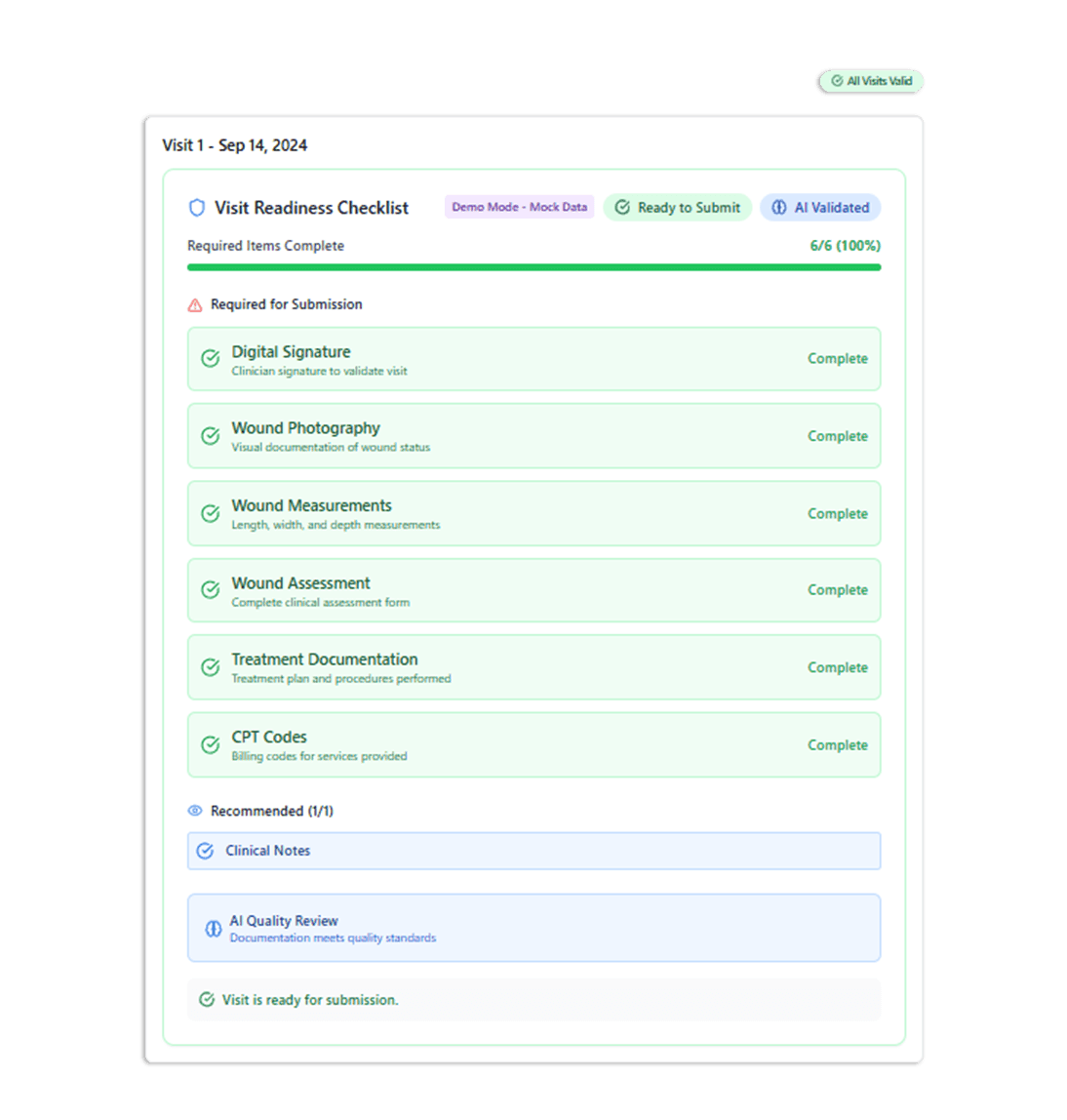
- 2Medicare documentation check passes automatically
- 3CPT/ICD-10 codes pre-lined by the system
- 4Billing team reviews and confirms codes
- 5Claim submitted — same day as visit in most cases
What a Claim-Ready Note Includes
By the time a Medipyxis chart reaches billing, every required element is already in place. No callbacks to the clinician. No manual code lookup. No reconstruction.
LCD-Complete Documentation
Every required wound measurement, tissue type, treatment rationale, and progress note is present. The Medicare documentation check passed before the chart was closed.
Pre-Lined Billing Codes
CPT codes for every procedure and ICD-10 codes for every diagnosis are attached — derived from clinical documentation, not assigned after the fact.
Graft Lot Audit Trail
Every graft application includes the lot number, expiry date, and Medicare compliance check result — already attached to the claim.
Payer-Specific Formatting
Medicare, Medicaid, and commercial payer requirements are applied automatically based on the patient's insurance on file.
Revenue Cycle Dashboard — Faster Cash Flow Under Tighter Reimbursement
The Medipyxis RCM dashboard gives billing teams and leadership real-time visibility into the claim lifecycle — from documentation to payment. Under tighter Medicare reimbursement, faster cash flow is a competitive advantage.
- ✓Claims submitted, pending, paid, and denied — all in one view
- ✓Denial reason tracking and trend analysis by code and payer
- ✓Days in A/R by payer and visit type
- ✓Denial appeal workflow built into the dashboard
- ✓Financial performance by clinician, location, and payer
Revenue Cycle at a Glance
Pre-submit
LCD compliance check*
Same day
Claim submission
Up to 90%
Less prep time
Real-time
Payment tracking
Denial Management Built In
Billing Works Because Every Module Works Together
EHR & Documentation
LCD-compliant charts with pre-lined codes arrive in billing ready to submit — not ready to review.
Graft Inventory ERP
Lot documentation attached during the visit satisfies the audit trail Medicare requires for graft claims.
Leadership Cockpit
Financial performance, denial trends, and A/R metrics are visible in the executive dashboard in real time.
Billing & Revenue Cycle — Common Questions
Related Resources
See How Claims Go Out the Same Day as the Visit
Walk through the billing workflow and see how pre-lined codes turn documentation into revenue — faster.