
About Medipyxis
We Watched Mobile Wound Care Teams Drown in 7 Tools. So We Built One.
This isn't a pivot from a different industry. We came from wound care operations. We lived the chaos. Then we fixed it.
Where It Started
Mobile wound care is one of the most logistically complex disciplines in healthcare. Clinicians drive between SNFs, ALFs, and patient homes — often without reliable internet. They carry temperature-sensitive graft products that must be documented to the lot number. They navigate prior authorizations, Medicare LCD requirements, and insurance eligibility checks — all before the patient is even seen.
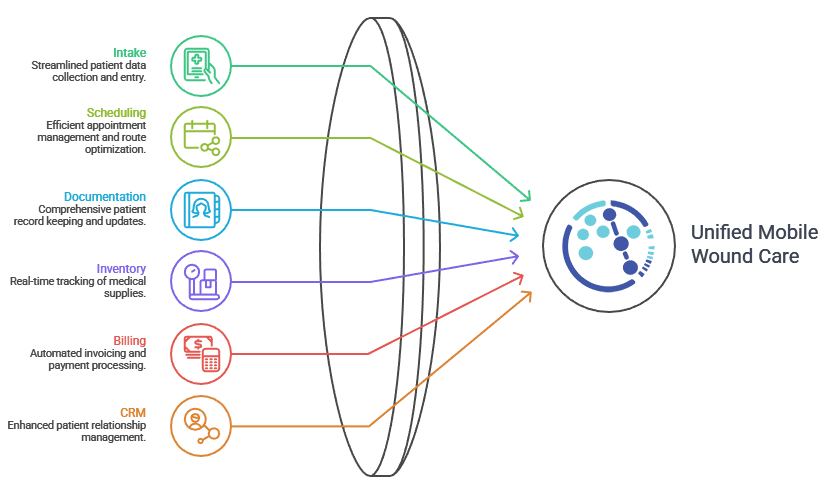
When the founders of Medipyxis first worked in and around mobile wound care practices, they saw the same pattern everywhere: seven different tools, none of them talking to each other. An EMR for charting. A separate system for referrals. A spreadsheet for graft inventory. Email for credentialing alerts. Paper for route planning. A standalone billing platform. And a leadership team flying blind without real-time visibility into any of it.
The results were predictable. Graft denials piling up because lot numbers were mismatched. Referrals falling through the cracks during the handoff from intake to scheduling. Clinicians spending the bulk of their visit on documentation instead of patient care.
Why We Built It From Scratch
Medipyxis was founded to end that chaos. Not by building another general EMR with wound care modules bolted on — but by designing from scratch, around the specific workflows of mobile wound care teams, with compliance and billing built into the core.
The result is a platform that consolidates seven tools into one — EHR, referral intake, graft inventory, compliance, billing, and leadership analytics — sharing a single patient record and a single data model. When a clinician documents a graft application at the bedside, that data flows automatically to billing, compliance, inventory, and the leadership dashboard. Nothing falls through the cracks because there are no cracks.
What It Looks Like in Practice
Medipyxis is designed to deliver measurable improvements across the workflows that matter most.
Guided
LCD-compliant charting*
with built-in LCD templates
Lot-level
Graft audit trail*
chain of custody from shipment to claim
Recovered referrals
Designed outcome
from AI intake + assignment
AI-routed
Referral intake*
AI reads, verifies, and assigns
Figures shown describe Medipyxis workflow design targets and platform capabilities, not guaranteed customer results. Actual outcomes depend on practice baseline, adoption depth, payer mix, and implementation quality. Nothing on this site is a guarantee of specific clinical, operational, or financial outcomes.
What We Believe
These four values shape every product decision we make.
Clinician-Obsessed
Every feature is evaluated against one question: does this make the clinician's job easier or harder? We do not ship complexity. Nurses and NPs should spend their time on patient care — not on software.
Radically Simple
Mobile wound care is already complicated. Our software shouldn't be. We strip every workflow down to its essential steps and build guardrails that guide users without getting in their way.
Compliance Without Compromise
Medicare compliance is not optional, and it should not be an afterthought. Medipyxis bakes LCD requirements, credential tracking, and audit trails into every workflow so compliance is the default — not an extra step.
Data-Driven Care
Good wound care decisions are informed by data. Medipyxis captures clinical data, surfaces trends in leadership dashboards, and gives practices the visibility they need to evaluate workflows and outcomes — final clinical decisions remain with the care team.
See What We Built
The best way to understand Medipyxis is to see it in action. Book a 15-minute demo with a wound care implementation specialist.