
WoundRounds vs Medipyxis: Facility-Based Prevention or Mobile Operations?
Choosing between Medipyxis and WoundRounds? See how mobile routing, intake automation, LCD guardrails, and billing workflows compare.
Caleb Ebanks
Medipyxis
Medipyxis vs WoundRounds: Choosing Between a Mobile Wound Care Operating System and a Facility Wound Prevention Platform
When teams line up Medipyxis against WoundRounds, the fastest way to get confused is to treat it like a "feature checklist" contest.
Most of the time, it's a setting + workflow decision.
WoundRounds is built and marketed for facility-based wound programs—hospitals and nursing homes that need strong bedside documentation, pressure injury prevention workflows, and standardized reporting.
Medipyxis is built and marketed for mobile wound care operations—where success depends on how fast you move from referral → scheduled visit → LCD-complete documentation → inventory traceability → bill-ready output.
So the real question isn't "Which one does more?"
It's this: Are you optimizing facility-based prevention and bedside documentation—or running a mobile wound care operation that lives and dies by intake speed, routing efficiency, inventory control, and clean billing handoffs?
(Everything below reflects how each product publicly describes itself; actual capabilities vary by implementation and integration choices.)
What WoundRounds Is Built Around: Facility-First Care
WoundRounds describes itself as an electronic documentation and wound management system designed to help hospitals and nursing homes identify patients at risk for pressure ulcers and manage prevention systematically.
In a real facility workflow, that tends to look like:
- Bedside assessment + consistent documentation: Capturing complete wound assessment details at the bedside—characteristics like size, odor, pain, and description—along with image capture to track progress over time.
- Risk prevention workflows: Prevention tools such as the Braden Scale, plus processes to flag at-risk patients and prompt interventions earlier.
- Reporting for clinical teams and administrators: Standardized reporting that supports daily planning, wound prevention oversight, and QA/regulatory workflows.
- Dashboards and team visibility: Dashboards and reporting as a coordination layer, described as a wound-dedicated EHR with a mobile wound app.
If your "center of gravity" is the facility—and your biggest pain is prevention, standardization, and bedside consistency—WoundRounds is aimed directly at that job.
What Medipyxis Is Built Around: Mobile-First Operations
Medipyxis is positioned around a different reality: mobile wound care where the clinical work matters, but operations are what limit scale.
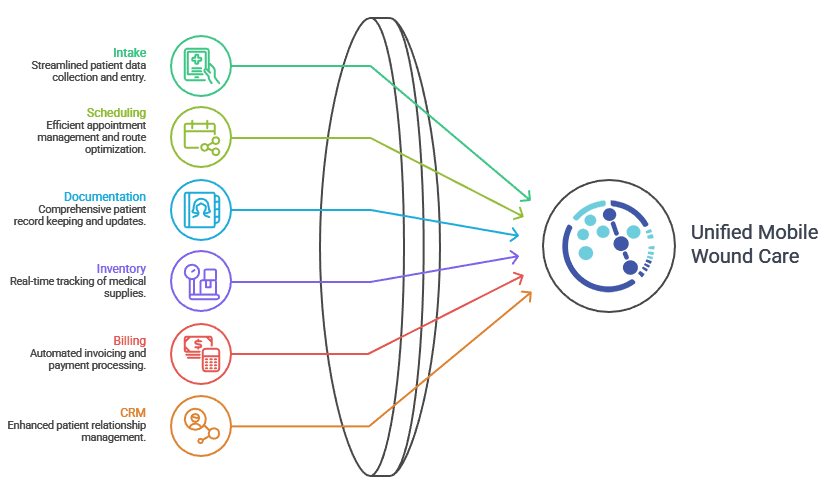
It describes itself as an all-in-one system that combines workflows mobile teams often patch together across multiple tools:
- Intake & fax/email automation
- Compliance guardrails (including an LCD Navigator)
- Routing & scheduling
- Inventory ERP + vendor portal
- Real-time billing capture and billing workflows (including a Billing Queue)
In a typical mobile workflow, Medipyxis describes something like:
- Referral arrives (fax/email) → becomes structured intake: Converting inbound referrals into clean intake, verifying insurance before scheduling, and recommending the right clinician.
- Scheduling + routing as part of the same operating flow: Routing and scheduling are positioned as core—not something you bolt on later.
- Documentation guided for Medicare/LCD completeness: Wizards plus an LCD Navigator that audits the visit before attestation and can block incomplete submissions.
- Advanced products managed like revenue, not "misc supplies": Lot/expiry tracking tied to the wound case, point-of-care capture of product usage, and tighter controls around advanced inventory.
- Billing gets a clean handoff: The Billing Queue concept means completed visits arrive organized—codes, product usage, and supporting evidence packaged—so billing can review and submit instead of reconstructing.
That's a fundamentally different blueprint than a facility-first prevention platform.
Where Medipyxis Tends to Have the Edge Over WoundRounds for Mobile Teams
1) It's built to win the front end: referral → scheduled visit
WoundRounds' messaging is heavily centered on bedside assessment, prevention, and facility reporting. Medipyxis, by contrast, talks explicitly about converting fax/email referrals into structured intake, verifying insurance before scheduling, and routing the right clinician to the right patient.
In mobile wound care, that referral-to-visit cycle time is often the real choke point.
2) Routing and field execution are treated as first-class workflows
WoundRounds fits a facility environment where "routing" isn't the daily constraint. Medipyxis highlights routing and scheduling as core mobile workflows, including route optimization.
For mobile teams, route efficiency isn't a nice-to-have—it's directly tied to volume, staffing pressure, and margin.
3) Documentation is tied to LCD guardrails before attestation
WoundRounds emphasizes clinically validated tools and standardized documentation/reporting in facility contexts. Medipyxis emphasizes guardrails—specifically an LCD Navigator that audits the visit before it's signed and can stop incomplete submissions.
That matters when the cost of "one missing element" is a denial, rework, or delayed billing.
4) A billing handoff that's designed like an operations workflow
WoundRounds discusses reimbursement reporting, but its public story remains centered on wound management, prevention, and facility reporting. Medipyxis describes a more operational, step-by-step handoff: a Billing Queue where visits arrive "ready to audit"—with codes, usage, and evidence connected.
The difference is subtle but important: reporting helps you understand what happened; a billing queue is designed to get claims out the door cleanly.
5) Advanced products and grafts are treated like an ERP problem
WoundRounds materials focus on assessment, prevention tools, and enterprise reporting. Medipyxis explicitly positions advanced inventory as ERP-style governance: lot/expiry, traceability, linkage to the wound case/visit, and audit-ready logs.
If advanced products are a meaningful part of your revenue (and risk), that workflow design matters.
6) "Operating system" vs "documentation layer"
WoundRounds is positioned as wound management + risk prevention + reporting inside facilities. Medipyxis is positioned as consolidating intake, routing, documentation guardrails, inventory workflows, and billing into one connected operating model for mobile wound care.
For mobile operators, fewer tool switches usually means fewer delays, fewer dropped details, and less staffing pressure as you scale.
When WoundRounds May Be the Better Fit
WoundRounds is often the more natural choice when your program is primarily facility-based and the goals are:
- Pressure ulcer risk prevention and intervention workflows
- Standardized bedside wound/skin assessments with image capture
- Facility and enterprise reporting for QA and regulatory needs
If the facility is the "hub," WoundRounds is designed around that reality.
Bottom Line
If you're running mobile wound care, Medipyxis has the clearer advantage because it's marketed as an end-to-end operating system: referral intake, routing/scheduling, LCD-complete documentation guardrails, advanced inventory ERP (including graft traceability), and billing-ready workflows like the Billing Queue.
If your focus is facility prevention + bedside documentation + facility reporting, WoundRounds is built for that environment and is positioned strongly around prevention tools and standardized reporting.
FAQ
Is Medipyxis the same kind of system as WoundRounds?
Not really. WoundRounds is positioned as a wound management and risk prevention system with bedside documentation and facility reporting. Medipyxis is positioned as an all-in-one operating system for mobile wound care, connecting intake, routing/scheduling, LCD guardrails, inventory ERP, and billing workflows.
What's the biggest Medipyxis advantage over WoundRounds?
For mobile operators, it's operational: intake automation, routing/scheduling, LCD guardrails before attestation, advanced inventory ERP with traceability, and a Billing Queue that turns completed visits into billing-ready output.
Does WoundRounds support reports and facility-level visibility?
Yes. WoundRounds emphasizes standardized reports and dashboards for clinicians and administrators, including QA-style reporting and tools for monitoring patients at risk for pressure ulcers.