
Medipyxis vs Intellicure: The Practical Comparison for Mobile Wound Care Teams
Medipyxis vs Intellicure: Which platform runs mobile wound care from referral to reimbursement without adding complexity or staff?
Caleb Ebanks
Medipyxis
Medipyxis vs Intellicure: The Practical Comparison for Mobile Wound Care Teams
If you're comparing Medipyxis vs Intellicure, you're usually not trying to decide which one has nicer documentation screens.
You're really asking:
Which platform helps us move faster, stay compliant, and get paid—without hiring more people or creating more handoffs?
This comparison gets confusing because the two products are often bought for different reasons.
Intellicure is commonly evaluated as a wound charting / wound center documentation solution—often in setups where it lives alongside (or inside) broader hospital EHR workflows. A lot of the appeal is "work where clinicians already work."
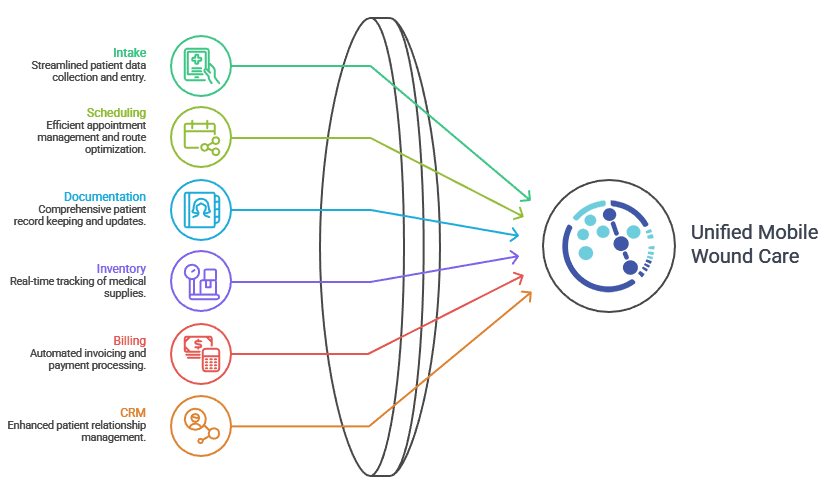
Medipyxis is commonly positioned as a mobile wound care operating system—the system that connects referral intake → scheduling/routing → field documentation → compliance guardrails → advanced product tracking → billing-ready output.
So instead of trying to win a checklist war, the cleanest way to compare them is with a few real-world stress tests—the moments where mobile wound care either runs smoothly or falls apart.
Start With the Real Question: What Problem Are You Hiring the Software to Solve?
If your biggest pain is documentation inside a wound center…
Intellicure tends to make sense when the priority is efficient, structured charting and reimbursement-minded documentation support in a wound center environment.
If your biggest pain is running mobile wound care like a business…
Medipyxis tends to resonate when the priority is operational throughput—moving from referral → visit → reimbursement cleanly across multiple facilities, multiple clinicians, and constantly changing schedules.
That distinction matters because mobile programs rarely break at the documentation screen. They break at the handoffs.
The Stress Tests That Usually Decide It
Stress Test #1: A messy referral comes in (fax/email) and you need a visit scheduled fast
In mobile wound care, speed-to-first-visit is revenue. The friction is usually intake—not clinical care.
Where Medipyxis tends to win: Medipyxis is positioned to take referral chaos and turn it into a structured intake workflow that flows directly into scheduling and operations—so intake isn't "an inbox," it's a trackable process.
Why that matters vs Intellicure: Intellicure is usually evaluated primarily as a charting/clinical documentation engine. It's not typically positioned as the operational front door that converts fax/email demand into scheduled capacity.
Stress Test #2: Your day is won or lost on routing—and routes change constantly
For mobile teams, margin is hiding inside route efficiency. Two extra stops, one missed facility window, one urgent add-on… and the whole day can collapse.
Where Medipyxis tends to win: Medipyxis is often positioned around mobile-first field operations—meaning scheduling, routing, and visit workflows are connected instead of split across tools.
Why that matters vs Intellicure: Intellicure can be very strong for documentation and reimbursement support, but most buyers don't think of it as the "route engine" that runs daily mobile operations.
Stress Test #3: Clinicians are documenting where Wi-Fi doesn't exist
Mobile wound care happens in hallways, elevators, parking lots, and rural dead zones. "We'll chart later" turns into "billing will chase it later."
Where Medipyxis tends to win: Medipyxis is positioned with field-first documentation realities in mind, including offline workflows—finish the visit correctly on-site, then sync when connectivity returns.
Why that matters vs Intellicure: Intellicure's value proposition tends to shine when charting is anchored to wound center operations and EHR-aligned workflows—settings where connectivity and workflows are more predictable.
Stress Test #4: You're using advanced products/grafts and you need chain-of-custody proof
Once advanced products show up, inventory stops being "a supply closet problem." It becomes margin, compliance, and audit readiness.
Where Medipyxis tends to win: Medipyxis is often positioned with graft/advanced products tracking built into the workflow—lot/expiry/usage tied to the patient and the visit—so traceability isn't a side project.
Why that matters vs Intellicure: Intellicure's public positioning is typically centered on charting, decision support, and wound center efficiency—not an ERP-style control layer for advanced product reconciliation.
Stress Test #5: Billing needs "bill-ready," not "chart archaeology"
Mobile programs scale when billing stops being detective work.
Where Medipyxis tends to win: Medipyxis is commonly positioned to connect the completed visit directly to billing output—so the system is designed to reduce missing elements, rework, and back-and-forth.
Why that matters vs Intellicure: Intellicure is often evaluated for charting efficiency and reimbursement support inside documentation. Medipyxis is positioned more as a full chain: referral → route → visit → compliance → billing output.
Stress Test #6: Leadership wants the operational truth without stitching reports together
Once volume grows, leadership needs to see: where referrals come from, how fast they convert, how capacity is being used, where compliance and billing friction is building up, and what's driving margin.
Where Medipyxis tends to win: Medipyxis is positioned as a single system of record for mobile wound care operations—making it easier to get operational insight without exporting and reconciling across tools.
Why that matters vs Intellicure: Intellicure can be excellent for outcomes, documentation, and reimbursement support—but mobile programs often need that plus an operational backbone.
Where Intellicure Can Be the Better Fit
A fair comparison should say this clearly: there are situations where Intellicure is the more natural choice.
Intellicure often makes sense when:
- You're a hospital-based outpatient wound center optimizing documentation and reimbursement inside established workflows
- You want wound charting that fits tightly into existing EHR operations
- The main win is charting speed, coding support, and standardization—not mobile routing and field execution
If you're not struggling with mobile operations—and your primary goal is streamlining wound center documentation—Intellicure can be a strong candidate.
The Clearest Medipyxis Advantages Over Intellicure (Plain-English Summary)
- Medipyxis is built to run mobile wound care operations end-to-end, not just chart wounds.
- Medipyxis is focused on intake-to-visit conversion—where mobile programs commonly bottleneck.
- Medipyxis is routing and field-execution oriented, which directly affects throughput and margin.
- Medipyxis is designed to support documentation completeness in the field, reducing downstream fixes and billing holds.
- Medipyxis emphasizes advanced product traceability workflows, which matter when grafts/products drive both revenue and audit exposure.
- Medipyxis connects the visit to billing-ready output, reducing "billing archaeology."
FAQ
Is Medipyxis a replacement for Intellicure?
For many mobile wound care organizations, Medipyxis is evaluated as a broader operational system, while Intellicure is commonly evaluated primarily as a wound documentation/charting solution. Whether it's a "replacement" depends on whether your need is mostly charting—or running the entire mobile workflow.
Can a team use Intellicure and Medipyxis together?
Some organizations use one tool for documentation while keeping operations elsewhere. But most mobile teams that choose Medipyxis are trying to reduce tool sprawl and handoffs—so the long-term goal is often consolidation.
What makes Medipyxis different from a wound charting app?
Medipyxis is positioned as the mobile wound care operating system: it's about the workflow from referral intake to routing to field documentation to compliance and bill-ready output—especially for teams operating across facilities and geographies.
Bottom Line
If your buyer is a mobile wound care operator, lead with Medipyxis and sell the operational outcomes: faster intake conversion, more efficient routes, fewer documentation gaps, tighter product traceability, and faster billing readiness.
If your buyer is a hospital wound center optimizing charting inside existing EHR workflows, Intellicure may feel more "native"—unless they're also trying to build or scale a mobile program, in which case Medipyxis' operating-system approach can be the differentiator.