
Medipyxis vs WoundZoom: Best Software for Mobile Wound Care in 2026
Role-by-role comparison highlighting Medipyxis's operational scope versus WoundZoom's documentation and AI measurement strengths.
Caleb Ebanks
Medipyxis
Quick Snapshot: What Each Platform Is Trying to Do
WoundZoom in Plain Terms
WoundZoom centers on wound imaging, measurement, and documentation with a mobile app and cloud portal (WoundZoom CONNECT) designed to support reporting and EHR integration.
Key features include:
- AI-based, non-contact measurement
- Auto-border capture
- Optional auto-depth functionality
- Overlay feature for consistent image orientation over time
- Offline workflow with sync
- Reporting aimed at supporting payer/auditor needs
- EHR integration
WoundZoom also offers ZoomBill as a separate solution for billing services and billing software.
Bottom line: WoundZoom is a strong documentation + measurement + integration platform with a separate billing offering.
Medipyxis in Plain Terms
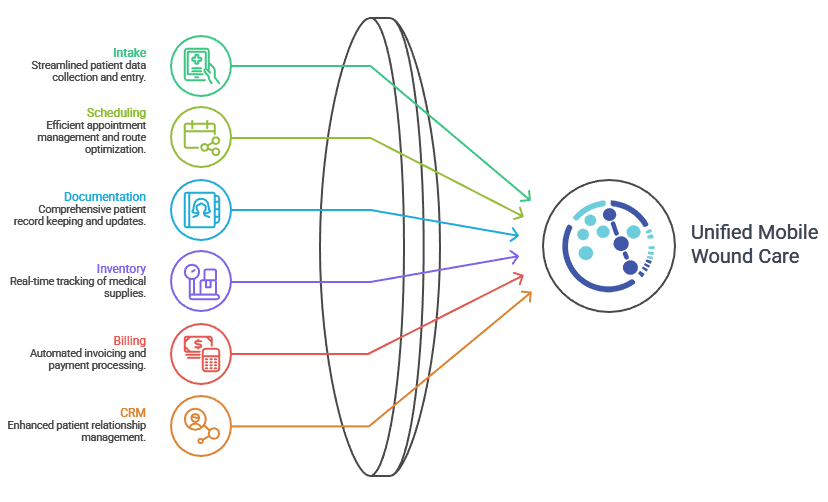
Medipyxis is positioned as an end-to-end operating system for mobile wound care, running the entire workflow surrounding wound documentation.
The connected model includes:
- Intake & fax automation
- Clinical workflow + compliance guardrails
- Routing & scheduling
- Inventory ERP + vendor portal
- Real-time billing capture
- Referral ROI visibility
Medipyxis specifically highlights operational handoffs including a Billing Queue and LCD Navigator that audits visits before attestation.
Bottom line: Medipyxis is built to run the operation end-to-end, including the "before" and "after" parts that typically create bottlenecks in mobile care.
Medipyxis vs WoundZoom, by Role
1) Intake & Scheduling Coordinator
The real question: Can referrals become scheduled visits without extensive rework?
WoundZoom's approach: WoundZoom emphasizes patient/census management in CONNECT and focuses on capturing wound encounter data and reducing double documentation through EHR integration.
Medipyxis's approach: Medipyxis prioritizes referral intake as a core workflow: converting fax/email into structured data, verifying insurance before scheduling, recommending appropriate clinicians, and placing patients into available time slots efficiently.
Where Medipyxis stands out: If your biggest constraint is referral throughput, Medipyxis is built to remove friction before the first visit is even on the calendar.
2) Field Clinician
The real question: Can documentation happen quickly while maintaining consistency and reducing compliance risk?
WoundZoom's strengths: AI measurements, auto-border, optional depth, overlay guidance for consistent photos, offline capture with sync, and EHR integration to minimize duplicate work.
Medipyxis's approach: Workflow efficiency over measurement alone: Intake Wizard and Visit Wizard, LCD Navigator that audits visits before attestation and blocks incomplete submissions, field-first workflows like offline charting and route optimization.
Where Medipyxis has an edge: If your clinicians are tired of the loop of "do the visit → document → later get told what's missing → scramble to fix it," Medipyxis is explicitly designed to reduce that pain with pre-attestation guardrails.
3) Inventory & Graft Lead
The real question: How can high-cost advanced products be controlled without spreadsheets and guesswork?
WoundZoom's emphasis: WoundZoom focuses on documentation, analytics, and reporting supporting billing/compliance, but its core doesn't center on inventory ERP for grafts.
Medipyxis's emphasis: Dedicated Graft ERP/Advanced Products ERP with Medicare guardrails aligned to LCD rules, audit-ready reporting with traceability logs, real-time lot/expiry tracking tied to wound cases.
Where Medipyxis leads: If advanced products materially impact margin and audit risk, Medipyxis is built to make traceability and expirations part of the same workflow.
4) Billing & Ops Leadership
The real question: How quickly do visits convert to clean claims, and how visible is operational performance?
WoundZoom's offering: Reporting supporting billing/compliance and a separate ZoomBill line including billing services and software.
Medipyxis's offering: A Billing Queue where completed visits land with pre-coded diagnoses, advanced treatment data attached, and medical necessity evidence connected via LCD Navigator. It also emphasizes leadership visibility across the entire chain.
Where Medipyxis has the edge: WoundZoom can be excellent for documentation-to-EHR workflows and reporting, and ZoomBill can address billing needs. But Medipyxis' differentiator is the tight coupling: intake, routing, compliance guardrails, inventory traceability, and billing prep live in one connected workflow.
Clearest Medipyxis Advantages Over WoundZoom
Based on how both products describe themselves, Medipyxis leads in:
- Referral intake automation progressing from fax/email to scheduled visits
- Routing + scheduling integrated with documentation and operations
- LCD Navigator guardrails auditing visits before attestation
- Graft/Advanced Products ERP with Medicare guardrails and audit-ready traceability
- Billing Queue organizing visits with codes and supporting evidence pre-attached
- Broader "one platform" approach including BD/CRM + ROI visibility
When WoundZoom May Be the Better Fit
WoundZoom can be optimal when priorities include:
- Upgrading the wound documentation + measurement + analytics layer as the primary goal
- Strong EHR integration reducing double documentation
- Standardizing imaging and measurement workflows
- Existing intake, routing, inventory controls, and billing operations running smoothly
If you're not trying to overhaul operations—and you primarily want to modernize measurement and documentation across settings—WoundZoom can line up well.
A "Prove It" Demo Script
To drive confident internal decisions, use this workflow-based demonstration:
- Start with a real referral (fax/email) and show its conversion into a patient record and scheduled visit
- Show clinician assignment and route impact (distance/workload/efficiency)
- Run a multi-wound visit, then demonstrate guardrail responses when required elements are missing
- Document an advanced product/graft use and generate immediate traceability output
- Conclude at billing: show what arrives, what's pre-attached, what requires human review
FAQ
Is Medipyxis Better Than WoundZoom?
For mobile wound care operations, Medipyxis is often the better fit because it's built to run the full workflow—referral intake through routing, compliance guardrails, inventory ERP, and billing prep—inside one system. For teams primarily focused on wound imaging/measurement + documentation + analytics with strong EHR integration, WoundZoom can be strong.
What's the Biggest Advantage Medipyxis Has Over WoundZoom?
Operational scope. Medipyxis explicitly includes intake automation, routing/scheduling, LCD guardrails, graft ERP traceability, and billing queue workflow as a unified system for mobile wound care.
Does WoundZoom Integrate With EHRs?
Yes. WoundZoom promotes EHR integration and reduces double documentation through CONNECT portal and integration approaches.