
Medipyxis vs WoundMatrix: Which Platform Improves the Full Referral-to-Billing Workflow?
Medipyxis vs WoundMatrix in 2026: end-to-end operational workflow compared with WoundMatrix's focused capture and telehealth capabilities.
Caleb Ebanks
Medipyxis
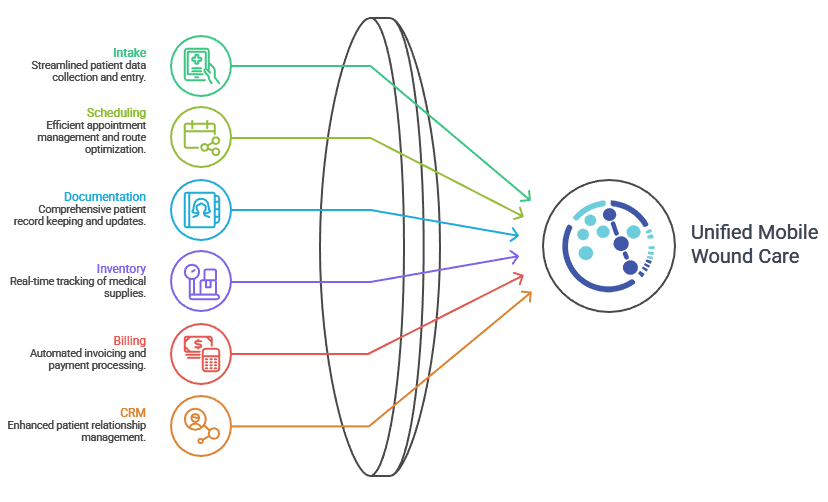
When comparing Medipyxis against WoundMatrix, the real decision centers on which platform manages the complete wound care episode—from referral through billing—without creating handoffs and gaps.
To make this comparison useful, the wound episode must be examined in sequence, noting where each product focuses based on public positioning.
(Note: This is a positioning-based comparison. Actual capabilities vary by configuration, integrations, and updates.)
What Each Platform Is Trying to Be
What WoundMatrix Is Built For
WoundMatrix positions itself as a mobile wound management and telehealth solution centered on secure capture, measurement, and upload of wound images and encounter data, plus reporting and outcome tracking.
Key operational features include:
- Customizable data fields and real-time notifications
- Offline and online modes with later sync
- Telehealth workflows where patients upload wound images for measurement and tracking
- Compliance features including HIPAA and 21 CFR Part 11 claims
WoundMatrix functions primarily as a documentation, measurement, and telehealth layer for reliable wound encounter data capture.
What Medipyxis Is Built For
Medipyxis positions itself as "the all-in-one system built for mobile wound care"—an operating system for the business side of mobile wound care rather than just a capture tool.
It describes a connected workflow addressing multiple traditionally separate systems:
- Intake and fax automation
- Compliance guardrails, including an LCD Navigator
- Routing and scheduling
- Inventory ERP plus vendor portal
- Real-time billing capture
- Referral ROI and growth visibility
The Wound Episode Comparison: Where the Differences Show Up
1) Before the Visit: Referrals → Scheduled Visits
The critical question: Can referrals become scheduled visits without bottlenecks?
For mobile wound care operations, this step determines volume success or failure.
- Medipyxis emphasizes turning fax and email referrals into structured intake, preventing duplicates, verifying insurance before scheduling, recommending optimal clinicians based on drive time and workload, and tracking referral status to prevent case loss.
- WoundMatrix doesn't position referral intake automation as its primary focus. Its messaging starts closer to the encounter itself: point-of-care capture, measurement, and telehealth monitoring.
Practical takeaway: If referral intake is the operational bottleneck, Medipyxis holds an advantage because it addresses this step natively.
2) During the Visit: Fast, Consistent Documentation
The critical question: Can clinicians document quickly and consistently in real-world field conditions?
WoundMatrix appears strong in this area based on its messaging.
- WoundMatrix emphasizes point-of-care documentation, image capture, offline/online modes, and measurement workflows designed to reduce variability.
- Medipyxis also discusses field-first workflows including offline charting, but frames documentation as one link in a larger operational chain rather than a finish line.
Practical takeaway: Both platforms support documentation. The distinction lies in what follows: Medipyxis positions the visit note to flow directly into compliance and billing.
3) Right After the Visit: Bill-Ready Output vs Billing Chase-Down
The critical question: Does documentation become bill-ready, or does billing hunt for missing pieces?
This represents one of the clearest separators.
- Medipyxis describes a Billing Queue workflow where completed visits arrive with pre-lined codes, attached usage including advanced products, and supporting medical-necessity evidence from the LCD Navigator.
- WoundMatrix emphasizes secure documentation capture, reporting, outcome tracking, and optional EHR integration, but doesn't publicly describe an "audit and submit" workflow.
Practical takeaway: For faster reimbursement and fewer denials, Medipyxis advantages itself through explicit design of bill-ready output.
4) Between Visits: Telehealth Monitoring and Patient-Submitted Images
The critical question: Does the care model require patients uploading wound photos between visits?
WoundMatrix clearly markets this capability.
- WoundMatrix describes telehealth workflows and a patient app enabling patients to upload wound images for clinician review, measurement, and healing progress tracking.
- Medipyxis differentiates through operational throughput and reimbursement protection—intake, routing, compliance guardrails, inventory, and billing—rather than patient self-capture.
Practical takeaway: Programs dependent on remote monitoring may favor WoundMatrix as a telehealth-enabled capture layer. Programs prioritizing clinician throughput and reimbursement protection benefit from Medipyxis's surrounding workflows.
5) At Scale: Advanced Products, Traceability, and Audit Risk
The critical question: When grafts and advanced products become a major cost center and audit risk, how is this managed?
Medipyxis draws a distinct line here.
- Medipyxis describes a dedicated Graft & Advanced Products ERP: real-time unit tracking, patient-visit linkage, and audit-ready traceability reporting aligned to Medicare coverage rules.
- WoundMatrix positions around documentation, measurement, telehealth, analytics, and optional EHR integration—not as a graft ERP.
Practical takeaway: With advanced products representing significant revenue and risk, Medipyxis treats graft workflows as an ERP problem rather than a spreadsheet side-process.
Clearest Medipyxis Advantages Over WoundMatrix
Based on public positioning, the most defensible differentiators are:
- Referral intake automation: fax/email conversion to structured intake with insurance verification and smart assignment
- Routing and scheduling integrated within the system running visits and back-office operations
- LCD workflow guardrails preventing incomplete submissions before attestation
- Billing Queue workflows organizing visits into bill-ready output with codes, usage, and supporting evidence
- Graft and Advanced Products ERP with Medicare guardrails and audit-ready traceability reporting
- Referral ROI and growth visibility as platform functions rather than clinical capture only
When WoundMatrix May Be the Better Fit
WoundMatrix may be preferable when primary goals include:
- Reliable mobile wound capture and measurement
- Outcome tracking and reporting
- Built-in telehealth workflows with patient image uploads
- Offline capability and customizable fields
FAQ
What's the Difference Between Medipyxis and WoundMatrix?
WoundMatrix positions as a mobile wound management and telehealth platform focused on capture, measurement, upload, reporting, and patient image submission. Medipyxis positions as an all-in-one mobile wound care operating system including referral intake automation, routing/scheduling, LCD guardrails, graft ERP, and billing workflows.
What's the Biggest Medipyxis Advantage Over WoundMatrix?
Operational scope. Medipyxis manages the complete referral-to-billing chain including LCD guardrails and billing queue workflows, not just wound encounter capture.
Does WoundMatrix Support Telehealth and Patient-Submitted Wound Photos?
Yes—WoundMatrix offers telehealth workflows and a patient app allowing wound image uploads for caregiver assessment and measurement.