
Medipyxis vs +WoundDesk: Which Platform Protects Margin in Mobile Wound Care?
Medipyxis vs WoundDesk in 2026: comparing operational scope, billing workflows, inventory management, and referral intake automation for wound care.
Caleb Ebanks
Medipyxis
Most comparisons of wound care tools start with photos, measurements, and templates. This one doesn't. Because the most expensive breakdown in mobile wound care usually isn't a blurry image—it's:
- A visit your billing team can't submit yet
- A graft you can't fully reconcile later
- A referral that sits untouched until the window closes
So let's flip the script: start at the claim, then work backward to the referral. When you do that, the difference between Medipyxis and +WoundDesk gets a lot clearer.
(Everything below is based on what each product publicly emphasizes in its materials. Capabilities can vary by configuration and change over time.)
What +WoundDesk Is (Based on Public Positioning)
+WoundDesk presents itself as a mobile solution for wound assessment and documentation. It describes a setup that includes:
- A mobile app
- An administration portal
- A wound report, with a health analytics dashboard noted as "in development"
A big part of its positioning is semi-automated measurement during documentation—producing outputs like a severity score and wound surface measurement. The mobile app is currently Android-based, with iOS referenced as "available shortly."
What Medipyxis Is (Based on Public Positioning)
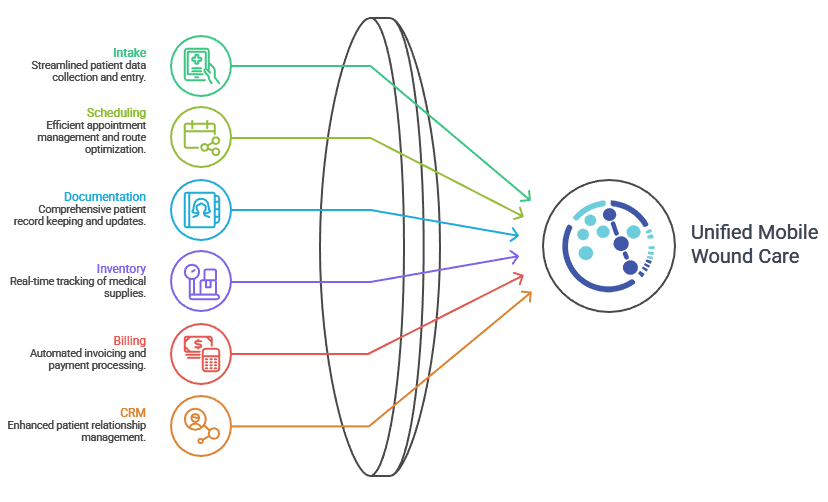
Medipyxis markets itself as an all-in-one operating system for mobile wound care—less about "just documenting the visit," and more about running the whole chain:
- Intake + fax automation
- Clinical workflow and compliance guardrails
- Scheduling and routing
- Inventory ERP + vendor portal (including grafts/advanced products)
- Real-time billing capture
- Referral ROI visibility
It calls out specific workflows that connect the dots end-to-end: referral intake + smart assignment, an LCD Navigator that audits visits before attestation, advanced inventory/graft ERP, and a Billing Queue.
The "Reverse Walkthrough": Claim → Back to Referral
Step 5: Billing-Ready Output
If you've ever heard, "We can't submit this yet," you already understand why billing belongs at the top.
With Medipyxis: Completed visits land in a Billing Queue with codes pre-lined, advanced product usage attached, and supporting medical-necessity evidence coming through the LCD Navigator.
With +WoundDesk: The emphasis is on documentation and reporting, including exporting consultation reports as PDFs for the record.
Step 4: Advanced Products + Traceability
In mobile wound care, advanced products aren't "supplies." They're margin—and audit exposure.
With Medipyxis: Graft/advanced products ERP layer tracks units in real time, links use to patient and visit, and supports traceability reporting.
With +WoundDesk: Core messaging centers on assessment, measurement, documentation, and reporting—not ERP-style graft governance.
Step 3: Documentation That Won't Bounce
+WoundDesk's strength: Making assessment and documentation easier, with semi-automated measurement and outputs like severity scoring.
Medipyxis' emphasis: Documentation inside a compliance-and-reimbursement workflow, with LCD guardrails that audit the visit before attestation and block incomplete submissions.
Step 2: Scheduling, Routing, and Assignment
With Medipyxis: Routing, scheduling, and assignment are core workflows—accounting for distance, utilization, and route efficiency.
With +WoundDesk: Scheduling and routing aren't central to its primary positioning.
Step 1: Referral Intake
With Medipyxis: Fax/email intake automation, structured referrals, duplicate prevention, insurance verification, smart assignment.
With +WoundDesk: The starting point is the visit itself—assessment and documentation—rather than intake automation.
Clearest Medipyxis Advantages Over +WoundDesk
- End-to-end operations vs documentation-first: Intake → routing → compliance → inventory → billing as one connected workflow
- Referral intake automation: Fax/email → structured intake, insurance verification, smart assignment
- LCD guardrails before attestation: Designed to prevent incomplete, non-billable submissions
- Billing Queue handoff: Built-in "audit and submit" flow for billing teams
- Graft/advanced products ERP: Lot/expiry tracking tied to wound cases with traceability
- Less tool sprawl: Stack compression vs another point solution
When +WoundDesk May Be the Better Fit
+WoundDesk can be a strong choice if your main goal is mobile wound assessment and documentation—especially if you care most about measurement and scoring outputs, an admin portal, and producing a wound report efficiently. It publishes clear security materials including ISO 27001 hosting in Switzerland.
FAQ
What's the difference between Medipyxis and +WoundDesk?
+WoundDesk is positioned as a mobile wound assessment and documentation solution with reporting, measurement, and severity scoring. Medipyxis is positioned as an all-in-one mobile wound care operations system connecting intake, routing/scheduling, compliance guardrails, inventory ERP, and billing workflows.
What's Medipyxis' biggest advantage?
Operational scope. The story Medipyxis tells is: referral intake → assignment/routing → LCD-complete documentation → inventory traceability → billing-ready output, all connected.
Can +WoundDesk sync data to an electronic patient record?
+WoundDesk states you can export consultation reports as PDFs from the admin portal; for direct syncing it suggests contacting support.