
Medipyxis vs Salesforce Health Cloud: Best Choice for Mobile Wound Care
Purpose-built wound care platform versus enterprise healthcare CRM: which operates mobile clinics better in 2026?
Caleb Ebanks
Medipyxis
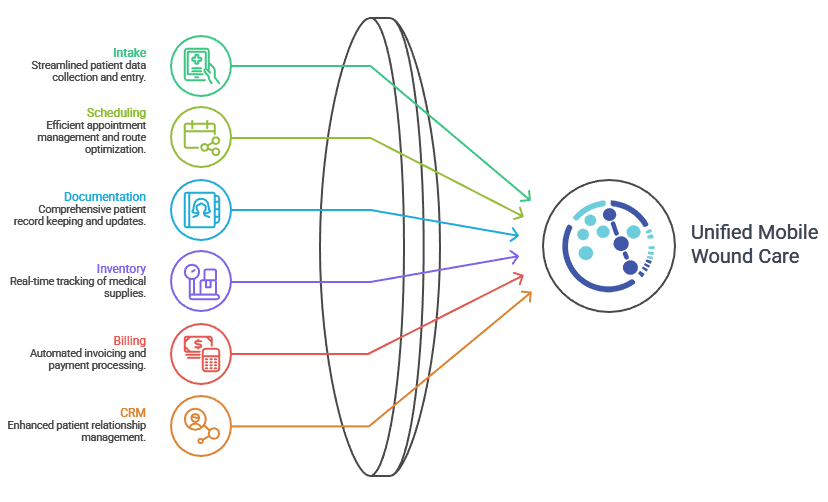
Mobile wound care teams typically face operational bottlenecks rather than documentation gaps. The challenge involves moving episodes through complete workflows—from referral through scheduling, compliant documentation, graft traceability, and billing-ready claims—without fragmentation across multiple systems.
These products serve fundamentally different purposes and shouldn't be compared as direct competitors.
Medipyxis positions itself as a purpose-built mobile wound care operating system spanning referral automation, scheduling and routing, wound documentation with Medicare/LCD compliance, inventory ERP with vendor workflows, and real-time billing integration.
Salesforce Health Cloud functions as an enterprise healthcare CRM and care coordination layer designed to extend existing EHR systems through connected data, care management workflows, referral management, FHIR APIs, and cross-system automation.
The core decision involves where your operational "source of truth" should reside: within a wound-specific operating model or within a configurable enterprise platform orchestrating existing systems.
The Easiest Way to Tell What You're Actually Buying
When a referral arrives late in the day, consider what must happen next and where that work lives:
- Intake and de-duplication
- Insurance verification and authorization checks
- Assignment and route reshuffling
- Offline-capable documentation
- Medicare/LCD completeness verification
- Graft availability, lot tracking, and expiry logging
- Billing output preparation
If workflow steps scatter across multiple systems, you're adopting an operating model rather than purchasing isolated software.
What Each Platform Is Trying to Be
Medipyxis: "Run the Whole Mobile Wound Care Machine in One Place"
Medipyxis emphasizes one connected workflow across intake, insurance verification, scheduling and routing, clinical documentation, billing and coding, and advanced inventory ERP alongside HR and business development functions. Its value proposition targets operational drag, rework cycles, documentation delays, denials, and inventory leakage.
Salesforce Health Cloud: "Be the Enterprise Layer That Connects Everyone"
Health Cloud emphasizes integrated care management, provider relationship management, utilization management (prior authorizations, appeals, grievances), FHIR-based interoperability, and intelligent appointment automation. It's typically positioned as an orchestration layer extending EHR and other systems rather than replacing them as the clinical documentation engine.
At a Glance Comparison
Medipyxis executes mobile wound care end-to-end. Salesforce Health Cloud coordinates care and relationships across enterprise ecosystems.
Referral → Scheduled Visit
Medipyxis integrates fax and email intake, structured data capture, insurance verification, and intelligent assignment within one workflow.
Health Cloud positions referral management and appointment automation as part of broader enterprise scheduling infrastructure.
Routing + Field Operations
Medipyxis treats routing optimization and offline field realities as core functionality.
Health Cloud supports scheduling workflows but isn't primarily marketed as a field-operations engine for mobile teams.
Wound Documentation + Medicare/LCD Guardrails
Medipyxis incorporates wound-specific documentation controls (LCD Navigator) that prevent incomplete submissions.
Health Cloud functions as a collaboration and data layer around the EHR, so point-of-care Medicare/LCD guardrails aren't the default narrative.
Grafts and Advanced Products
Medipyxis features dedicated graft and advanced products ERP handling lot tracking, expiry management, visit linkage, and audit-ready reporting.
Health Cloud isn't positioned as a graft inventory ERP; organizations would need to design custom workflows.
Billing Readiness
Medipyxis positions a Billing Queue where codes are pre-lined and product usage attaches to visits automatically.
Health Cloud offers powerful automation but billing flows typically require configuration around organizational billing and revenue cycle management stacks.
Where Medipyxis Tends to Win for Mobile Wound Care
- Intake conversion to scheduled capacity — structured capture plus insurance verification plus assignment and routing logic
- Wound documentation preventing Medicare/LCD denials — LCD Navigator targets the "fix it later" loop
- Advanced product governance — lot tracking, expiry, audit-ready reporting
- Billing workflow design — Billing Queue ensures organized handoffs
- Mobile-first operational reality — routing, offline charting, autosync
- Single-system workflows — intake through billing within one model
Important nuance: Salesforce offers substantial configuration flexibility. This isn't inherently disadvantageous but typically means designing wound workflows (objects, automation, integrations, governance) rather than adopting pre-built wound-native models.
Where Salesforce Health Cloud Can Be the Better Call
Health Cloud becomes the stronger choice for payers, integrated delivery networks, or large health systems standardizing Salesforce across service, marketing, and data functions:
- Enterprise care management (care plans, whole-person workflows, gap closure)
- Interoperability strategy (FHIR APIs, pre-built integrations, cross-system data aggregation)
- Provider network and utilization workflows (credentialing, contracting, prior auths)
- CRM and engagement layers supporting multiple service lines beyond wound care
Pricing Reality Check
Salesforce Health Cloud is positioned as an enterprise platform; pricing varies by tier, deployment scope, region, and contract size, and typically includes substantial configuration, implementation, and ongoing administration costs in addition to per-seat licensing. Verify current pricing directly with Salesforce.
Medipyxis is positioned at lower per-seat pricing with the wound-care workflows pre-built rather than configured. See Medipyxis pricing for current tiers; final pricing depends on tier, seat count, and onboarding scope.
Decision Guide
You'll Usually Lean Medipyxis If:
- Mobile wound care clinics need comprehensive chain-of-custody in single platform
- Referrals arrive via fax/email and intake velocity drives volume growth
- Routing and offline operational constraints are daily realities
- Graft and advanced product traceability requirements exist
- Billing velocity and accuracy matter significantly
You'll Usually Lean Salesforce Health Cloud If:
- Building enterprise engagement and care orchestration across multiple systems
- Care plans, utilization workflows, provider networks, and CRM are central
- Integration strategy and cross-system FHIR data unification matter
- Wound care is one service line among many requiring coordination
Bottom Line
Salesforce Health Cloud functions as an enterprise care orchestration heavyweight. For mobile wound care operators prioritizing faster intake, intelligent routing, Medicare/LCD-complete documentation, graft traceability, and billing-ready output, Medipyxis addresses purpose-built operational requirements. These platforms don't compete directly because they solve fundamentally different operational challenges.