
Medipyxis vs PointClickCare: A Straightforward Comparison for Wound Care Operators
Medipyxis vs PointClickCare in 2026: one is a SNF-first EHR, the other runs the full referral-to-billing workflow for mobile wound care teams.
Caleb Ebanks
Medipyxis
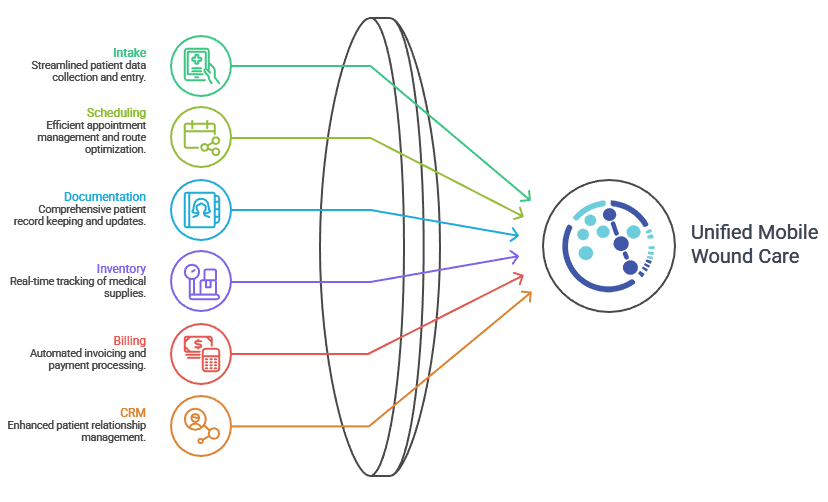
If you manage wound care across multiple locations with mobile teams, you've likely encountered the same challenge: referrals pile up, paperwork becomes overwhelming, and billing stalls. Most operators conclude they need better software—but selection proves difficult when options appear similar initially.
The clearest distinction:
- PointClickCare centers on facility-based EHR functions, designed mainly for skilled nursing facilities, with wound capabilities supporting documentation and bedside monitoring.
- Medipyxis functions as a mobile wound care operating system, linking referral intake → scheduling/routing → documentation compliance → inventory/graft tracking → billing → performance insights within one integrated workflow.
What Medipyxis Is Built For
Medipyxis positions itself as a specialized platform for mobile wound care operators, aiming to reduce operational inefficiency so teams expand volume while maintaining margins without excessive staffing increases.
The platform extends beyond charting, emphasizing "between-the-visits" processes that typically create friction:
- Referral intake automation (fax/email → structured intake)
- Scheduling and route planning
- Documentation workflows with compliance-oriented safeguards
- Graft and supply tracking (inventory control)
- Billing and coding preparation with audit trails
- Leadership oversight and analytics
The platform distinguishes itself from traditional EHRs by addressing field work realities: offline charting, route optimization, and workflows structured around mobile operations—not facility documentation alone.
What PointClickCare Is Built For
PointClickCare positions itself as a secure, cloud-based platform designed around skilled nursing and post-acute care workflows, emphasizing care transitions, interoperability, and clinical and financial outcomes in SNF settings.
For wound functionality, PointClickCare provides Skin and Wound, positioned around wound progression visibility and supporting consistent monitoring and documentation. Highlighted capabilities include:
- Bedside workflow support
- Dashboards and tracking visibility
- Assessment access through app and web
- Integration into resident chart and broader SNF workflow tools
PointClickCare also provides broader solutions spanning clinical, revenue cycle, and operations, anchored by its SNF EHR platform.
The Core Difference (and Why It Matters)
Summary:
PointClickCare prioritizes facility-first SNF operations, with wound tools targeting documentation and monitoring within that environment.
Medipyxis prioritizes the full mobile wound care business, connecting end-to-end workflow from intake through billing—plus operational elements determining whether you scale effectively or encounter obstacles.
This distinction matters because mobile wound care challenges typically emerge around the clinical documentation moment rather than during it:
- Referrals arriving through disorganized channels
- Scheduling complexity across multiple locations
- Travel time and routing inefficiencies
- Incomplete documentation delaying billing
- Inventory loss (particularly with advanced therapies)
- Claims delayed due to incomplete or difficult-to-locate information
Where Medipyxis Has Advantages for Mobile Wound Care Operators
1) Built for mobile wound care operations—not just documentation
Medipyxis is purpose-built for mobile wound care, with modules spanning referral-to-billing and operations beyond charting.
PointClickCare positions itself first as an EHR built for skilled nursing, with wound tools framed around bedside documentation and monitoring.
Why it matters: Mobile operators require a platform treating logistics, compliance, inventory, and billing as primary workflows—not secondary features.
2) Referral intake automation and smart assignment
Medipyxis emphasizes intake automation: converting fax/email referrals into structured intake, verifying insurance prior to scheduling, and recommending appropriate clinicians so intake doesn't require expanding administrative staff.
PointClickCare's public positioning centers on SNF EHR workflows and wound documentation—not intake automation as a central feature.
Why it matters: Reducing referral friction represents often the quickest approach for increasing visits without expanding overhead.
3) Route planning and field constraints (including offline support)
Medipyxis explicitly highlights offline charting, route optimization, and field-first workflows, encompassing scheduling, route planning, and patient ETA-style messaging.
PointClickCare's wound messaging emphasizes bedside workflows, app/web access, and clinical monitoring inside facility operations.
Why it matters: Mobile teams succeed when routing, travel time, and field constraints are fundamental to the workflow—not added afterward.
4) Compliance-oriented documentation guardrails and bill-ready workflows
Medipyxis markets documentation safeguards designed to ensure documentation accuracy initially and maintain billing flow—particularly under stricter reimbursement standards. The mobile EHR is built to produce defensible, billing-ready records without post-visit rework.
PointClickCare emphasizes documentation efficiency and wound progression visibility, though wound positioning isn't framed around mobile LCD-style safeguards as the principal differentiator.
Why it matters: In mobile wound care, documentation must be not only captured—but defensible, thorough, and aligned with billing requirements.
5) Graft tracking and inventory ERP positioning
Medipyxis positions graft tracking and inventory control as core platform elements, encompassing end-to-end tissue tracking and minimizing waste tied to expired inventory.
PointClickCare's wound materials emphasize monitoring and documentation; graft inventory ERP isn't presented as a primary capability.
Why it matters: If advanced therapies drive your business economics, improved inventory control protects margin and decreases operational chaos.
6) Billing and coding prep plus operational visibility
Medipyxis highlights billing and coding preparation, audit trails, and real-time billing capture as integrated workflow components—positioning billing readiness as intentionally designed rather than managed after-the-fact.
PointClickCare provides revenue cycle tools as part of a broader SNF suite, though wound-specific materials emphasize documentation and monitoring rather than a mobile referral-to-billing operating framework.
Why it matters: Mobile wound care expands faster when billing readiness is embedded—reducing constant chart chasing and post-visit corrections.
7) ROI visibility and business development tracking
Medipyxis explicitly promotes business development tooling—tracking referrals, connecting outreach to performance, and establishing measurable ROI.
PointClickCare's positioning emphasizes clinical operations and outcomes in skilled nursing rather than BD/ROI tooling as a central promise.
Why it matters: In referral-driven mobile wound care, linking outreach → referrals → visits → revenue in one platform makes growth measurable and improvable.
When PointClickCare May Be the Better Fit
PointClickCare may be stronger if:
- Your primary setting is skilled nursing / post-acute facility operations
- You need an integrated SNF EHR centered on care transitions and facility workflows
- Your wound program operates mainly in facilities, with needs centered on documentation and progression monitoring within that context
When Medipyxis Is the Better Fit
Medipyxis typically works better if you're operating—or actively expanding—a mobile wound care team requiring one system connecting:
- Fax/email referral intake → structured intake
- Scheduling and route planning
- Compliance-oriented documentation safeguards and bill-ready workflows
- Graft tracking and inventory control
- Operational oversight and ROI visibility
Summary: If scaling mobile wound care without administrative burden, rework, and billing delays is your goal, Medipyxis addresses that operational reality.
See how Medipyxis runs the full workflow →
FAQ: Medipyxis vs PointClickCare
Is Medipyxis an EHR?
Medipyxis positions its EHR and visit documentation as compliant, mobile, and supporting billing—while framing documentation as one element of a broader end-to-end operating system for mobile wound care.
Does PointClickCare have wound care software?
Yes. PointClickCare provides Skin and Wound, positioned around wound progression visibility and supporting consistent monitoring, with dashboards and app/web assessment access.
What's Medipyxis' biggest advantage over PointClickCare for mobile wound care?
Medipyxis addresses the full mobile wound care operation—intake automation, routing/scheduling, compliance-oriented documentation safeguards, graft tracking, billing/coding prep, and ROI visibility—all integrated within one workflow.