
Medipyxis vs Pixalere: Mobile Wound Care OS vs Canadian E-Wound Platform
Compare Pixalere's Canadian wound documentation platform with Medipyxis' end-to-end mobile wound care operating system for US practices in 2026.
Caleb Ebanks
Medipyxis
Pixalere and Medipyxis both specialize in wound care — but they were built for very different markets, care settings, and operational models.
Pixalere is a Canadian wound care documentation platform with the largest wound database in Canada and a strong presence in Canadian nursing homes. It's peer-developed, clinically focused, and designed to standardize wound assessments across long-term care facilities. The platform emphasizes wound photography, healing trajectory tracking, and collaborative care between nurses and wound care specialists.
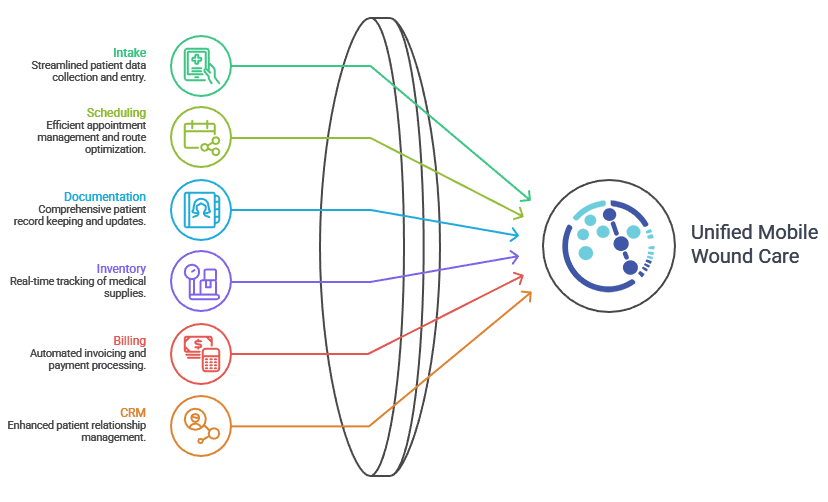
Medipyxis is a US-focused end-to-end operating system built specifically for mobile wound care practices — from referral intake through billing and reimbursement.
The core question:
"Do I need a wound documentation and assessment platform for facility-based care, or a full operations system built for mobile wound care in the US market?"
(Quick note: everything below reflects public product positioning as of June 2026. Exact capabilities depend on configuration, integrations, and how your organization runs.)
The Quick Buyer-Fit Snapshot
Pick Pixalere when you need wound documentation for facility-based care
Pixalere positions itself as a clinical wound care application that helps nurses and wound care specialists document, track, and collaborate on wound healing. Key strengths include wound photography with healing trajectory visualization, standardized assessment protocols, and a large clinical database that supports benchmarking outcomes.
Pixalere's strongest footprint is in Canadian nursing homes and long-term care facilities. The platform is designed for settings where multiple clinicians assess the same patient's wounds over time and need a shared, visual record of healing progress.
If your primary need is "standardized wound documentation with photo tracking in a facility setting," Pixalere is built for that workflow.
Pick Medipyxis when you need the full mobile wound care operating chain
Medipyxis doesn't stop at documentation. It covers the entire operating chain for mobile wound care: referral intake automation, route-based scheduling, field documentation with LCD compliance guardrails, skin substitute/graft inventory tracking, and billing capture — all connected in a single workflow.
If your pain is "we're a US mobile wound care practice losing referrals, fighting denials, and managing graft inventory on spreadsheets," Medipyxis was purpose-built for that reality.
What You're Really Comparing: "Clinical Documentation" vs "Practice Operations"
| Dimension | Pixalere | Medipyxis |
|---|---|---|
| Core identity | Wound documentation & assessment platform | Mobile wound care operating system |
| Primary market | Canada (nursing homes, LTC facilities) | United States (mobile wound care practices) |
| Care setting | Facility-based (nursing homes, hospitals) | Field-based (patient homes, SNFs, ALFs) |
| Referral intake | Not a primary feature | Automated fax-to-digital intake pipeline |
| Scheduling | Not a primary feature | Route-optimized mobile scheduling |
| Wound documentation | Core strength — photo tracking, healing trajectories | Comprehensive with LCD compliance guardrails |
| Graft/supply tracking | Not highlighted | End-to-end: lot tracking, expiration, vendor management |
| Billing integration | Not highlighted | Real-time CPT/HCPCS capture, clearinghouse submission |
| Compliance | Canadian clinical standards | US Medicare LCD pre-validation (L33831, L37166, L38720) |
| Patient engagement | Patients can view healing progress | Practice-facing; patient portal planned |
The Geographic and Regulatory Gap
This is the most important distinction for US-based practices evaluating Pixalere:
Pixalere was built for the Canadian healthcare system. Canadian wound care operates under provincial health authorities with different documentation requirements, reimbursement models, and clinical standards than the US Medicare/Medicaid system.
Medipyxis was built for US Medicare compliance. LCD pre-validation, HCPCS Q-code lookup for skin substitutes, MAC-specific documentation requirements, and real-time billing capture are native to the platform — not bolted on.
If you're a US practice, adopting a Canadian platform means adapting workflows to a system that wasn't designed for CMS documentation requirements, prior authorization workflows, or Medicare billing codes.
When Each One Wins
Pixalere wins when:
- You operate nursing homes or LTC facilities in Canada
- Wound documentation and photo-based healing tracking is your primary need
- You want a peer-developed platform with a large Canadian wound database
- Your billing and scheduling are handled by separate systems
Medipyxis wins when:
- You run a mobile wound care practice in the United States
- You need referral-to-reimbursement in one connected workflow
- Medicare LCD compliance and skin substitute billing are daily concerns
- You need graft inventory tracking with lot-level traceability
- You want scheduling, documentation, billing, and compliance in one platform
The Bottom Line
Pixalere and Medipyxis are both wound-care-specific — but they solve different problems in different markets. Pixalere excels at standardizing wound assessments across Canadian facilities. Medipyxis runs the entire business of mobile wound care in the US.
If you're a US-based mobile wound care practice evaluating Pixalere, the key question is whether a platform built for Canadian facility-based care can adapt to your Medicare billing, LCD compliance, and field operations needs — or whether you need a system that was designed for them from day one.
Ready to see how Medipyxis handles mobile wound care operations? Request a demo →