
Medipyxis vs OmniMD: Purpose-Built Wound Care vs Multi-Specialty AI EHR
Medipyxis vs OmniMD in 2026: mobile wound care operating system with LCD compliance vs AI-forward multi-specialty EHR with ambient scribe and full RCM.
Caleb Ebanks
Medipyxis
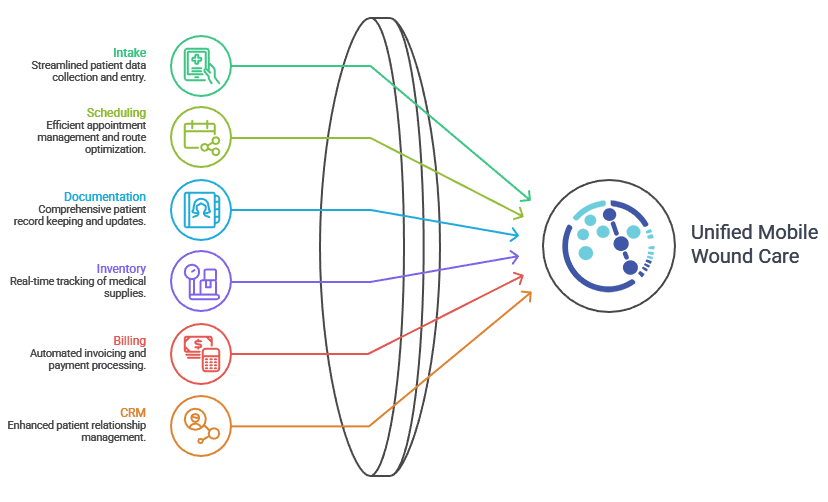
OmniMD and Medipyxis represent two fundamentally different approaches to healthcare software.
OmniMD is a modern, AI-forward EHR designed for multi-specialty practices — with an ambient scribe, AI clinician assistant, AI front desk, and a full RCM suite. If you run a general practice or multi-specialty clinic and want AI assistants at every stage of the encounter, OmniMD has invested heavily in that direction.
Medipyxis is a purpose-built wound care operating system — from referral intake through billing — designed specifically for mobile wound care teams visiting patients in homes, SNFs, and ALFs.
So the question isn't really "which has better features." It's:
"Do I need a general AI-forward EHR that I'll configure for wound care, or a system built from the ground up for wound care operations?"
(Quick note: everything below reflects public product positioning as of June 2026. Exact capabilities depend on configuration, integrations, and how your organization runs.)
The Quick Buyer-Fit Snapshot
- You run a mobile wound care practice visiting patients in homes, SNFs, or ALFs and need scheduling that accounts for drive time and route density — Medipyxis was built for this workflow from day one.
- You are a multi-specialty clinic or solo practitioner looking for a modern, AI-forward EHR with ambient scribe, e-prescribing, and a patient portal — OmniMD is commonly positioned as a strong fit.
- Medicare LCD compliance is a daily concern for your wound care documentation — Medipyxis includes a built-in LCD Navigator that pre-checks documentation against coverage criteria before claim submission.
- You want a single vendor for EHR + full RCM outsourcing across multiple specialties — OmniMD tends to offer broader RCM service options with denial prediction and AR prioritization.
At a Glance
| Dimension | Medipyxis | OmniMD |
|---|---|---|
| Primary focus | Mobile wound care (in-home, SNF, ALF) | Multi-specialty office-based practice management |
| Deployment | Cloud (browser + optional Electron field app) | Cloud-based SaaS |
| AI capabilities | AI medical coding, LCD compliance navigator, OCR referral intake | AI scribe, AI medical coder, AI clinician assistant, AI front desk, AI RCM |
| Billing model | Integrated billing with graft inventory ERP and LCD pre-check | Full RCM suite with denial prediction, payer-pattern analytics |
| Scheduling | Fleet-style route optimization for mobile clinicians | Traditional appointment scheduling |
| Specialty depth | Purpose-built for wound care workflows | General-purpose with customizable templates |
Where OmniMD May Be the Better Fit
Breadth of AI tools across the encounter
OmniMD has invested heavily in AI across the entire visit lifecycle — from an AI front desk that handles scheduling and insurance verification, to an ambient AI scribe, to an AI clinician assistant that surfaces differential diagnoses and medication cross-checks during the encounter. Practices that want AI assistants at every touchpoint of a general office visit will find a wide surface area in OmniMD.
Multi-specialty versatility
OmniMD is designed to serve solo practitioners, small groups, and multi-specialty clinics. Its EHR templates are customizable across specialties, and it offers e-prescribing, lab integrations, patient kiosks, and a patient portal. If your organization spans multiple service lines beyond wound care, OmniMD's generalist architecture avoids the need to stitch together specialty-specific systems.
Full-service RCM with payer intelligence
OmniMD's billing platform includes denial prediction, payer-specific claim adaptation, underpayment recovery, and AR prioritization by recovery likelihood. Practices that want to outsource the entire revenue cycle to a single vendor with sophisticated payer analytics may find OmniMD's offering more comprehensive for general medical billing.
Where Medipyxis Tends to Win
Purpose-built mobile wound care workflows
Medipyxis is not a general EHR adapted for wound care — it was designed from the ground up for clinicians who travel to patients. The scheduling engine handles fleet routing, drive-time optimization, and multi-facility coverage patterns. Documentation flows follow wound-specific assessment frameworks (BWAT scoring, wound measurement capture, graft tracking) rather than general SOAP note templates adapted after the fact.
OCR-powered referral intake
Incoming referral faxes and documents are processed through OCR to auto-populate patient demographics, insurance details, and wound history. This eliminates the manual data-entry bottleneck that mobile wound care practices face when processing high volumes of SNF and home health referrals. OmniMD does not appear to offer comparable intake automation for inbound referrals.
Graft inventory ERP
Medipyxis includes a built-in inventory management system for biological skin substitutes and graft products — tracking lot numbers, expiration dates, usage per patient, and cost-per-unit across the supply chain. This is a specialized need that general-purpose EHRs, including OmniMD, typically do not address natively.
LCD Navigator for Medicare compliance
Wound care billing is uniquely dependent on Local Coverage Determinations. Medipyxis pre-validates documentation against applicable LCDs before claim submission, flagging missing criteria and reducing denial risk specific to wound care procedures and biologics. OmniMD's AI coding and compliance tools are designed for general medical coding rather than wound-care-specific LCD adherence.
Single data model from referral to reimbursement
Patient data in Medipyxis flows through one unified model — from referral intake through wound assessment, treatment documentation, graft usage, coding, and claim submission. There is no integration layer between separate modules. This tends to reduce the data reconciliation burden that practices experience when connecting standalone EHR, inventory, and billing systems.
Frequently Asked Questions
Can OmniMD handle wound care documentation?
OmniMD's EHR is customizable, and practices can build wound-care-oriented templates. However, it does not include wound-specific assessment tools (measurement tracking, BWAT, graft inventory), LCD pre-validation for wound care procedures, or mobile fleet scheduling. Practices doing wound care as one of many specialties may find OmniMD workable with configuration effort; practices where wound care is the primary service line tend to find purpose-built systems more efficient.
Does Medipyxis offer an AI scribe like OmniMD?
Medipyxis uses AI for medical coding and compliance checking rather than ambient encounter transcription. The documentation workflow is structured around wound-specific assessment fields rather than free-text dictation, which tends to produce more consistently coded output for wound care encounters. Practices that rely heavily on dictation for non-wound-care visits may prefer OmniMD's ambient scribe approach.
Which platform is better for a practice that does both wound care and general medicine?
It depends on volume mix. If wound care represents the majority of encounters and revenue, Medipyxis's specialized workflows and LCD compliance tools tend to deliver more value. If wound care is a small fraction of a multi-specialty practice, OmniMD's generalist architecture may be more practical. Some organizations run both — Medipyxis for the wound care team and a general EHR for other service lines.