
Medipyxis vs Netsmart: Wound Care Operations vs Post-Acute Enterprise EHR
Medipyxis vs Netsmart in 2026: purpose-built wound care with LCD compliance vs multi-setting post-acute platform for home health and behavioral health.
Caleb Ebanks
Medipyxis
Netsmart and Medipyxis serve overlapping populations but approach them from very different starting points.
Netsmart is a broad post-acute care platform built for organizations that operate across home health, hospice, skilled nursing, behavioral health, and human services. Their CareFabric ecosystem (myUnity, myAvatar, myEvolv, GEHRIMED, TheraOffice) is designed for mid-to-large organizations that need a single EHR spanning multiple care settings and service lines.
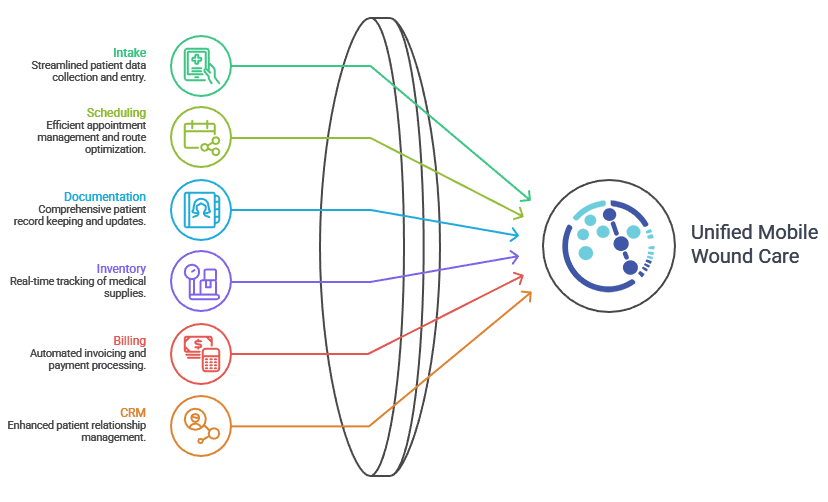
Medipyxis is a purpose-built wound care operating system — from referral intake through billing — designed specifically for mobile wound care teams.
The real question:
"Do I need a broad post-acute platform that handles wound care as one of many visit types, or a system engineered specifically for wound care operations?"
(Quick note: everything below reflects public product positioning as of June 2026. Exact capabilities depend on configuration, integrations, and how your organization runs.)
The Quick Buyer-Fit Snapshot
- You are a mobile wound care practice that needs scheduling, documentation, and billing built around traveling to patients and treating wounds specifically — Medipyxis was purpose-built for this workflow.
- You operate across multiple post-acute care settings (home health, hospice, skilled nursing, assisted living) and need a unified EHR platform that spans all of them — Netsmart's myUnity is commonly positioned for this use case.
- You need wound-care-specific compliance tooling including LCD pre-validation, graft inventory tracking, and wound measurement documentation — Medipyxis includes these natively.
- You are a behavioral health, IDD, or human services organization — Netsmart has deep specialization in these verticals that Medipyxis does not address.
At a Glance
| Dimension | Medipyxis | Netsmart |
|---|---|---|
| Primary focus | Mobile wound care (in-home, SNF, ALF) | Post-acute care, behavioral health, human services |
| Deployment | Cloud (browser + optional Electron field app) | Cloud-based platform (CareFabric ecosystem) |
| Product breadth | Single integrated platform for wound care lifecycle | Multiple EHR products by care setting (myUnity, myAvatar, myEvolv, GEHRIMED, TheraOffice) |
| AI capabilities | AI medical coding, LCD compliance navigator, OCR referral intake | Bells AI documentation assistant, telehealth, e-prescribing |
| Home health features | Fleet scheduling, route optimization, wound-specific documentation | Home health EHR with scheduling, documentation, billing, EVV |
| Target org size | Small-to-mid wound care practices and mobile groups | Mid-to-large post-acute organizations, health systems, public-sector agencies |
Where Netsmart May Be the Better Fit
Multi-setting post-acute care organizations
Netsmart's myUnity platform is designed to manage home health, hospice, skilled nursing, palliative care, assisted living, memory care, and personal care under one EHR. Organizations that operate across several of these care settings and need a single platform for transitions of care, unified clinical records, and consolidated billing tend to find Netsmart's breadth difficult to match with a specialty-focused system.
Behavioral health and human services
Netsmart has decades of specialization in behavioral health (myAvatar, myEvolv), addiction treatment, intellectual and developmental disabilities, autism services, child and family services, and public-sector health programs. These are verticals Medipyxis does not serve. Organizations in these spaces will find Netsmart's workflows, compliance frameworks, and reporting purpose-built for their needs.
Enterprise scale and payer connectivity
Netsmart serves large health systems, state Medicaid programs, managed care organizations, and public-sector agencies. Their CareFabric platform includes population health management, care coordination across provider networks, and payer-facing analytics. Organizations with hundreds of clinicians, multi-state operations, or government contracts tend to find Netsmart's enterprise infrastructure and compliance certifications well-matched to their scale.
Electronic visit verification (EVV)
Netsmart's Mobile Caregiver+ provides EVV capabilities that satisfy state Medicaid requirements for home- and community-based services. Practices that bill Medicaid for home visits and need compliant EVV tracking may find this a meaningful differentiator.
Where Medipyxis Tends to Win
Wound-care-specific clinical workflows
Netsmart's home health module handles general home health documentation and scheduling, but it is not built around wound care as a specialty. Medipyxis provides wound measurement tracking, BWAT scoring, wound photography workflows, treatment protocol templates specific to wound types, and graft application documentation — none of which are standard in Netsmart's home health EHR.
Graft inventory ERP
Biological skin substitutes represent one of the highest-cost supply items in wound care, and their billing requires lot-level tracking, expiration management, and per-patient usage documentation. Medipyxis includes this as a native module. Netsmart does not offer graft-specific inventory management, which means wound care practices on Netsmart typically manage graft inventory through spreadsheets or a separate system.
OCR referral intake
Mobile wound care practices often receive high volumes of referrals via fax from SNFs, home health agencies, and physician offices. Medipyxis processes these through OCR to auto-populate patient records. Netsmart's referral workflows are designed for inter-organizational care coordination rather than high-volume inbound fax processing with automated data extraction.
LCD Navigator for wound care compliance
Medicare wound care billing is governed by specific Local Coverage Determinations that vary by MAC jurisdiction. Medipyxis pre-checks documentation against the applicable LCDs before claim submission, reducing denials for wound care procedures and biologics. Netsmart's compliance tools are broader in scope (supporting post-acute quality measures, OASIS, MDS) but do not include wound-care-specific LCD pre-validation.
Single data model vs. product portfolio
Medipyxis runs on a single unified data model from referral through reimbursement. Netsmart's breadth comes from a portfolio of acquired products (myUnity, myAvatar, myEvolv, GEHRIMED, TheraOffice), each with its own data architecture, unified under the CareFabric platform layer. For wound care practices that want zero-integration-overhead simplicity, Medipyxis's single-system approach tends to reduce implementation complexity and ongoing data reconciliation.
Frequently Asked Questions
Our organization does home health and wound care. Can Netsmart handle both?
Netsmart's myUnity platform handles home health documentation, scheduling, billing, and EVV well. However, its wound care capabilities are general rather than specialized — it lacks wound-specific assessment tools, graft inventory tracking, and LCD pre-validation for wound care procedures. Organizations where wound care is a dedicated service line (rather than an occasional home health activity) tend to find that a general home health EHR requires significant workaround effort for wound-specific documentation and compliance needs.
Is Medipyxis too narrow if we might expand beyond wound care?
Medipyxis is purpose-built for wound care, and that specialization is its strength. If your growth plan includes expanding into hospice, behavioral health, or skilled nursing facility management, Netsmart's multi-setting platform would likely serve those additional verticals better. Many organizations run a specialized wound care system alongside a broader post-acute platform and find that the depth-in-wound-care tradeoff is worthwhile for their wound care team's efficiency and billing accuracy.
How do the two platforms compare on mobile field clinician support?
Both platforms support clinicians working in the field. Netsmart offers mobile apps and EVV through Mobile Caregiver+. Medipyxis provides fleet-style route optimization, drive-time-aware scheduling, and an optional offline-capable Electron app designed for clinicians who move between homes and facilities throughout the day. The key difference is that Medipyxis's mobile experience is built around the wound care visit workflow specifically, while Netsmart's mobile tools serve a broader range of home- and community-based visit types.