
Medipyxis vs eKare: Which Platform Runs Mobile Wound Care End-to-End?
Medipyxis vs eKare in 2026: operational workflow vs imaging focus for mobile wound care teams — find out which fits your priorities.
Caleb Ebanks
Medipyxis
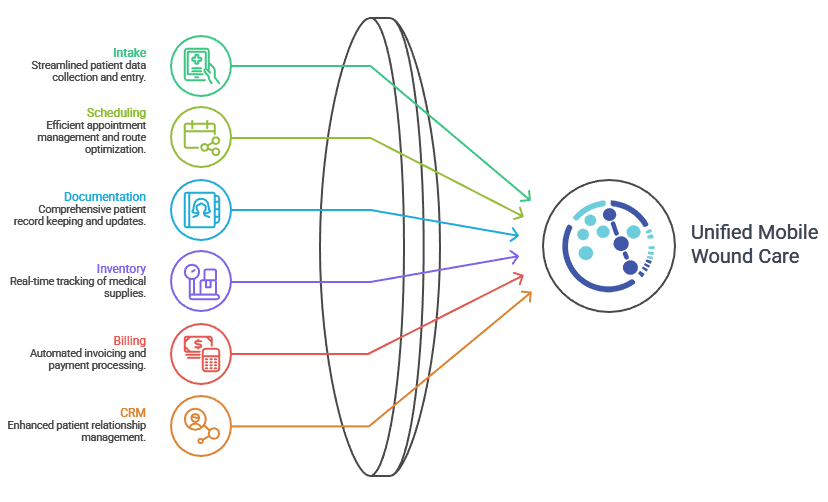
When comparing these platforms, you're actually evaluating different operational priorities rather than competing versions of the same product.
One objective centers on clinical measurement: "We need better wound imaging and measurement—and we want remote monitoring to be cleaner and more consistent."
The other focuses on operational efficiency: "We need the whole mobile wound care operation to move faster—from referral to reimbursement—without adding more staff or more handoffs."
A quick gut-check that usually settles it
Consider a late-day referral arriving by fax or email requiring urgent patient scheduling. Your team must navigate multiple steps:
- Intake and de-duplication
- Insurance verification and authorization checks
- Clinician assignment
- Route changes
- Complete documentation meeting Medicare/LCD standards
- Product availability confirmation
- Clean billing handoff
The critical question: How many separate systems does your team currently use to complete this workflow?
If multiple tools plus manual coordination are required, Medipyxis targets this "operations compression" challenge specifically. If your workflow already runs smoothly but measurement consistency and remote monitoring need improvement, eKare may serve your needs better.
Start with the simplest exercise: draw your wound care "stack"
Map the weekly work your mobile team handles. Most organizations juggle these components:
- Referral intake (fax/email/portal to patient record)
- Insurance verification and authorization
- Scheduling and routing
- Visit documentation with Medicare/LCD compliance
- Advanced products and graft tracking
- Billing workflow with coding and claim prep
- Leadership visibility regarding capacity, compliance, margin, and referral ROI
Medipyxis positions itself as a single connected system spanning the entire stack. eKare focuses on the clinical measurement, imaging, and engagement layer with integration into existing ecosystems.
What eKare is built for
eKare's messaging emphasizes inSight—an imaging and wound measurement solution using computer vision—along with supporting telehealth, analytics, and interoperability modules.
eKare highlights:
- Advanced wound imaging and measurement features
- Regulatory positioning (CE-marked and FDA-registered device status)
- Telehealth and remote monitoring capabilities
- Integration support through APIs and SMART on FHIR standards
eKare suits organizations prioritizing measurement quality, remote patient engagement, and integration with existing EHR systems.
What Medipyxis is built for
Medipyxis positions itself as an all-in-one mobile wound care operating system designed to reduce operational friction rather than add another tool.
Key workflow emphasis includes:
- Referral intake conversion: Transforms fax/email into structured intake with duplicate prevention, insurance verification before scheduling, and clinician recommendations based on drive time and workload
- Mobile wound care EHR with compliance guardrails: Features Intake Wizard, Visit Wizard, and LCD Navigator that audits documentation before attestation
- Advanced inventory and graft ERP: Real-time lot and expiry tracking tied to wound cases with point-of-care usage capture
- Billing support: Billing Queue delivers completed visits with pre-lined codes, attached product usage, and packaged evidence
- Operational visibility: Dashboards providing oversight plus referral ROI metrics
Medipyxis targets organizations struggling with speed, staffing constraints, denials risk, inventory management, or billing delays.
Where Medipyxis tends to be structurally stronger than eKare for mobile operators
Compare what breaks first when volume increases—typically not imaging, but the operational chain around visits.
1) Referral intake to scheduled visit
Fax/email referrals often create intake labor bottlenecks and scheduling delays rather than measurement tool limitations.
Medipyxis directly targets structured intake, duplicate reduction, pre-scheduling insurance verification, and assignment logic designed for field realities. eKare's strength centers on imaging/measurement and remote monitoring rather than intake automation.
Impact: Faster referral-to-first-visit timelines without immediate staffing increases.
2) Scheduling and routing integrated with clinical workflow
Routing represents the throughput lever in mobile wound care. When routing exists outside the clinical workflow, daily friction emerges: last-minute rescheduling, missed facility windows, manual coordination, and wasted travel.
Medipyxis positions routing and scheduling as core platform functions. eKare emphasizes interoperability but doesn't frame routing as the daily operational engine.
Impact: Fewer hours consumed by logistics—often the most expensive hidden cost in mobile operations.
3) LCD guardrails embedded in documentation
Both platforms support wound documentation. The distinction lies in how firmly the system enforces "complete and defensible" before clinicians complete their charts.
Medipyxis includes an LCD Navigator that audits the visit before attestation and blocks incomplete submissions. eKare's headline features are measurement and imaging, while Medipyxis emphasizes guardrails with downstream billing integration.
Impact: Fewer denials and reduced post-visit chart cleanup cycles.
4) Advanced products as governed assets
Using advanced products requires more than documentation—you need traceability, expiration control, reconciliation, and clean visit-to-billing linkage.
Medipyxis treats graft and advanced products as an ERP workflow with lot/expiry tracking, patient/visit linkage, vendor reconciliation, and audit-ready logs. eKare's positioning centers elsewhere.
Impact: Better inventory control and reduced margin leaks from waste or documentation gaps.
5) Billing-ready claim packets
Documentation generation is common; fewer tools design around what billing needs next.
Medipyxis' Billing Queue concept delivers completed visits organized for review—codes pre-lined, usage attached, supporting evidence packaged—enabling faster billing movement.
Impact: Shorter claim timelines and reduced billing reconstruction work.
6) Reduced tool sprawl
Scaling creates a coordination tax: intake in one tool, scheduling in another, documentation elsewhere, inventory in spreadsheets, billing chasing everyone.
Medipyxis positions itself as a unified platform with a single source of truth. eKare positions as best-in-class imaging layer with strong integration capability—ideal if your strategy emphasizes best-of-breed tools with integration resources.
Impact: Fewer handoffs, reduced dropped details, less staffing pressure during growth.
Where eKare may be the better fit
eKare may be the right choice when priorities include:
- Improving measurement consistency and imaging quality
- Building strong remote monitoring and telehealth workflows with patient participation
- Integrating into larger IT ecosystems using standards like SMART on FHIR
If intake, routing, inventory controls, and revenue cycle workflows already function well, and you want to upgrade the measurement and remote monitoring layer, eKare merits consideration.
Quick summary: why teams choose Medipyxis over eKare
In one sentence:
Medipyxis operates the complete mobile wound care workflow—from referral intake through routing, LCD-compliant documentation, graft traceability, and billing-ready output—within a single connected environment.
Key capabilities:
- Referral intake automation converting fax/email to structured intake and scheduled visits
- Routing and scheduling within the same platform
- LCD compliance guardrails before attestation
- Graft and advanced products ERP with traceability
- Billing Queue supporting audit-and-submit workflows
- Unified operational oversight across capacity, compliance, margin, and referral ROI
FAQ
Is Medipyxis a wound measurement tool like eKare?
Not equivalently. eKare emphasizes advanced imaging and measurement plus telehealth capabilities. Medipyxis operates as a broader mobile wound care system encompassing intake, routing, compliance guardrails, inventory ERP, and billing workflows.
What's the biggest Medipyxis advantage over eKare?
For mobile wound care operators, operational coverage represents the primary distinction: Medipyxis connects intake through billing-ready output without relying on fragmented tool ecosystems.
Does eKare integrate with EHRs?
eKare describes integration support through APIs, RESTful specifications, and SMART on FHIR standards.