
Urinary Bladder Matrix for HS Defects: Outpatient Healing Results
Case series shows how urinary bladder matrix (UBM) scaffolds enable outpatient management of large hidradenitis suppurativa excision wounds in young patients.
Damon Ebanks
Medipyxis
Medical education note: This article is for clinicians and is not a substitute for patient-specific medical advice.
Why Large HS Excision Wounds Are Such a Reconstructive Headache
Hidradenitis suppurativa (HS) is a chronic, immune-mediated skin disease characterized by recurrent abscesses, sinus tracts, and scarring in intertriginous areas such as the axillae, groin, and inframammary folds.
For patients with moderate–severe (Hurley II–III) disease, wide local excision of all involved tissue remains the most definitive way to control fibrosis and sinus tracts and can significantly reduce recurrence. The problem: wide excision often leaves large soft-tissue defects over mobile regions like the axilla and chest. Traditional closure options each come with trade-offs:
- Healing by secondary intention — avoids donor-site morbidity but may require months of dressing changes and can lead to contracture and contour deformity.
- Split-thickness skin grafts (STSG) — faster epithelial coverage but higher risk of contracture, color mismatch, and graft failure, particularly in flexural areas.
- Local or regional flaps (e.g., TDAP) — excellent functional and cosmetic outcomes but require specialized expertise, longer OR time, and inpatient recovery.
For young HS patients being treated in resource-limited or outpatient-focused settings, a simpler, biologically active option that can bridge to secondary intention or delayed grafting is very attractive. That's where urinary bladder matrix (UBM) comes in.
What Is Urinary Bladder Matrix (UBM) and Why Does It Matter for HS?
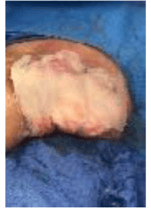
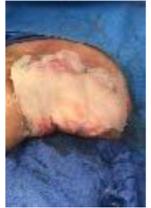 UBM applied to Cytal wound — large HS excision defect.
UBM is a decellularized extracellular matrix (ECM) scaffold derived from porcine urinary bladder (e.g., MatriStem®, MicroMatrix®, Cytal® from ACell/Integra).
Key properties relevant to post-HS excision wounds:
- 3D collagen-rich scaffold that supports host cell infiltration, angiogenesis, and tissue remodeling.
- Promotes a pro-healing M2 macrophage response, associated with "constructive remodeling" rather than dense scar.
- Available as sheets and particulate/powder, allowing coverage of large flat surfaces and packing of undermining or irregular cavities.
Across multiple wound types—chronic ulcers, traumatic wounds, upper-extremity degloving injuries, radiation-related wounds—UBM has been shown to support granulation and either complete re-epithelialization or preparation of a high-quality graft bed.
Case Series Overview: Outpatient HS Excision Defects Healed With UBM
A recent SAWC Fall 2025 abstract by Del Prado and colleagues reported a retrospective series of six young patients (ages 16–31) with axillary and/or chest HS who underwent wide local excision followed by outpatient management using urinary bladder matrix.
Patient Population and Surgical Approach
- Condition: Hurley II–III HS of axilla and/or chest
- Procedure: Wide local excision of all clinically involved HS tissue in an OR setting
- Primary closure: Partial primary closure performed where tension allowed
- Residual defect: Remaining open areas were managed with UBM applied in both sheet and powder forms, depending on wound geometry
UBM was covered with non-adherent dressings and moistened gauze, supporting a moist wound environment that patients could manage in the outpatient setting with standard nursing support.
Outcomes
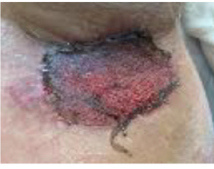 Wound from a patient granulated after two months of UBM-assisted outpatient management.
Over the follow-up period, key outcomes were:
- Granulation: All six patients achieved complete wound granulation within 2–3 months post-operatively.
- Final closure strategy: 2 patients required split-thickness skin grafts (STSG) to close the granulated defect. The remaining patients healed by secondary intention over the UBM-supported granulation bed.
- Function: Most patients preserved full range of motion in the involved shoulder/upper extremity; only one required a later surgical release for contracture.
- Disease recurrence: No HS recurrence was observed during the (admittedly limited) follow-up window.
How Does This Compare to Traditional HS Closure Options?
Wide Excision With Secondary Intention
Several series support wide excision with healing by secondary intention as an effective approach, with acceptable recurrence and quality-of-life outcomes—but healing can be prolonged and function across joints is a concern.
STSG and Flap Reconstruction
Narrative and systematic reviews note that skin grafts and flaps are frequently used after HS excision, especially in axillary and inguinal regions:
- STSGs can shorten time to epithelial coverage but may suffer from graft failure, hypertrophic scarring, and restricted shoulder movement, particularly in axillary HS.
- TDAP flaps and other fasciocutaneous flaps often give superior contour and function but demand advanced microsurgical skills and carry risks of flap necrosis, seroma, or lymphedema.
Biologic Matrices and HS
Biologic and synthetic matrices are increasingly being incorporated into HS reconstructive algorithms:
- Acellular dermal matrix (ADM) plus STSG has been shown to improve graft take, shorten hospitalization, and reduce complications compared with STSG alone in HS surgery.
- Synthetic electrospun fiber matrices have also been used as a temporary scaffold after HS excision.
UBM fits into this same conceptual space but brings ECM-driven constructive remodeling and a growing real-world track record across diverse wound types.
Practical Considerations for Using UBM After HS Excision
1. Patient and Wound Selection
UBM may be most useful when the patient is young or functionally active, when there is adequate blood supply and infection is controlled after HS excision, and when complex flap reconstruction is not feasible.
2. Wound Bed Preparation
- Achieve meticulous hemostasis and remove all necrotic HS tissue.
- Confirm infection control—UBM is best used on clean or clean-contaminated wounds.
- Consider pre- or peri-operative NPWT if large dead space or heavy exudate is present before ECM placement.
3. Choosing Sheet vs Powder
- Powder/particulate UBM is ideal for undermining, tunnels, or irregular cavities.
- Sheet UBM works well for broad, relatively flat surfaces after tangential undermining has been addressed.
4. Dressing Strategy and Follow-Up
In the HS case series, UBM was covered with a non-adherent interface and moistened gauze, with ongoing outpatient wound checks to monitor granulation and decide whether secondary intention or delayed STSG was appropriate.
5. Rehabilitation and Contracture Prevention
Because axillary HS involves high-mobility regions, early gentle range-of-motion exercises and physical therapy remain critical.
Bottom Line
- Wide local excision remains the definitive treatment for Hurley II–III HS but leaves large axillary and chest defects that are challenging to manage, especially outside tertiary centers.
- A six-patient case series showed that urinary bladder matrix used in sheet and powder form allowed outpatient management of large post-excisional HS wounds, with complete granulation by 2–3 months, selective use of STSG, preserved range of motion in most patients, and no early HS recurrence.
- For wound-care clinicians and surgeons, UBM offers a pragmatic addition to the reconstructive ladder for HS—particularly when you want to stage closure, keep care largely outpatient, and maintain shoulder function without committing immediately to complex flaps.
References
- Del Prado P, Shacker M, Stansbury B. Outpatient Healing of Large Post-Excisional Defects in Hidradenitis Suppurativa Using Urinary Bladder Matrix. SAWC Fall 2025 Abstracts, CS-025.
- Manfredini M, et al. Hidradenitis Suppurativa: Surgical and Postsurgical Management. J Clin Med. 2020.
- Alharbi Z, et al. A review of wide surgical excision of hidradenitis suppurativa. J Cutan Aesthet Surg. 2012.
- Gierek M, et al. Platelet-Rich Plasma and Acellular Dermal Matrix in the Surgical Treatment of Hidradenitis Suppurativa. J Clin Med. 2023;12(6):2112.
- Kimmel H, Rahn M, Gilbert TW. The Clinical Effectiveness in Wound Healing With Extracellular Matrix Derived From Porcine Urinary Bladder Matrix. J Am Col Certif Wound Spec. 2010;2(3):55–59.
- Baum GR, et al. Outcomes of Complex Wound Reconstruction in High-Risk Patients Using Decellularized Extracellular Matrix from Porcine Urinary Bladder. Eplasty. 2025;25:e15.
- Kapp DL, et al. Cellular, acellular, and matrix-like products (CAMPs) for wound management: consensus and clinical guidance. J Wound Care. 2025.