
Bioactive Glass Matrix for Pressure Injuries: Early PAR & Closure
Three chronic pressure injuries achieved 71–84% week-one area reduction using borate-based bioactive glass fiber matrix with closure within months.
Damon Ebanks
Medipyxis
Medical education note: This article is for clinicians and is not a substitute for patient-specific medical advice.
TL;DR
Three chronic full-thickness pressure injuries (one Stage 3, two Stage 4) in older adults failed to heal with standard care. After borate-based bioactive glass fiber matrix (BBGFM) application and weekly follow-up, all achieved rapid first-week Percentage Area Reduction (PAR) (71–84%) and eventual closure. No infections or adverse reactions occurred.
Why This Matters
Chronic pressure injuries remain difficult to close due to inflammation, impaired angiogenesis, and extracellular matrix (ECM) disorganization. The borate-based bioactive glass matrix acts as an adjunctive therapy that may accelerate stalled wounds through ion-mediated angiogenesis and fibroblast activation.
Study at a Glance
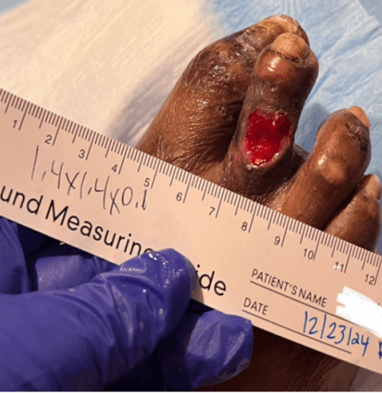
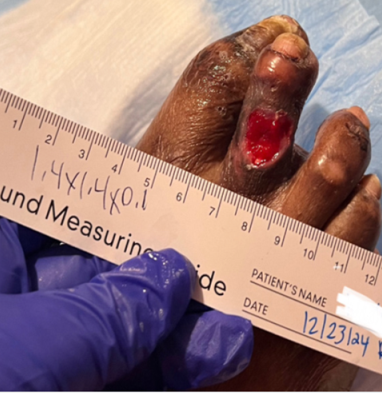 Patient with chronic injury, stage 4 second toe.
Design & setting: Case series from a wound care practice; three chronic pressure injuries (Stage 3 hip; Stage 4 sacrum; Stage 4 second toe). All had failed to close with standard care; one was unresponsive to prior cellular/tissue-based products (CTPs) and another had been complicated by infection.
Intervention & cadence:
- Wound bed prep: Sharp debridement and standard preparation.
- Matrix application: Borate-based bioactive glass fiber matrix applied per manufacturer's instructions and secured under appropriate secondary dressings.
- Follow-up: Weekly assessment and retreatment.
Outcomes measured:
- Primary: Week-1 PAR.
- Secondary: Full epithelialization/closure, ongoing area reduction, adverse events.
Results
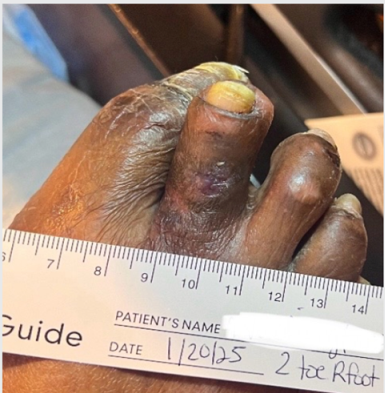 Stage 4 toe healed by day 28.
- Stage 4 toe: Week-1 PAR 72%; closure by Day 28.
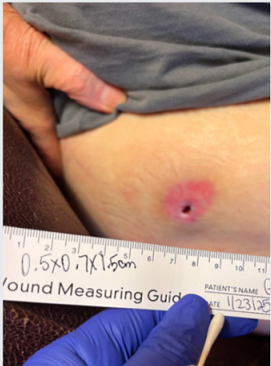 Stage 3 hip closure by four months.
- Stage 3 hip: Week-1 PAR 71%; closure by approximately 4 months.
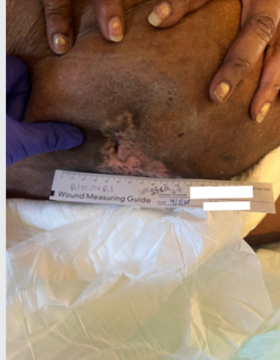 Stage 4 sacrum pressure injury closure after four months.
- Stage 4 sacrum: Week-1 PAR 84%; closure by approximately 4 months.
No treatment-related adverse reactions or infections were observed.
Why Borate Glass?
The matrix releases boron, sodium, potassium, magnesium, calcium, and phosphate ions—each associated with cell proliferation, neovascularization, and antimicrobial or host-modulating effects.
Its bioactive structure supports fibroblast and keratinocyte migration and angiogenesis, helping transition chronic wounds out of inflammatory stasis.
Practical Guidance
Patient selection: Chronic Stage 3–4 pressure injuries not improving on standard of care (SOC) or prior CTPs, with controlled bioburden.
Bed preparation: Sharp debridement → apply BBGFM → cover with moisture-balanced secondary dressing → weekly reassessment (aligned with WHS 2023 pressure injury protocols).
What to track: Week-1 PAR → serial percent area reduction → granulation quality → edge advancement → infection signs.
Limitations & Next Steps
This is a small n = 3 series without controls; comparative efficacy cannot be inferred. Still, the rapid early PAR and closure trajectory align with signals from controlled BBGFM trials in other chronic wound populations.
Bottom Line
For chronic Stage 3–4 pressure injuries that plateau on standard care, borate-based bioactive glass fiber matrix offers a synthetic, biologically active scaffold that may accelerate early granulation and closure. Early PAR values exceeding 70% and complete epithelialization within months align with emerging evidence that ion-releasing bioactive glass matrices can reignite healing.
References
- Borate bioactive glass fiber matrix in chronic pressure injuries: case series.
- Armstrong DG, et al. Resorbable glass microfiber matrix vs SOC in chronic wounds (RCT). Int Wound J. 2021.
- WHS 2023 Pressure Injury Treatment Guidelines.
- Bioactive glass mechanisms in wound healing: literature review.