
Peel-and-Place NPWT for Lower-Leg Wounds: 12-Patient Case Series
Case series demonstrates peel-and-place NPWT dressing enables 4–7-day wear, faster application, and reliable granulation in lower-leg wounds.
Damon Ebanks
Medipyxis
Medical education note: This article is for clinicians and is not a substitute for patient-specific medical advice.
Quick Take
A new all-in-one "peel-and-place" NPWT dressing—foam, non-adherent interface, and drape pre-bonded with a single port—was evaluated in 12 lower-leg wounds. The series reports two-minute applications, no pain at application or removal, 4–7-day wear time, and granulation with wound-size reduction in all patients; only mild periwound maceration occurred in 3 patients, attributed to non-adherence. Patients' wounds had been present 11–243 days and included surgical wounds (n=5), DFUs (n=4), dehiscence (n=2), and a diabetic foot infection (n=1).
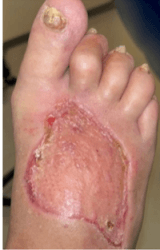
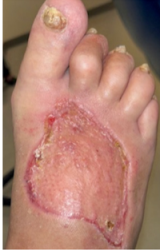 Foot ulcer after six weeks of peel-and-place NPWT.
Why it matters: Below-knee wounds are leak-prone (ankle motion, tibial crest, malleoli). A single-piece dressing can reduce steps and air-leak points while maintaining the therapeutic seal—especially useful in clinic-to-home transitions. Typical NPWT change intervals are every 48–72 hours, but the dressing in this series enabled 4–7 days between changes.
Study at a Glance
- Design/setting: Case series (12 patients; mean age 60.9 ± 15.7 years). Prior therapies included traditional NPWT or advanced dressings. Wounds present 11–243 days pre-enrollment.
- Technique: Sharp debridement; systemic antibiotics as necessary. All-in-one NPWT dressing applied; changes every 4–7 days. At removal, wounds were cleansed with a hypochlorous solution (5-minute soak) and gently patted dry.
- Outcomes reported: Granulation and area reduction in all wounds, no application/change pain, two-minute applications, mild periwound maceration in 3 non-adherent patients.
- Trademark note: The poster lists the product as Solventum™ V.A.C.® Peel and Place Dressing with ActiV.A.C.™ Therapy System (brand referenced in the study; follow your device IFU).
Limitations: Small, uncontrolled case series; no comparative arm or time-to-closure analysis. Treat as hypothesis-generating.
Why Peel-and-Place NPWT Helps on the Lower Leg
- Fewer leak points: A continuous, pre-bonded drape reduces "ladder" seams—the usual culprits across the ankle and Achilles.
- Speed: Single-piece placement streamlines clinic flow; in this series, ~2 minutes per application.
- Comfort & mobility: Lower profile and fewer junctions support ambulation and therapy adherence.
Mechanistically, NPWT fosters macro- and micro-deformation, improves perfusion, evacuates exudate, and promotes granulation; classic models and contemporary reviews converge on −125 mmHg as a common therapeutic setting (adjust per wound and patient).
Clinician-Ready Protocol
1) Prepare the Wound & Periwound
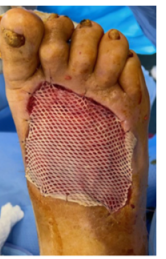 Foot wound prepared for NPWT application.
- Debride to a clean, bleeding bed; treat cellulitis/osteomyelitis per standard of care.
- Antibiotics as indicated (case series allowed systemic antibiotics).
- Skin protection: barrier film/hydrocolloid "donut" on fragile rims.
2) Apply the All-in-One NPWT Dressing
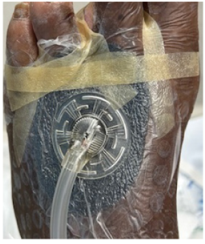 Application of NPWT dressing on foot.
- Trim foam slightly smaller than the wound (2–3 mm) to limit edge maceration.
- Bridge multiple wounds to a single port away from flexion lines.
- Seal in one motion; reinforce over malleoli/Achilles.
3) Start Therapy & Set Parameters
- Start with continuous −125 mmHg when tolerated; titrate −75 to −150 mmHg for pain, perfusion, and exudate profile (follow device IFU and local policy).
4) Dressing Changes
- Typical NPWT: every 48–72 h for open wounds (shorter if infected/contaminated).
- This series: every 4–7 days, enabled by the integrated interface + drape design; at removal, soak with hypochlorous solution for 5 minutes, pat dry, reassess, and re-seal.
5) Pairing Strategies
- Edema control: Graduated compression if arterial inflow is adequate.
- Gait training: Route tubing laterally/proximally; secure slack loops to prevent kinks.
- Home care: Education on leak alarms, bathing, and when to call.
Safety First: Indications & Contraindications
Good candidates: dehisced surgical wounds, diabetic foot/leg ulcers, traumatic lower-leg wounds needing exudate control and robust granulation.
Contraindications/precautions: necrotic eschar, untreated osteomyelitis, malignancy in the wound, and non-enteric/unexplored fistulas are classic "do-not-start" scenarios; use caution with critical limb ischemia or active bleeding.
What Outcomes to Expect
- Rapid exudate control and demaceration in week 1.
- Granulation and area reduction enabling graft/matrix placement—or, in select cases, secondary intention. In this series, all 12 wounds demonstrated granulation and size reduction; no pain was reported during application/changes.
Remember: evidence is early and uncontrolled here; align expectations with broader NPWT literature and your quality metrics.
FAQ
How long can a peel-and-place NPWT dressing stay on?
In the case series: 4–7 days between changes. Standard open-wound NPWT policies often recommend 48–72 hours, adjusted for infection/exudate and patient factors.
What pressure should I start with?
Many protocols begin at −125 mmHg continuous and adjust based on pain, perfusion, and exudate (range −75 to −150 mmHg). Follow device IFU and local guideline.
Does this replace debridement or antibiotics?
No—NPWT is adjunctive. Debridement, infection control, and offloading/edema management remain essential.
Is this dressing only for surgical wounds?
No. In the series, surgical wounds, DFUs, dehiscence, and infection-related wounds were treated.
Bottom Line
For leak-prone, highly mobile lower-leg wounds, an all-in-one peel-and-place NPWT dressing can streamline application and extend wear time while maintaining seals. In a 12-patient series, every case showed granulation and size reduction, with no application/change pain and 4–7-day intervals when wounds were clean and patients adhered. Use it adjunctively, set pressures thoughtfully, and keep change intervals appropriate for wound status.
References
- Effective Use of NPWT with an All-in-One Peel and Place Dressing to Manage Lower Leg Wounds (case series poster).
- StatPearls: Negative Pressure Wound Therapy — mechanisms, typical −125 mmHg setting, indications/contraindications.
- CLWK (2025) provincial guideline — open-wound change interval 48–72 h, practical precautions.
- Reviews on pressure setting ranges and rationale (−75 to −125 mmHg; adjust to patient/wound).