
All-in-One NPWT Dressing for Complex Wounds: 3 Case Results
Case series examining all-in-one peel-and-place NPWT dressings with hybrid silicone-acrylic drapes for complex wounds and skin protection.
Damon Ebanks
Medipyxis
Medical education note: This article is for clinicians and is not a substitute for patient-specific medical advice.
Why Complex Wounds and NPWT Can Be So Frustrating
Negative pressure wound therapy (NPWT) effectively manages complex wounds like diabetic foot ulcers and pressure injuries by promoting granulation and removing exudate. However, clinicians frequently encounter challenges including difficulty maintaining seals around irregular anatomy, managing heavy drainage, preventing periwound maceration, and minimizing pain during dressing removal.
To address these limitations, manufacturers have developed hybrid silicone-acrylic drapes paired with peel-and-place all-in-one dressings designed to streamline application, protect fragile skin, and maintain continuous therapy.
What Is an All-in-One NPWT "Peel-and-Place" Dressing?
Traditional NPWT requires separate components—reticulated foam and polyurethane drape—that must be individually cut, trimmed, and carefully sealed, making application time-consuming and technique-dependent.
The multilayer peel-and-place dressing (MPPD) combines three elements into one unit: a foam interface, non-adherent contact layer, and hybrid silicone-acrylic drape. The integrated design allows clinicians to place, smooth, and connect the dressing to the pump without custom assembly.
Hybrid silicone-acrylic technology maintains seal integrity while allowing repositioning and reducing pain during removal.
Case Series at a Glance: Three High-Risk Patients
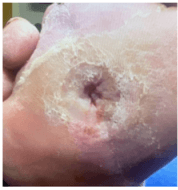
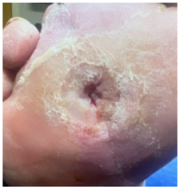 Patient A with dorsal foot ulcer on the plantar surface of the right foot.
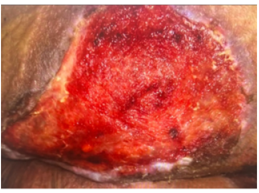 Patient B with stage 3 pressure injury on left buttock.
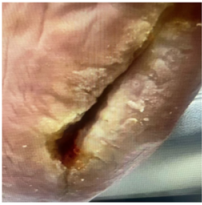 Patient C with surgical wounds on the plantar surface and lateral ankle.
The CS-043 case series evaluated three patients aged 56–63 presenting with:
- A diabetic foot ulcer
- A stage 3 pressure injury
- Complex surgical wounds
All patients had significant comorbidities including diabetes, hypertension, peripheral vascular disease, and prior amputation—populations where NPWT helps prevent further tissue loss.
Standard dressing wear time was seven days, though one patient required more frequent changes due to maceration and inadequate off-loading.
Application Time, Seal, and Periwound Skin
Staff reported full applications took "two minutes or less," substantially faster than custom-cut foam and drape configurations.
Dressing removal was painless across all cases, and NPWT seals remained intact throughout therapy. Notably, clinicians noted no periwound skin complications during the course of NPWT.
Healing Outcomes
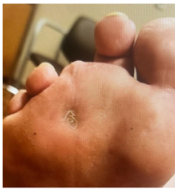 Diabetic foot ulcer of Patient A after 7 days of NPWT.
The diabetic foot ulcer closed completely after just seven days of NPWT with the all-in-one dressing. In the stage 3 pressure injury and surgical wounds, clinicians observed measurable size reduction and development of robust granulation tissue during treatment.
Practical Lessons
- Simplified NPWT builds save time. Pre-assembled dressings reduce application time to roughly two minutes.
- Periwound protection matters. The absence of periwound complications aligns with hybrid-drape case series and highlights value for older adults, those on steroids or anticoagulants, and patients with chronic edema.
- Off-loading and moisture control remain non-negotiable.
- NPWT should remain part of comprehensive care.
Bottom Line
For clinicians already using NPWT, this case series suggests that an all-in-one peel-and-place dressing with hybrid silicone-acrylic drape can preserve NPWT's documented healing benefits while simplifying application and protecting fragile periwound skin.
References
- CS-043: All-in-one NPWT case series. SAWC Fall 2025.
- Meta-analyses supporting NPWT for diabetic foot ulcers and pressure injuries.
- Hybrid silicone-acrylic drape case series.
- NPWT for stage 3-4 pressure injuries: RCT data.