
Novel Repair for Recurrent Achilles Tendon Rupture
Bipedicled fasciocutaneous flap reconstruction offers a vessel-preserving alternative for chronic Achilles wounds when traditional repairs fail.
Damon Ebanks
Medipyxis
Medical education note: This article is for clinicians and is not a substitute for patient-specific medical advice.
Why Recurrent Achilles Tendon Rupture Is So Challenging
Achilles tendon rupture affects active adults significantly. When initial repairs fail, exposed tendon, scarred soft tissue, and limited local vascularity create conditions for chronic nonhealing wounds that prove far more difficult to treat than original injuries.
Case Overview: A 72-Year-Old with Stubborn Posterior Ankle Wound
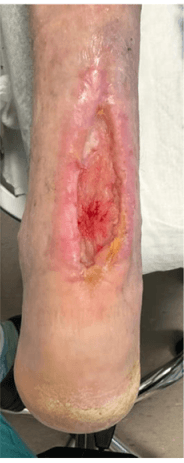
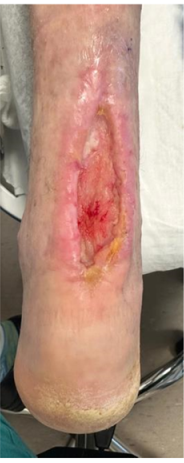 72-year-old man with a nonhealing posterior left ankle wound following Achilles tendon rupture.
A 72-year-old presented with a nonhealing posterior ankle wound following multiple Achilles ruptures and failed skin grafts. Vascular studies confirmed adequate distal perfusion, making aggressive reconstruction feasible.
Surgical Strategy: Bipedicled Fasciocutaneous Advancement Flap
The team performed sharp debridement followed by creation of a bipedicled fasciocutaneous advancement flap based on lateral calcaneal artery perforators. A split-thickness skin graft covered the donor site. Early postoperative venous congestion required return to surgery for flap readvancement and additional grafting.
Outcome: Stable Coverage and No Recurrent Rupture
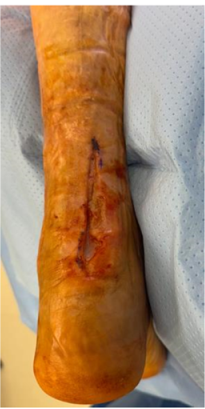 Patient shortly after 2nd procedure of Bipedicled Fasciocutaneous Flap Reconstruction.
After the second procedure, the flap healed completely without infection, necrosis, or dehiscence. No recurrence of Achilles tendon rupture occurred, with durable soft-tissue coverage maintained at follow-up.
Why Bipedicled Fasciocutaneous Flaps Work
These flaps use two vascular pedicles, offering enhanced blood supply, reliable perfusion, and low donor-site morbidity—particularly valuable around vulnerable tendons and surgical scars.
The Role of Lateral Calcaneal Perforator-Based Flaps
The lateral calcaneal artery supplies a robust network to the posterior heel and Achilles region. Clinical series report high flap-survival rates with minimal donor-site complications.
Where This Fits in Modern Achilles Rupture Management
Current evidence shows both nonoperative and surgical care work, but surgery reduces re-rupture rates at the cost of higher wound complications. Recurrent cases demand more complex reconstruction than simple repair.
Chronic and Recurrent Achilles Ruptures: Why They're Different
Once continuity is lost for weeks, tissue quality deteriorates, gaps enlarge, and simple repair often fails. Tendon transfers, grafts, or scaffold augmentation become necessary.
Clinical Takeaways for Wound and Reconstructive Teams
Reconstruction must address both tendon and soft tissue. Stable coverage, preserved perfusion, and tension-free closure are just as important as restoring mechanical continuity. Bipedicled flaps offer a middle ground between simple grafts and free-tissue transfer, especially for older or medically complex patients.
Bottom Line
Recurrent Achilles rupture with chronic posterior breakdown requires strategic, multidisciplinary planning beyond primary repair. Bipedicled fasciocutaneous advancement flaps provide robust, well-vascularized local tissue offering an effective alternative to free flaps in appropriate cases.
References
- Novel bipedicled fasciocutaneous flap for Achilles reconstruction. SAWC Fall 2025.
- Lateral calcaneal perforator-based flaps: clinical series.
- Achilles tendon rupture management: current evidence.