
Is Pure Hypochlorous Acid Safe in the NICU?
Retrospective review of 100+ NICU patients examining safety of pure hypochlorous acid wound cleanser in premature infants from 21-40 weeks gestation.
Damon Ebanks
Medipyxis
Medical education note: This article is for clinicians and is not a substitute for patient-specific medical advice.
Introduction
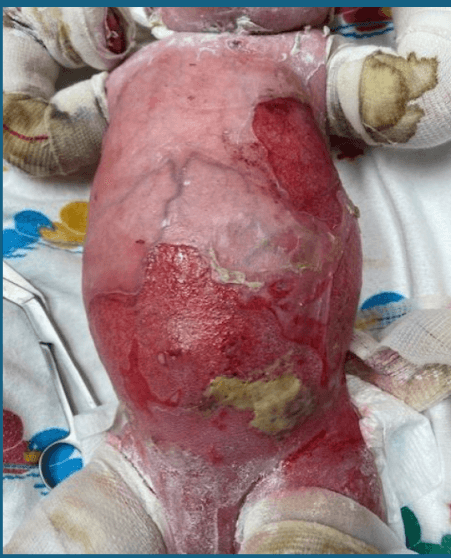
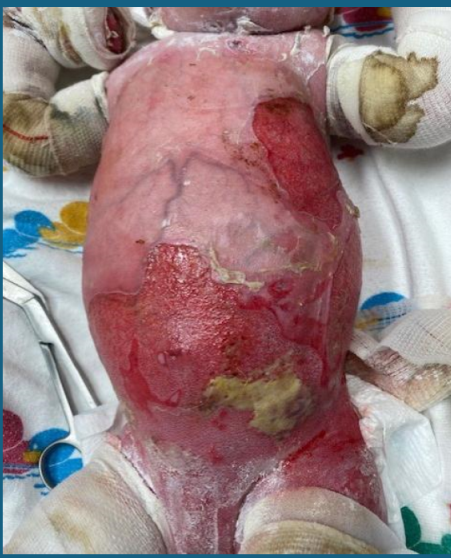 Newborn with epidermolysis bullosa — example of extreme NICU skin fragility.
Premature and critically ill neonates have extremely fragile skin and are particularly vulnerable to damage from topical antiseptics and adhesive products; chlorhexidine-based preparations, for example, have been linked to chemical burns in very low birth weight infants.
Hypochlorous acid (HOCl)–based wound cleansers provide broad-spectrum antimicrobial and anti-biofilm activity while generally demonstrating low cytotoxicity and favorable tolerability in adult and pediatric wound care.
Existing neonatal and pediatric reports, including small observational series in NICU perianal contact dermatitis, mixed neonatal/pediatric wounds, and pediatric burns, suggest that pure HOCl-preserved wound cleansers are well tolerated and may support wound healing in these populations.
We therefore conducted a retrospective review to evaluate the cutaneous safety of a pure HOCl-preserved wound cleanser when used on the skin and wounds of premature infants in a neonatal intensive care unit (NICU).
Methods
We retrospectively reviewed the medical records of more than 100 consecutive NICU patients who received a pure HOCl-preserved wound cleanser (pHA) as part of wound care between 2024 and 2025. For each infant, we recorded gestational age, sex, wound type (e.g., extravasation injury, pressure injury, surgical site complication, contact dermatitis, skin tear, or congenital skin disorder), care environment (isolette vs open crib, phototherapy exposure), and the number of pHA applications. Documentation at treated sites was examined for any evidence of contact dermatitis, chemical burn, or other erosive skin injury temporally associated with pHA use.
Results
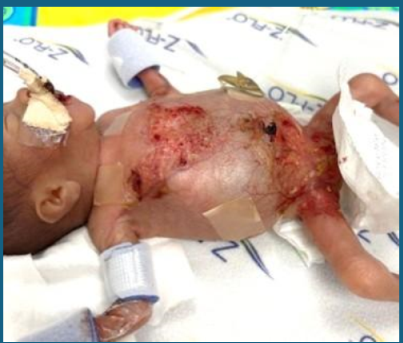 Infant with skin tears after 23 weeks of gestation — healing under pure hypochlorous acid wound care.
Infants ranged from 21 weeks' prematurity to 40 weeks' gestation at the time of treatment. Across all wound types and care environments reviewed, no pHA-related skin injury was identified. pHA was well tolerated regardless of gestational age, underlying diagnosis, or number of applications.
Discussion
In this large single-center retrospective series, routine use of pure HOCl-preserved wound cleanser on neonatal and preterm skin was not associated with clinically apparent contact dermatitis or chemical injury, even in infants as premature as 21 weeks' gestation. These findings are consistent with previous pediatric case series in infants and children—including premature neonates and children with complex wounds and burns—where pure HOCl solutions were well tolerated and associated with favorable healing trajectories.
A recent pediatric wound-care textbook chapter and a narrative review of pediatric wound management both emphasize HOCl-based cleansers as a useful, low-cytotoxic component of multimodal therapy for infected or complex pediatric wounds.
Taken together with broader HOCl reviews describing its antimicrobial, anti-biofilm, and anti-inflammatory properties and generally favorable safety profile, these data support incorporating pure HOCl-preserved wound cleansers into standardized NICU wound-care protocols while recognizing that prospective controlled neonatal trials are still needed.
Bottom Line
- In a retrospective review of more than 100 NICU patients (21–40 weeks' gestation), repeated use of a pure hypochlorous acid (pHA)–preserved wound cleanser was not associated with contact dermatitis, chemical burns, or other erosive skin injury.
- pHA was well tolerated across a wide range of wound types—including extravasation injuries, pressure injuries, surgical-site complications, perianal dermatitis, skin tears, congenital skin disorders, and device-related wounds—and in diverse care environments (isolette, open crib, phototherapy).
- These real-world NICU data reinforce small existing pediatric case series suggesting that pure HOCl is a gentle yet effective cleanser for fragile infant skin and wounds, including in very preterm infants.
- While larger prospective studies are still needed, this series supports the routine inclusion of pure hypochlorous acid cleansers in neonatal and preterm wound-care protocols when minimizing topical toxicity is a priority.
References
- Amaya R. Efficacy of Pure Hypochlorous Acid Preserved Solution in the Treatment of Severe Perianal Contact Dermatitis in Infants. Poster presented at: Symposium on Advanced Wound Care (SAWC) Spring 2023; National Harbor, MD (CS-008).
- Amaya R. Dressings for Pediatric Wound Infections. In: Ciprandi G, Beeckman D, eds. Neonatal and Pediatric Wound Care: A Contemporary Perspective on Practice. Turin: Minerva Medica; 2025:176–193.
- Boyar V. Cleansing Neonatal and Pediatric Wounds: Efficacy and Safety of Hypochlorous Acid. Poster presented at: SAWC Spring 2020.
- Elsass FT. Adjunctive Debridement With Hypochlorous Acid for Healing Complex Wounds in Children. Ostomy Wound Manage. 2016;62(4):8–10.
- Faust E. Wound Cleansing With a Hypochlorous Acid–Preserved Wound Cleanser in Pediatric Patients With Burns. Wound Manag Prev. 2022;68(2):8–10.
- Neri I, Ravaioli GM, Faldella G, Capretti MG, Arcuri S, Patrizi A. Chlorhexidine-Induced Chemical Burns in Very Low Birth Weight Infants. J Pediatr. 2017;191:262–265.e2.
- Block MS, Rowan BG. Hypochlorous Acid: A Review. J Oral Maxillofac Surg. 2020;78(9):1461–1466.
- Boyar V. Hypochlorous Acid in Pediatric Wound Management: From Cleansing to Healing Wounds. Wound Manag Prev. 2020;66(8):8–11.
- Del Rosso JQ, Bhatia N. Status Report on Topical Hypochlorous Acid. J Clin Aesthet Dermatol. 2018;11(11):36–39.