
Icelandic Cod Fish Skin Grafts for Complex Surgical Wounds
Prospective case series examining acellular cod fish-skin grafts for nonhealing post-surgical wounds, showing faster closure and reduced pain.
Damon Ebanks
Medipyxis
Medical education note: This article is for clinicians and is not a substitute for patient-specific medical advice.
Study Overview
- Population: Patients with nonhealing or complex post-surgical wounds.
- Intervention: Kerecis™ (Icelandic cod fish-skin) applied weekly or every other week as clinically indicated.
- Endpoints: Time to healing, VAS pain, % wound-area reduction, and infection rates.
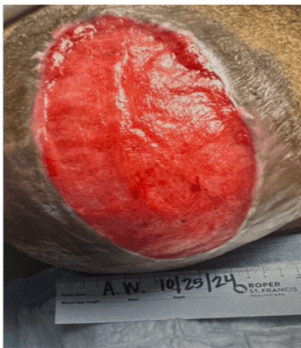
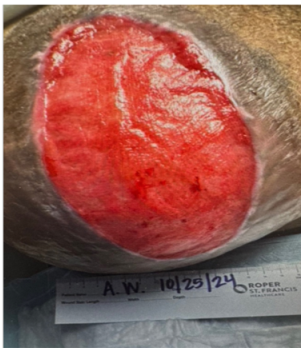 Patient with complex surgical wound exposing beefy red, highly vascular granulation tissue.
Bottom line: Across the series, patients closed in under 12 weeks on average, with lower pain scores. Clinicians observed neovascularization and less inflammation consistent with a pro-healing microenvironment.
Key Findings
- Design: Prospective case series of patients with nonhealing or complex post-surgical wounds treated with an acellular Icelandic cod (Gadus morhua) fish-skin graft (Kerecis™).
- Protocol: Weekly or bi-weekly graft applications; outcomes tracked for time to healing, pain (VAS), wound-size reduction, and infection rates.
- Results: Patients healed in under 12 weeks on average and reported less pain; the graft was associated with neovascularization and reduced inflammation.
- Mechanism: The intact fish-skin matrix retains native collagen, elastin, glycosaminoglycans, and Omega-3 fatty acids; pore architecture supports fibroblast migration.
Why Fish-Skin Grafts?
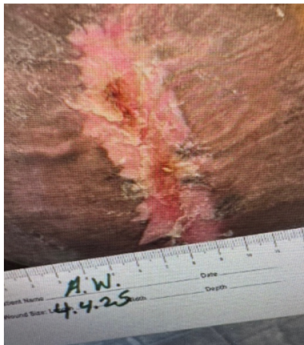 Same patient after eight applications of fish skin grafts — surgical wound healed at four months.
Traditional autografts and allografts can be limited by donor-site morbidity, availability, and immune response—problems that are amplified in high-risk surgical patients. The case series highlights acellular North Atlantic cod fish-skin grafts as a biologically active scaffold that may accelerate closure in difficult wounds while reducing pain.
What Makes This Matrix Different?
- Native ECM preserved: collagen, elastin, and GAGs remain intact after processing.
- Omega-3–rich scaffold: anti-inflammatory lipid profile may support more orderly healing.
- Human-like porosity: microarchitecture closely matches human fibroblast dimensions, promoting cell ingress and granulation.
Practical Takeaways for Clinicians
When to Consider Fish-Skin Grafts
- Surgical wound dehiscence or wounds stalled after standard care.
- High-risk hosts (e.g., impaired vascularity, elevated infection risk) where graft availability or donor-site morbidity is a concern.
Application Rhythm
The series used weekly or bi-weekly applications, integrated with routine wound-bed preparation and monitoring of pain, bioburden, and area reduction—a cadence that can be adapted to exudate and bed quality.
What to Watch
- Trajectory: consistent size reduction week-to-week.
- Pain: falling VAS scores after grafting.
- Signs of vascular response: healthier granulation and neovascular "blush."
Strengths, Caveats & Next Steps
- Strengths: biologically plausible mechanism; consistent improvements in pain and closure time in difficult postoperative wounds.
- Caveats: A prospective case series cannot establish causality; randomized comparisons would clarify effect size vs. other advanced matrices.
- Reading list from the case series: Magnusson et al., Wound Repair & Regeneration (2015); Baldursson et al., Advances in Wound Care (2015); Lullove, Journal of Wound Care (2017)
FAQs
What wounds were targeted?
Nonhealing and complex post-surgical wounds managed in specialty settings.
How often were grafts placed?
Weekly or every other week, depending on wound status and exudate.
What outcomes improved?
Time to closure (less than 12 weeks), pain reduction via VAS scores, wound-size reduction, and lower observed inflammation, with neovascularization noted clinically.
What's unique about this material?
Acellular cod fish skin with preserved extracellular matrix and omega-3 fatty acids; porosity favorable for fibroblast migration and tissue integration.
References
- Esmaeili 2023 – Review: Acellular fish skin for wound healing. PMC
- Magnússon 2017 – Regenerative & antibacterial properties (Mil Med). OUP
- WOUNDS 2023 DFU RCT (Lantis & Lullove) – summary. Kerecis
- Baldursson 2015 – Full-thickness wounds noninferiority study. PubMed
- KEREFISH / ODIN RCT Protocol (DFU). PubMed
- Kerecis Graft Guide IFU. Kerecis
- ClinicalTrials.gov ODIN DFU trial. NCT04133493
- Yoon 2022 – Donor site study (Burns). PubMed
- Luze 2022 – Review in burns (evidence summary). PMC
- Magnússon 2015 – Decellularized fish skin characteristics. PubMed
- Kerecis Omega3 Wound IFU. Kerecis
- Ruiz-Muñoz 2024 – Review in Primary Care Diabetes. Primary Care Diabetes