
GV/MB Foam for Peristomal Atopic Dermatitis: A Case-Based Guide
Case study demonstrates gentian violet/methylene blue foam effectiveness for peristomal atopic dermatitis in an 84-year-old colostomy patient.
Damon Ebanks
Medipyxis
Medical education note: This article is for clinicians and is not a substitute for patient-specific medical advice.
TL;DR (Clinician Quick Take)
A case poster from Holy Cross Health (Fort Lauderdale, FL) reports that gentian violet/methylene blue-impregnated polyurethane (PU) foam used around a colostomy reduced erythema, exudate, pruritus, and inflammation in 14 days, improved appliance adherence, and caused no reported adverse events—after multiple prior interventions had underperformed. Dressings were changed every 24–72 hours and secured with hypoallergenic tape. The patient achieved longer wear time and was discharged with home-health follow-up.
Why This Topic Matters
Peristomal skin complications are common and can compromise pouch adhesion, trigger leakage, and raise infection risk—all of which erode quality of life and increase utilization. Atopic dermatitis in the peristomal zone is particularly challenging because of its recurrent, inflammatory nature. When conventional measures stall, a non-cytotoxic antibacterial dressing that is atraumatic to remove may help clinicians regain control of the skin barrier.
Case Snapshot
Setting & Authorship
Photos by Linda Concepcion, BSN, RN, WCC (Holy Cross Health, Fort Lauderdale, FL).
Patient
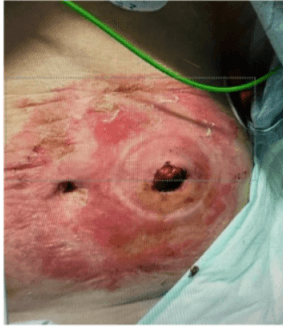
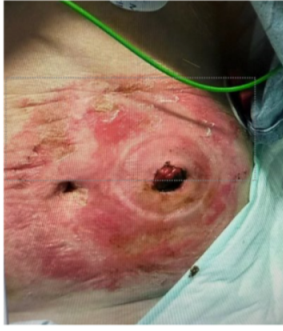 84-year-old woman with colostomy at initial visit.
84-year-old woman with a 2019 colostomy and a long history of recurrent peristomal problems. She presented with weeping skin, persistent erythema, and pruritus consistent with peristomal atopic dermatitis; multiple earlier interventions had yielded limited success.
Intervention (Dressing Protocol)
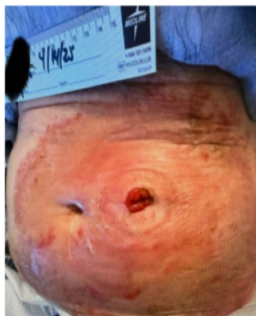 84-year-old patient during GV/MB foam treatment.
- Applied gentian violet/methylene blue (GV/MB)-impregnated PU foam to the affected peristomal skin.
- Secured with hypoallergenic tape; changes every 24–72 hours depending on exudate and skin condition.
- Monitored for 14 days for symptom relief, adhesion, and skin integrity, with visual assessments/photography.
Clinical Results
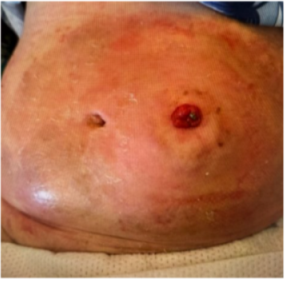 Patient after 14 days of GV/MB foam treatment.
- Marked reduction in erythema, exudate, and inflammation; improved appliance adherence.
- Non-cytotoxic antibacterial and atraumatic dressing characteristics supported a rapid rebound of skin integrity.
- No adverse events reported; the patient tolerated the regimen well.
What Is GV/MB-Impregnated PU Foam?
- Polyurethane foam provides atraumatic contact and moisture management.
- Gentian violet + methylene blue confer non-cytotoxic antibacterial activity, which may help temper bioburden-related inflammation without harming viable tissue.
- In this case, those properties aligned with rapid symptom relief and better adhesion, allowing longer wear intervals.
Practical pearl: When dermatitis under the wafer keeps the peristomal surface damp, inflamed, and itchy, a bioburden-modulating, atraumatic foam can give the skin a chance to re-epithelialize while you optimize fit and accessories.
How to Replicate the Approach
Confirm the Problem
Rule out pressure, mechanical trauma from the wafer, leakage/chemical irritation, and infection. Document dermatitis features (erythema, weeping, pruritus).
Apply GV/MB Foam
Cut foam to fit the affected peristomal area; secure with hypoallergenic tape; keep the stoma visible for precise wafer fitting. Change every 24–72 hours based on exudate.
Optimize the Pouching System in Parallel
Use supportive accessories and adjust technique to reduce undermining and shear; aim for 2–3-day wear time as skin calms.
Reassess by Day 14
Expect reduced erythema/exudate and improved adhesion; if achieved, step down to routine ostomy care and home-health/ostomy-nurse follow-up.
Clinical Signals to Consider GV/MB Foam
- Recurrent, inflamed peristomal dermatitis despite prior measures.
- Weeping/bioburden-prone skin contributing to wafer lift and leakage.
- Need for a non-cytotoxic antibacterial option that is atraumatic at changes.
Limitations: Evidence here is single-patient and case-based; larger series and controlled studies are still needed for robust guidance.
FAQ
Is GV/MB foam safe for fragile peristomal skin?
In this case, the dressing was well-tolerated with no reported adverse events and was atraumatic at removal/change.
How often did the dressing need to be changed?
Every 24–72 hours, depending on exudate and skin condition, with close monitoring.
Will this help my patient keep a pouch on longer?
The case showed improved adhesion and 2–3-day wear times during recovery, culminating in extended wear by discharge once the skin healed. Individual results vary.
Take-Home for Clinicians
For ostomates with recurrent, inflamed peristomal skin and adhesion problems despite standard care, GV/MB-impregnated PU foam is a reasonable adjunct to trial. In this documented case, it calmed dermatitis in approximately two weeks, improved wear time, and avoided skin trauma—practical wins that can stabilize pouching while you refine fit and accessories.
References
- Edwards K, et al. Gentian Violet and Methylene Blue Antibacterial Foams: Bioburden control and wound progression. PMC
- Woo KY, et al. Prospective evaluation of gentian violet/methylene blue antibacterial dressings in chronic wounds. PMC
- Hydrofera Blue Product Monograph (PU/PVA, non-cytotoxic labeling, use guidance). WoundSource
- UChicago Ostomy Guide: typical pouch wear time and adhesion considerations. UChicago Medicine
- Hollister Learning Center: pouching system wear-time. Hollister