
Fish Skin Grafts for Post-Radiation Calf Wounds: Limb Salvage Case Study
Acellular fish skin grafts with omega-3 fatty acids enabled limb salvage in a 93-year-old with radiation-damaged calf wound when conventional therapies failed.
Damon Ebanks
Medipyxis
Medical education note: This article is for clinicians and does not replace patient-specific medical advice or local protocols.
Why Post-Radiation Wounds Are So Hard to Heal
Radiation therapy effectively treats non-melanoma skin cancers but causes long-term microvasculature damage, fibroblast dysfunction, and depleted stem cell pools. Chronic wounds in irradiated areas are common and threaten function and independence. Large reviews of radiation-induced skin injury highlight endothelial damage, fibrosis, and impaired remodeling as core mechanisms with no single established standard therapy.
When wounds occur over load-bearing areas like the posterior calf, stakes escalate. Mobility, fall risk, and independent living depend on closure without tight, restrictive scarring that limits ankle and knee movement.
Case Snapshot: 93-Year-Old Woman With a Post-Radiation Calf Wound
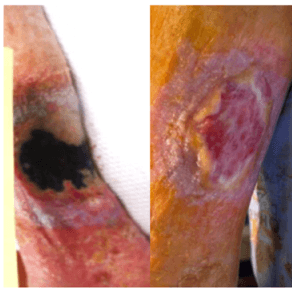
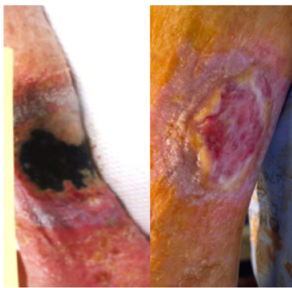 Initial presentation: 93-year-old woman with large right posterior calf wound after radiation therapy.
A 93-year-old woman with basal cell carcinoma history on her right posterior calf completed external-beam electron radiation (5,500 cGy in 20 fractions) five months prior to wound center presentation. She presented with a large posterior-calf wound measuring 8.0 × 7.0 cm covered by dense, dry eschar. Surgical oncology and plastic surgery considered her high risk for limb loss if the wound did not progress.
Key challenges included:
- Advanced age and frailty
- Prior radiation with compromised local vasculature
- Wound size and location over the calf
- Limited reconstructive options and high anesthesia risk
The clinical goal was clear: close the wound while preserving limb function and minimizing operative burden.
When Conventional Options Hit a Ceiling
Before pursuing fish skin grafts, the team attempted an aggressive standard sequence of advanced therapies:
- Porcine urinary bladder matrix
- Amniotic membrane allografts
- Porcine small-intestinal submucosa
These biologics produced interval improvement but never achieved full granulation or complete epithelialization. The wound plateaued. Split-thickness skin grafting and rotational flap coverage were ruled out due to age, comorbidities, and surgical risk. Hyperbaric oxygen therapy was contraindicated because of additional basal cell carcinoma sites.
What Is an Acellular Fish Skin Graft—and Why Might It Help Here?
Acellular fish skin grafts (FSGs) are xenografts derived from decellularized cold-water fish skin. Unlike heavily processed mammalian dermal matrices, FSGs retain a native, three-dimensional extracellular matrix with preserved architecture and a lipid profile dominated by omega-3 fatty acids.
Key properties relevant to radiation-damaged tissue include:
- Scaffold function: Collagen structure provides a template for cellular infiltration and neovascularization.
- Omega-3–driven bioactivity: Omega-3 fatty acids modulate inflammation, support pro-resolving pathways, and may reduce pain.
- Low disease-transfer risk: Cold-water fish skin can be gently processed, preserving matrix integrity while avoiding prion and mammalian pathogen concerns.
A 2018 prospective series of 25 complicated chronic wounds treated with a marine Omega-3 wound matrix showed high rates of granulation and closure, suggesting FSGs can be effective in complex, limb-threatening wounds.
Fish Skin Graft in This Basal Cell Carcinoma Calf Wound
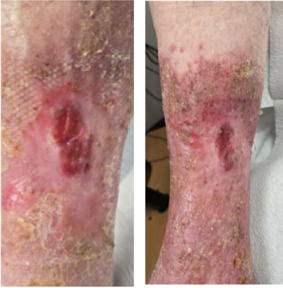 Post-radiation calf wound near complete closure after debridements and fish skin graft applications.
Given the stalled wound, lack of surgical options, and need to preserve limb function, the team elected to proceed with aggressive sharp debridement down to a healthy, bleeding base, followed by acellular fish skin graft application.
Treatment Strategy
- Debridement: Thorough removal of necrotic eschar and non-viable tissue to reset the wound bed.
- First FSG application: Fish skin graft tailored to wound dimensions and secured per manufacturer protocol.
- Advanced wound dressings: Moisture-balancing secondary dressings to protect the graft and manage exudate.
- Serial follow-up: Monitoring for graft incorporation, granulation, and epithelial edge migration.
Over subsequent weeks, the wound demonstrated robust granulation, progressive contraction, and epithelialization. The patient achieved near-complete closure, maintained calf mobility, and avoided limb loss and prolonged hospitalizations.
How This Case Fits the Larger Evidence Base
Radiation Injury and Fish Skin Grafts
A 2025 JAAD Case Reports article described successful intact fish skin graft use in soft tissue radionecrosis after multiple standard therapies, including hyperbaric oxygen, failed.
Strong Data in Chronic Limb Wounds
Fish skin grafts have been studied more extensively in chronic lower-extremity wounds:
- Diabetic foot ulcers and venous leg ulcers: Studies show faster healing and higher closure rates when fish skin grafts are added to standard care compared with standard care alone.
- Real-world analysis: A 2025 retrospective study of chronic wounds treated with acellular fish skin grafts demonstrated meaningful improvements in closure and acceptable costs in real-world practice.
Practical Takeaways for Wound Care Teams
- Re-frame "nonhealing" post-radiation wounds as limb-salvage problems. When conventional biologics stall, consider whether the patient truly qualifies for split-thickness skin grafting or flap coverage.
- Debridement is still non-negotiable. The fish skin graft here was paired with aggressive debridement.
- Match the graft to the patient's risk profile. For a 93-year-old with limited reconstructive options, minimally invasive placement of a biologic scaffold manageable in the outpatient setting is appealing.
- Set expectations and monitor function. In frail patients, near-complete closure with preserved mobility can be a more meaningful endpoint than textbook-perfect scarring.
- Document outcomes. Radiation-related wound data remain sparse; every well-documented case strengthens the emerging evidence base.
Bottom Line
- Radiation-related calf wounds after basal cell carcinoma can be limb-threatening, particularly in very elderly patients who are poor candidates for split-thickness skin grafting, flaps, or hyperbaric oxygen.
- In this 93-year-old woman, serial biologic grafts failed to achieve closure—yet aggressive debridement followed by acellular fish skin graft led to near-complete healing and limb salvage.
- Mechanistically, fish skin grafts offer a preserved dermal matrix enriched with omega-3 fatty acids, providing a bioactive scaffold supporting granulation, epithelialization, and inflammation resolution.
References
- Yang X, Ren H, Guo X, et al. Radiation-induced skin injury: pathogenesis, treatment, and management. Aging (Albany NY). 2020;12(22):23379-23393.
- Zhivov EV, Vague M, Ortega-Loayza AG. Treatment of soft tissue radionecrosis with intact fish skin graft. JAAD Case Reports. 2025;62:46-49.
- Dorweiler B, Trinh TT, Dünschede F, et al. The marine Omega-3 wound matrix for the treatment of complicated wounds. Int Wound J. 2018;15(4):701-708.
- Karhana S, Khan MA. Omega-3 acellular fish skin grafts for chronic and complicated wounds: a systematic review of efficacy and safety. Dermatol Pract Concept. 2025;15(2):4945.
- Wang D, Hatch S, Apte RS, et al. Acellular fish skin xenografts for treatment of periocular defects after Mohs surgery. Ophthalmic Plast Reconstr Surg. 2024;40(2):e49-e55.