
Intact Fish Skin Grafts for Neonatal Wounds: Case Series
Early outcomes of intact fish-skin grafts for complex wounds in premature neonates, showing rapid closure with minimal adverse effects.
Damon Ebanks
Medipyxis
Medical education note: This article is for clinicians. Always follow your institution's protocols and the device manufacturer's instructions for use.
Quick Take (TL;DR)
A pediatric wound-care team reported early experience using intact fish-skin grafts (IFSGs; derived from Atlantic cod) to treat complex wounds in premature neonates and hospitalized infants. After bedside wound-bed preparation and a single IFSG application left in place 7–14 days, complete closure occurred in all but one case, with an average time to closure of 17.2 days and no observed adverse effects. Gestational ages ranged from 21-week prematurity to term. Most infants required only one IFSG; a few needed two applications.
Why This Matters
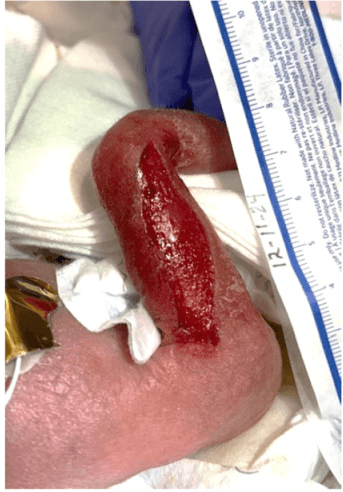
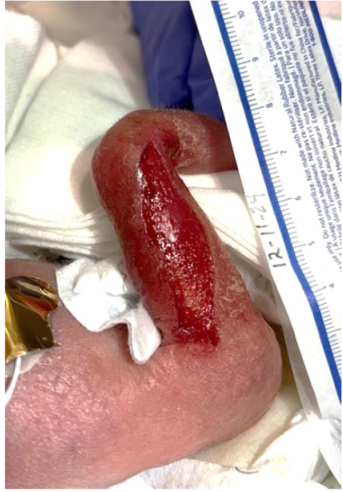 Complex neonatal wound from an infant.
Complex neonatal wounds (for example, iatrogenic injuries, postoperative sites, extravasation injuries) present challenges: small surface area magnifies fluid and heat loss, dressing changes can be traumatic, and product safety data in this population are limited. This case series suggests IFSG may be a practical, well-tolerated option that accelerates closure while reducing handling frequency—key benefits in fragile patients.
What the Team Did
Population: Premature neonates and infants cared for by a pediatric wound-care service; gestational ages from 21-week prematurity through term.
Product: Intact fish-skin graft (Kerecis Omega3®) sourced from Atlantic cod.
Setting & method: Bedside application after wound-bed preparation by two investigators; IFSG left in place for 7–14 days; sites assessed every 3–4 days for infection or intolerance. Primary endpoint: complete closure.
Outcomes at a Glance
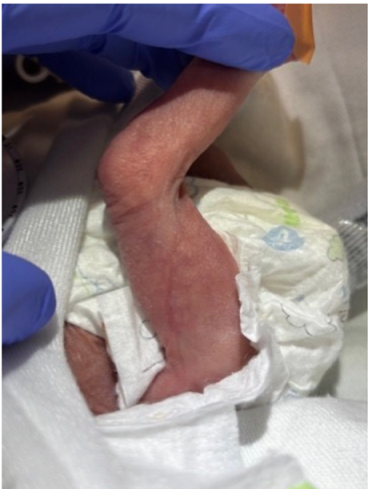 Successful closure of neonatal wound using fish skin graft after 18 days.
Cohort size: Infants ranging from extremely premature to term.
Applications: Most achieved closure with a single IFSG; a subset required two applications.
Effectiveness: Complete closure in all but one; mean time to closure 17.2 days.
Safety: No adverse effects or complications observed during monitoring.
Clinical Workflow You Can Replicate
- Prepare the bed: Perform gentle wound-bed preparation to remove non-viable tissue and optimize perfusion.
- Apply IFSG at bedside: Size to cover the wound; secure per local protocol. Leave undisturbed 7–14 days unless clinical changes require earlier inspection.
- Monitor every 3–4 days: Assess for signs of infection or intolerance; reinforce dressings as needed; maintain thermoregulation and moisture balance.
- Reapply if needed: Most infants closed with a single application; a minority benefited from a second application.
- Track the endpoint: Document time-to-closure and any events.
What Makes IFSG Attractive in the NICU/PICU
Low handling frequency: A single placement designed to remain 7–14 days minimizes painful, disruptive dressing changes on extremely fragile skin.
Early closure signal: A ~17-day mean closure supports shorter trajectories in select wounds.
Favorable tolerability: No adverse effects were recorded in this series despite exposure in extremely premature infants.
Limitations
- Uncontrolled case series from a single service; no comparator arm and potential selection bias.
- Heterogeneous wounds: applicability may differ by wound type and comorbidities.
- Protocol nuances: Outcomes reflect the investigators' workflow.
References
- Amaya R. Intact Fish Skin Grafts for Treatment of Complex Wounds in Premature Neonates and Hospitalized Infants. Poster at SAWC Fall 2025.
- Cherry I, et al. Exploring the Place of Fish Skin Grafts with Omega-3 in Pediatric Wound Management. J Pediatr Surg. 2023.
- Ciprandi G, et al. Use of acellular intact fish skin grafts in treating acute paediatric wounds. J Wound Care. 2022;31(10):824–832.
- Staubach R, et al. The Use of Fish Skin Grafts in Children as a New Treatment of Deep Dermal Burns. J Clin Med. 2024;13(8):2389.
- Marissen J, et al. The Delicate Skin of Preterm Infants. Neonatology. 2023;120(3):295–309.