
Seven-Day Peel-and-Place NPWT for Leg Wounds: Initial Clinical Experience
Initial 6-wound clinical series demonstrates encapsulated, peel-and-place NPWT dressing maintains seven-day seals with simplified application for leg wounds.
Damon Ebanks
Medipyxis
Medical education note: The content below is for clinicians. It is not a substitute for device IFUs, local protocol, or patient-specific medical advice.
Quick Take
A small initial series found that a novel encapsulated, peel-and-place NPWT dressing—built around a polyurethane foam manifolding core with a hybrid silicone–acrylic drape—maintained seals for up to seven days, was faster and easier to apply and remove than traditional reticulated open-cell foam (ROCF), and supported visible healing progression (granulation, epithelialization, and wound-size reduction) in six complex lower-extremity wounds from four patients (ages 23–69). Continuous −125 mmHg was used; dressings were changed at least weekly.
Why Consider a Peel-and-Place NPWT Dressing?
Traditional ROCF is a workhorse for NPWT, but multiple guidelines note that foam is typically changed every 48–72 hours to reduce granulation tissue ingrowth into the foam, which can increase pain, bleeding, and wound-bed disruption on removal.
A peel-and-place concept encapsulates the foam and pairs it with a hybrid silicone–acrylic drape designed for longer wear and gentler removal, aiming to extend wear time up to seven days while simplifying application—potentially reducing total dressing changes, chair time, and patient discomfort.
What This Initial Experience Reported
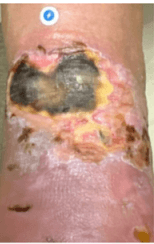
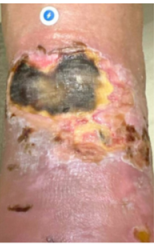 49-year-old male with right dorsal foot diabetic ulcer, 2 weeks after trauma.
Population & wounds: Four patients (2 F / 2 M) with six complex lower-extremity wounds received the peel-and-place NPWT dressing.
Technique: After excisional debridement as needed and systemic antibiotics when indicated, the peel-and-place NPWT dressing was applied with the foam core extending at least 1 cm beyond the wound perimeter, connected via multilumen tubing, and run at −125 mmHg continuous. The change interval was at least every 7 days.
Ease of use: Clinicians in the series rated peel-and-place faster and easier to apply and remove than hand-cut ROCF. Simulated-use studies of V.A.C.® Peel and Place show a similar pattern: average application time approximately 1:48 versus approximately 4:40 for traditional foam plus drape.
Patient experience: Patients preferred fewer dressing changes; product evaluations report reduced dressing-change frequency (up to 67% fewer changes per week) and painless or low-pain removal.
Clinical trajectory: All six wounds showed forward progression (granulation tissue formation, dimensional reduction, epithelialization) over the treatment window.
How to Set It Up (Clinic Playbook)
Always follow the device IFU. The outline below mirrors the poster's protocol and published manufacturer instructions.
Debride First
Perform excisional debridement to remove devitalized tissue and manage infection with systemic antibiotics as needed.
Sizing & Placement
Remove release liners; position the peel-and-place dressing so the foam core extends at least 1 cm past wound edges to ensure uniform manifolding under the drape.
Seal & Connect
Smooth the hybrid silicone–acrylic drape to achieve an airtight seal and connect multilumen tubing to the NPWT pump.
Pressure & Mode
Initiate −125 mmHg continuous NPWT.
Wear Time
Change the dressing at least every 7 days (earlier if clinically indicated by exudate, edge maceration, or leaks). The series reported no seal failures during the intended wear interval.
Practical Pearls From the Cases
Speed saves. Teams reported that encapsulation plus peel-away liners made application and removal faster than ROCF, trimming chair time.
Fewer touches. Once-weekly changes limit opportunities for wound-bed disturbance and patient discomfort from frequent foam exchanges.
Reliable seals. The hybrid drape maintained negative pressure throughout the intended wear period across all cases.
Cost & workflow. The authors highlight potential reductions in cost and application time compared with ROCF, derived from extended wear and simplified handling.
Results Summary
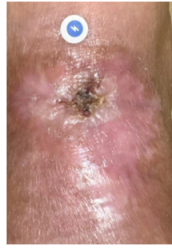 49 y/o male with right diabetic foot ulcer closed after 11 weeks of treatment.
- Patients: 4 (2 F / 2 M), ages 23–69
- Wounds: 6 complex lower-extremity wounds
- NPWT setting: −125 mmHg continuous
- Wear interval: Change at least every 7 days
- Sealing: Maintained seals for intended wear time (no reported leaks)
- User experience: Easier and faster application/removal vs ROCF
- Patient experience: Higher satisfaction due to fewer changes
- Healing trajectory: Granulation, size reduction, and epithelialization in all wounds during therapy
Limitations
This is a small, uncontrolled initial series (4 patients / 6 wounds) with no head-to-head randomization against standard ROCF. Most published Peel and Place data so far are manufacturer-sponsored animal studies, simulated-use evaluations, product guides, and individual case reports, rather than large randomized clinical trials.
References
- 3M / Solventum. V.A.C.® Peel and Place Dressing Kit – Product Guide.
- WoundSource. V.A.C.® Peel and Place Dressing Kit.
- Mansoor J, et al. Clinical evaluation of improvised gauze-based negative pressure wound therapy. Indian J Plast Surg. 2013.
- Wound Care Guidelines – CLWK. Negative Pressure Wound Therapy – Reusable & Disposable Guideline. 2024.
- Allen D, et al. Preclinical assessment of novel longer-duration wear negative pressure wound therapy dressing in a porcine model. 2023.
- Huang C, et al. The evolution of commercial negative pressure wound therapy systems for open-wound management. Adv Wound Care. 2023.
- Fernández LG, et al. Use of a novel silicone–acrylic drape with negative pressure wound therapy in anatomically challenging wounds. Int Wound J. 2020.
- Greenstein D, et al. Use of V.A.C. Peel and Place Dressing for Diabetic Foot Wounds. Dialogues in Wound Management. 2024.