
BIOMES Framework for Limb Salvage and CLTI Triage
Clinical framework for identifying high-risk lower-extremity wounds across six domains to enable early specialist referral and limb salvage.
Damon Ebanks
Medipyxis
Medical education note: This article is for clinicians and is not a substitute for patient-specific medical advice.
Why Delayed Referral Still Costs Limbs
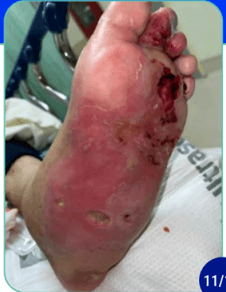
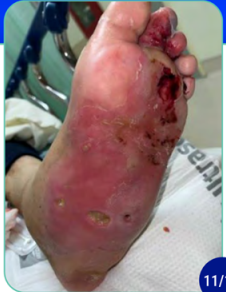 Patient with worsening infection, gas in soft tissue, and acute osteomyelitis — the cost of delayed referral.
Despite better tools and clearer limb-salvage guidelines, many patients with chronic limb-threatening ischemia (CLTI) or complex lower-extremity wounds still arrive at vascular and wound centers months after problems start. In Japan, Takahara and colleagues reported that patients with critical limb ischemia typically waited 1–3 months between wound onset and referral to a vascular center, despite long-standing guideline recommendations for early referral.
More recent work has reinforced that delayed referral is not just inconvenient—it's dangerous. A 2025 study found that delayed referral and revascularization in CLTI is independently associated with worse one-year outcomes, including higher amputation rates and mortality.
At the same time, contemporary CLTI reviews and limb-salvage program data show that structured, multidisciplinary care—vascular, podiatry, wound, endocrinology, and social support—can significantly reduce major amputations.
The gap between these two realities is where the BIOMES™ framework lives: it gives front-line clinicians a fast way to recognize "red flag" wounds and move them into limb-salvage pathways earlier.
What Is the BIOMES™ Framework?
The BIOMES™ tool is a structured clinical framework that looks at six domains known to drive wound chronicity and limb loss: Blood flow, Infection/Bioburden, Offloading/Overloading, Metabolic/Morbidities, Exudate/Edema, and Social/Economic factors.
In practical terms:
- B – Blood flow: Peripheral arterial disease, CLTI signs, non-palpable pulses, ABIs, toe pressures.
- I – Infection/Bioburden: Local and systemic infection, biofilm suspicion, osteomyelitis risk.
- O – Offloading/Overloading: Pressure, shear, gait abnormalities, footwear, splints or devices.
- M – Metabolic/Morbidities: Diabetes, renal disease, heart failure, malnutrition, smoking.
- E – Exudate/Edema: Volume and character of fluid, lymphedema, venous hypertension.
- S – Social/Economic: Housing, transportation, caregiver support, access to dressings and follow-up.
The BIOMES™ concept deliberately lines up with the Wound Balance framework developed by the World Union of Wound Healing Societies (WUWHS), which encourages clinicians to look beyond the wound surface and balance biological, mechanical, and patient-centered factors to restore a healing trajectory.
Case Series Overview: Three Limbs on the Line
The case presented three patients with chronic lower-extremity wounds and high risk of limb loss. All were assessed with the BIOMES™ framework at their very first wound-care encounter.
Key elements from the series:
- All three patients had complex comorbidity profiles, including diabetes and/or peripheral arterial disease.
- Each patient met two or more BIOMES™ "red flag" criteria at baseline, signaling elevated risk for deterioration and potential amputation.
- BIOMES™ scoring was used in real time to drive targeted interventions and to justify early referral to wound and vascular specialists, rather than waiting weeks or months.
- Cases were followed longitudinally, tracking wound progression, interventions, and limb-salvage outcomes.
Outcome: All three patients achieved limb salvage with measurable wound improvement over time.
How BIOMES™ Changes the First Visit
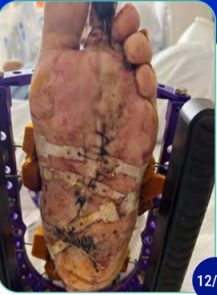 Patient foot healed using BIOMES tool after multiple debridements, umbilical skin substitute, and suture guard.
The headline from this series is simple: when BIOMES™ is applied at the first visit, fewer critical issues get missed.
1. It Forces You to Check Blood Flow
Instead of treating a chronic ankle ulcer as just a dressing problem, BIOMES™ pushes you to think CLTI first when pulses are weak, pain is disproportionate, or tissue loss is evolving. That is exactly the group often waiting months before seeing vascular specialists—time they don't have.
2. It Keeps Infection and Load Front and Center
By scoring Infection/Bioburden and Offloading/Overloading explicitly, the framework nudges clinicians away from passive "watch and wait" into active debridement, targeted topical/systemic antimicrobials, and real offloading solutions.
3. It Bakes In Wound Balance and Exudate Management
The Exudate/Edema domain maps directly onto WUWHS exudate guidance, which warns that exudate in the wrong amount, place, or composition can stall healing and drive complications.
At the same time, BIOMES™ fits neatly into the Wound Balance idea: instead of chasing one factor at a time, you aim for a balanced state where perfusion, bioburden, mechanical load, systemic health, and exudate are all optimized enough to let the wound move through the normal healing phases.
4. It Captures the "Hidden" Social and Economic Brakes
The Social/Economic dimension forces documentation of things like lack of transport, work demands, or inability to afford frequent dressing changes. Those factors routinely derail even the best clinical plan—and they're heavily emphasized in newer Wound Balance consensus documents.
How BIOMES™ Connects to Wound Balance
The Wound Balance concept, introduced in 2023 and expanded in 2025, aims to help clinicians build a holistic picture of each wound and patient—biological status, patient priorities, system constraints—then "rebalance" these elements toward healing.
BIOMES™ essentially operationalizes that idea at the bedside:
- Biological balance: Blood flow, infection, and metabolism (B, I, M).
- Mechanical balance: Offloading/Overloading + Exudate/Edema (O, E).
- Contextual balance: Social/Economic factors (S).
Recent consensus papers on Wound Balance explicitly encourage use of screening tools and checklists to make sure all these domains are considered early, and several international presentations now reference BIOMES™ as one such practical tool.
Putting BIOMES™ to Work in Your Clinic
- Screen every new leg/foot wound with BIOMES™ at triage. If two or more domains score as high risk, mark the wound as "limb-threatening until proven otherwise" and escalate.
- Use BIOMES™ to justify early referral. When you see concerning scores in Blood Flow or Infection/Bioburden, use them to support early vascular and wound-specialist referral rather than waiting for spontaneous improvement.
- Pair BIOMES™ with Wound Balance thinking. For each domain, ask: What is unbalanced here, and what's one realistic step to rebalance it this week?
- Document changes over time. Re-score BIOMES™ at key visits (e.g., every 2–4 weeks or after major interventions). Falling scores should correlate with clinical improvement.
- Close the feedback loop. Share BIOMES™ summaries with the multidisciplinary team (vascular, podiatry, ID, endocrinology).
Bottom Line
- Delayed referral is still a major limb-loss driver in chronic limb-threatening ischemia and complex lower-extremity wounds. Patients commonly wait 1–3 months before seeing vascular specialists, and delayed referral predicts worse one-year outcomes.
- The BIOMES™ framework gives front-line clinicians a fast, structured way to flag high-risk wounds across six domains.
- In a three-patient case series, applying BIOMES™ at the first wound-care encounter identified multiple healing barriers, prompted timely targeted interventions, and contributed to successful limb salvage in all three cases.
- BIOMES™ is tightly aligned with the Wound Balance concept, helping clinicians move from reactive "wound management" to proactive, holistic healing.
- For wound-care programs, integrating BIOMES™ into triage and documentation is a practical way to standardize early risk recognition.
References
- Brookshier T. Novel Approaches to Limb Salvage Utilizing the BIOMES™ Framework: A Case Series. SAWC Fall 2025 Abstracts (CS-017). SAWC
- Takahara M, Iida O, Soga Y, et al. Duration from wound occurrence to referral to a vascular center in patients with critical limb ischemia. Ann Vasc Dis. 2020;13(1):56–62. PMC
- Kojima S, et al. One-year clinical outcomes of delayed referral and revascularization for CLTI. J Vasc Surg. 2025. ScienceDirect
- Komai H, et al. Multidisciplinary treatment for critical limb ischemia in Japan. Ann Vasc Dis. PMC
- World Union of Wound Healing Societies (WUWHS). Wound Exudate: Effective Assessment and Management. Wounds International; 2019. Wounds International
- Wounds International. Wound Balance: Achieving Wound Healing with Confidence. 2023. Wounds International
- WUWHS. Implementing Wound Balance: Outcomes and Future Recommendations. 2025. Wounds International
- Secemsky EA, et al. Contemporary chronic limb-threatening ischemia care in the United States. J Soc Cardiovasc Angiography Interv. 2025. JSCAI
- Shishehbor MH, et al. Impact of interdisciplinary system-wide limb salvage program on amputation and vascular outcomes. Circ Cardiovasc Interv. 2022;15(9):e011306. AHA Journals