
Bioactive Glass Matrix Heals Dorsal Foot Ulcer with Exposed Hardware
A 69-year-old achieved 88.9% wound closure using borate-based bioactive glass after hardware removal failed prior therapies.
Damon Ebanks
Medipyxis
Medical education note: This article is for clinicians and is not a substitute for patient-specific medical advice.
A 69-year-old woman developed a chronic dorsal foot ulcer with exposed tendon and hardware following 1st MTP fusion. After hardware removal and three serial borate-based bioactive glass fiber matrix (BBGFM) applications, the wound achieved 88.9% percent-area reduction and closure by week 18.
Clinical Problem: When Dehiscence Meets Hardware
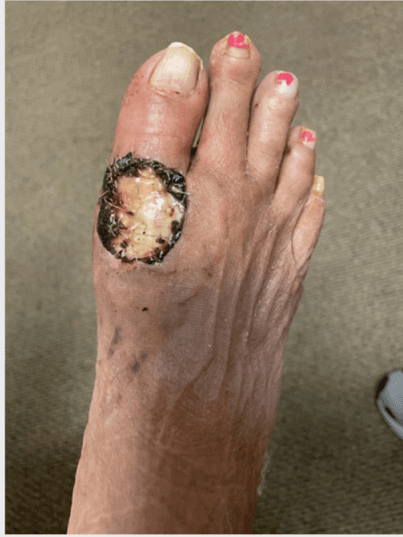
 Dorsal foot ulcer with exposed tendon, initial visit.
Post-fusion wounds with exposed tendon or hardware remain difficult to salvage. Motion, infection, and poor soft-tissue coverage keep them in inflammatory stasis, even with negative pressure wound therapy (NPWT) or cellular matrices.
Prior Care & Inflection Point
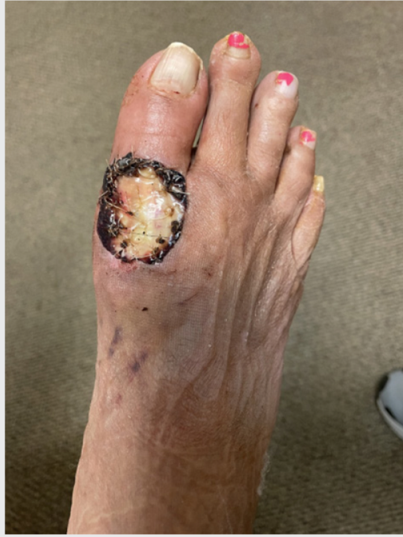
 Six days post BBGFM placement — rapid granulation visible.
Initial care with bovine and amniotic matrices plus VAC/NPWT yielded only temporary gains. Hardware removal on 1/31/25 was followed by BBGFM placement on 2/12/25.
Why It May Work
Borate-based glass matrices release therapeutic ions (boron, calcium, phosphate) that drive angiogenesis, fibroblast proliferation, and M1→M2 macrophage modulation, producing a regenerative micro-environment even over exposed structures.
Outcomes
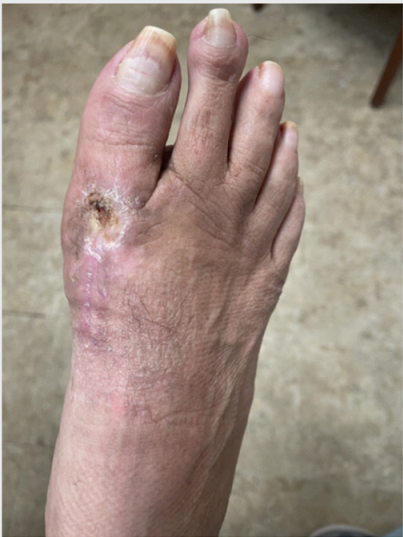
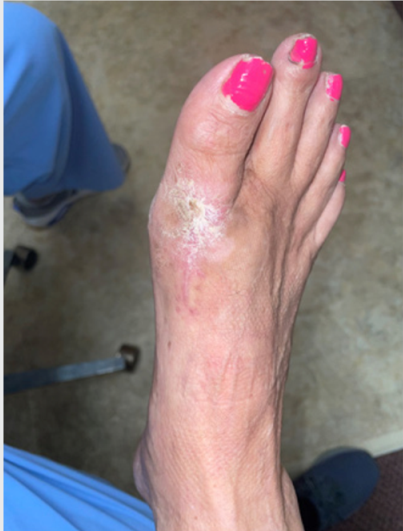 Full closure of dorsal foot ulcer on 4/14/25.
After three applications over approximately nine weeks:
- Baseline volume: 9.0 cm³ → approximately 1.0 cm³ (88.9% PAR) at week 18
- Serial photos confirmed granulation → epithelialization → closure by 4/14/25
- Percent-area reduction (PAR) ≥ 50% by 4 weeks is predictive of 12-week healing
Mechanism Snapshot
Borate glass fibers influence the wound microenvironment by promoting neovascularization and fibroblast proliferation, helping transition chronic wounds from stasis to healing—especially valuable when tendon or hardware exposure prevents typical granulation.
Practical Pearls for Exposed-Hardware Wounds
- Reset the bed first: treat infection, debride, and remove mechanical barriers
- Plan on serial applications: repeated matrix use over weeks correlates with improved closure
- Measure trajectory: track PAR and photo documentation
- Keep it multimodal: combine with compression/offloading—matrix is adjunctive, not a replacement
Limitations
Single-patient evidence; confounded by hardware removal and concurrent care. Nonetheless, the temporal association between BBGFM initiation and rapid granulation/closure supports further controlled study.
Bottom Line
When traditional therapies—including NPWT, amniotic membranes, and bovine matrices—fail to restore coverage over exposed tendon or hardware, borate-based bioactive glass fiber matrix (BBGFM) can serve as a regenerative bridge to closure. By releasing therapeutic ions that drive angiogenesis, fibroblast activation, and antimicrobial balance, BBGFM helps convert non-granulating, high-risk wounds into actively healing ones—even in the challenging post-fusion setting.
References
- Armstrong DG, et al. Resorbable glass microfiber matrix vs SOC in chronic wounds (RCT). Int Wound J. 2021.
- Ren Z, et al. Bioactive Glasses: Advancing Skin Tissue Repair. 2025.
- Homaeigohar S, et al. Bioactive glass-based fibrous wound dressings. 2022.
- Buck DW, et al. Bioactive glass fiber matrix case series (chronic wounds). 2020.
- Drago L, et al. Recent Evidence on Bioactive Glass Antimicrobial Properties. 2018.