
Bioactive Glass Matrix for Recalcitrant Trauma and Amputation Wounds
Three lower-extremity trauma cases achieved full closure using boron-based bioactive glass fiber matrix integrated into multimodal wound care.
Damon Ebanks
Medipyxis
Medical education note: This article is for clinicians and is not a substitute for patient-specific medical advice.
TL;DR (Key Findings)
Three lower-extremity wounds (post-ORIF dehiscence, transmetatarsal amputation, and midfoot amputation) achieved full closure after serial applications of a boron-based bioactive glass fiber matrix (BBGFM) integrated into multimodal wound care—debridement, infection control, and moisture/biofilm management—consistent with findings from the pivotal Mirragen RCT and follow-on reviews.
Case Highlights
- Post-ORIF ankle dehiscence: 18 cm³ wound healed completely over ≈ 8.5 months after BBGFM was added to standard of care.
- Post-TMA wound: 100% closure in 12 weeks after 7 applications (weekly–biweekly cadence consistent with trial protocol and case series usage patterns).
- Post-midfoot amputation: Full epithelialization after 10 applications over 21 weeks.
All three cases demonstrated robust granulation and epithelial advancement, in line with mechanistic evidence showing borate glass ions stimulate angiogenesis and fibroblast activity.
Why This Matters
Trauma and amputation wounds often stall despite standard care due to bioburden and repeated surgery. This case series adds to emerging evidence that borate bioactive glass matrices can restart healing when standard of care plateaus and represents a promising adjunctive option when progress stalls.
Cases at a Glance
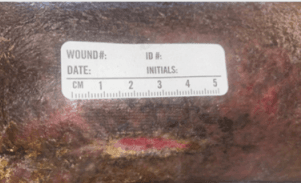
Case 1: 45-Year-Old Female, Dehisced Surgical Wound After Hardware Removal (Post-ORIF Ankle)
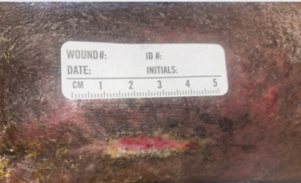 Case 1: dehisced surgical wound after hardware removal (post-ORIF ankle).
- Wound & History: Early Pseudomonas and S. aureus; staged grafting with human placental tissue + collagen dermal layer
- Prior Issues/Care: Serial BBGFM after infection control & debridement
- Outcome: From 18 cm³ with negative trajectory → full closure ~8.5 months.
Case 2: 60-Year-Old Male, Post-Transmetatarsal Amputation (TMA)
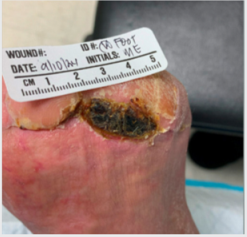 Case 2: post-transmetatarsal amputation wound.
- Wound & History: Non-healing bed with eschar/slough; managed initially with topical antiseptic/cleanser
- Prior Issues/Care: Seven BBGFM applications
- Outcome: 100% closure at 12 weeks.
Case 3: 62-Year-Old Male, Chronic Necrotic Post-Midfoot Amputation Wound
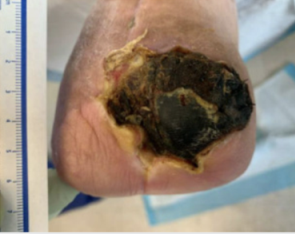 Case 3: chronic necrotic post-midfoot amputation wound.
- Wound & History: Stalled after five xenograft skin substitutes + collagen-alginate dressings
- Prior Issues/Care: Ten BBGFM applications over 21 weeks
- Outcome: Contracted, granulated, and fully epithelialized (peak 4.9 cm³).
Clinical theme: In each case, progress accelerated only after BBGFM was layered into a multimodal plan (sharp debridement, infection control, absorbent/antimicrobial dressings).
Practical Takeaways for Wound Programs
- Start with fundamentals then escalate. Standard bed prep and antimicrobial dressings preceded BBGFM use in all patients.
- Plan for serial applications. Weekly-to-biweekly cadence mirrors clinical-trial protocols and ongoing DFU studies.
- Watch for early "go/no-go" signals. Granulation and edge advancement within weeks suggest continuing therapy.
- Keep the strategy multimodal. Integration with debridement and infection control aligns with RCT standard of care framework.
Outcomes and Limitations
- Trajectory reversal: All wounds contracted and granulated after BBGFM introduction.
- Time to closure: 8.5 months (post-ORIF) | 12 weeks (TMA) | 21 weeks (midfoot).
- Quality of tissue: Described as "robust granulation and epithelialization," consistent with bioactive-glass healing mechanisms.
- Study size (n = 3) → uncontrolled; authors recommend prospective trials to define comparative effectiveness and application cadence.
Bottom Line
Recalcitrant trauma and amputation wounds often resist closure even after best-practice wound care and prior advanced matrices. This three-patient series reinforces growing evidence that a boron-based bioactive glass fiber matrix can help restart stalled healing by stimulating granulation and epithelial advancement within a multimodal framework.
Serial use—typically weekly to biweekly applications following debridement and infection control—produced measurable improvements in wound trajectory and tissue quality, echoing outcomes seen in randomized and real-world studies. While these results are early and uncontrolled, they align with broader clinical data showing that bioactive glass dressings enhance angiogenesis, fibroblast activity, and microbial balance—creating conditions for sustainable closure.
For clinicians managing complex lower-extremity wounds, BBGFM represents a promising adjunctive option to deploy when progress plateaus, integrated with foundational wound care and objective progress tracking.
References
- Armstrong DG, et al. Resorbable glass microfiber matrix vs SOC in chronic wounds (RCT). Int Wound J. 2021. PMC
- Ren Z, et al. Bioactive Glasses: Advancing Skin Tissue Repair. 2025. PMC
- Homaeigohar S, et al. Bioactive glass-based fibrous wound dressings. 2022. PMC
- Kargozar S, et al. Using Bioactive Glasses in the Management of Burns. 2019. PMC
- Armstrong DG, et al. A borate-based bioactive glass advances wound healing. 2025. PMC
- Buck DW, et al. Bioactive glass fiber matrix case series (chronic wounds). 2020. LWW
- HMP case write-up: Bioactive glass on infected wounds/exposed hardware. HMP Global
- ClinicalTrials.gov – Bioresorbable glass fiber matrix in DFUs. NCT03398538 | NCT06403605
- Drago L, et al. Recent Evidence on Bioactive Glass Antimicrobial Properties. 2018. MDPI
- Wilkinson HN, et al. Antimicrobial efficacy against P. aeruginosa & S. aureus in biofilm model. 2018. Europe PMC