
ADM + NPWT for Open Fractures: 7-Case Series
Meshed HR-ADM combined with NPWT for extremity wounds with periosteal stripping achieves healthy granulation in all cases, 86% closure rates.
Damon Ebanks
Medipyxis
Medical education note: For clinicians; not a substitute for patient-specific medical advice.
Clinician TL;DR
A single-surgeon retrospective series (2022–2025) from Rutgers New Jersey Medical School evaluated meshed human reticular acellular dermal matrix (HR-ADM) combined with negative pressure wound therapy (NPWT) for extremity wounds with periosteal stripping/exposed bone after open fractures and other severe injuries. Among 7 patients (mean age 57; 86% lower extremity; wounds 6–700 cm², median 48 cm²; 86% traumatic; 71% infected), all developed healthy granulation tissue over HR-ADM; 4 proceeded to split-thickness skin grafting (STSG) and 6/7 wounds (86%) were documented closed at follow-up.
Why This Matters
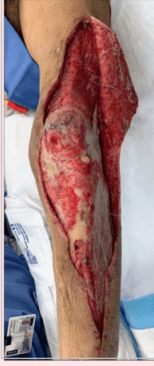
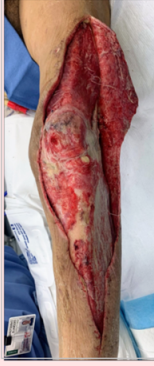 57-year-old patient with chronic lower extremity wound, initial visit.
Open-fracture soft-tissue loss—especially with periosteal stripping—often pushes teams toward flap reconstruction, yet many patients are poor flap candidates due to comorbidities, contamination, or resource constraints. Aseptically processed, meshed HR-ADM offers an open scaffold for host ingrowth and revascularization; when paired with NPWT, it can create a graft-ready bed or support secondary closure in select cases—offering a less-invasive, staged alternative to immediate flap surgery.
What the Rutgers Series Did and Found
Design & Setting
Single-surgeon, retrospective chart review (2022–2025) of extremity wounds with periosteal stripping treated with meshed HR-ADM + NPWT; endpoints included granulation presence, receipt of STSG, and wound closure.
Population Snapshot
- n = 7; mean age 57; 57% male
- 86% lower-extremity wounds
- Wound area 6–700 cm² (median 48 cm²)
- 86% traumatic; 71% infected at presentation
Outcomes
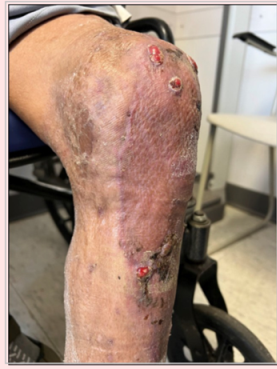 57-year-old patient post-op with healthy granulation tissue.
- Healthy granulation documented in all wounds after HR-ADM application
- STSG performed in 4/7 (57%)
- Closure achieved in 6/7 (86%), including 2 that closed without grafting
The Staged Pathway
- Debridement to a clean, bleeding bed; treat infection early.
- Apply meshed HR-ADM over exposed structures.
- Add NPWT to secure the matrix and manage the interface.
- Reassess for granulation; proceed to STSG once graft-ready—or continue toward secondary intention if progressing.
When to Consider HR-ADM + NPWT
- Open fractures with periosteal stripping/exposed bone where flap is contraindicated or delayed.
- Infected or contaminated wounds after adequate source control and debridement.
- Large surface-area defects where a granulation scaffold can reduce reconstructive complexity or stage toward STSG.
Practical Protocol You Can Adapt
Bed Prep & Infection Control
Serial, aggressive debridement, culture-guided therapy, and meticulous hemostasis before matrix application.
Matrix Placement
Lay meshed HR-ADM to maximize contact with viable tissue; conform to voids/edges.
NPWT Over the Matrix
Use NPWT dressings to maintain uniform pressure and moisture balance.
Decision Point at Granulation
- If bed is robust and uniform → STSG (done in 57% of patients in this series).
- If epithelialization is advancing → consider continued secondary intention (achieved closure in some cases).
Limitations
Small case series (n = 7), single surgeon, and variable follow-up—no comparator arm, cost analysis, or standardized NPWT parameters reported. Authors call for larger, prospective studies.
Bottom Line
When flap options are limited, meshed HR-ADM + NPWT can bridge exposed bone to a graft-ready bed and standardize staged closure in carefully selected open-fracture wounds.
References
- Single-surgeon retrospective series (Rutgers NJMS, 2022–2025).
- Dolivo D, et al. Decellularized human reticular allograft dermal matrix in diabetic murine wound model. Cytotherapy. 2021.
- Iorio ML, et al. ADM use in upper and lower extremity wounds. Plast Reconstr Surg. 2012.