
BBSM for Pressor Injuries: Safety, Timing & Outcomes
Synthetic bilayer dermal matrix shows promise in reconstructing foot tissue damaged by vasopressor-induced ischemia, enabling limb salvage without skin grafting.
Damon Ebanks
Medipyxis
Medical education note: This content is for informational purposes only and is not a substitute for professional medical advice, diagnosis, or treatment.
Why Vasopressor-Induced "Pressor Injuries" Are So Devastating
In the ICU, vasopressors can be life-saving—and limb-threatening simultaneously. High-dose agents maintaining blood pressure through intense vasoconstriction can severely reduce flow to distal vessels, particularly in toes and fingers, resulting in patchy or circumferential necrosis following septic shock resolution.
A large cohort examining vasopressor-induced ischemia reported amputation rates between 10–30% within thirty days and mortality around 15%, demonstrating that survival frequently comes with substantial tissue loss.
Meet the Patient
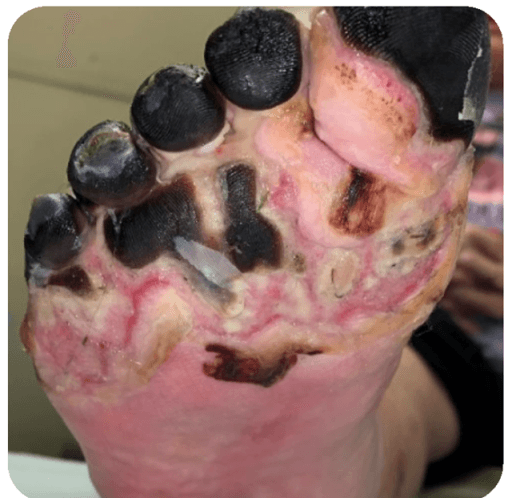
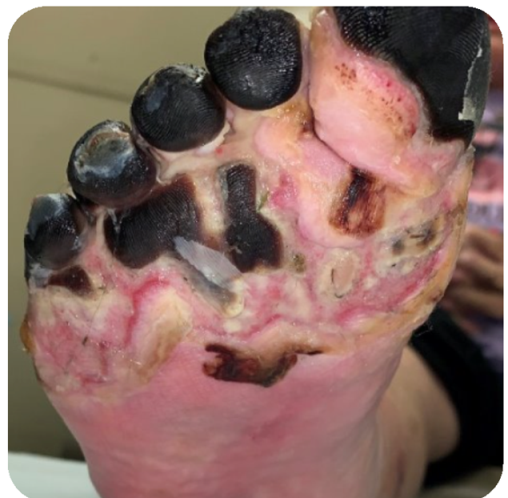 Initial visit: patient with necrotic toes and plantar foot damage.
In CS-057, the patient developed digital necrosis affecting all ten toes plus necrosis across both plantar feet following high-dose vasopressor therapy. Once stable and tissue demarcation had occurred, the patient required full and partial toe amputations, combined with sharp debridement of necrotic plantar tissue.
Because some toe wounds and plantar defects could not be closed primarily without excessive tension, the team selected a biodegradable bilayer synthetic matrix instead of immediate skin grafting or extensive soft-tissue flaps.
What Is a Biodegradable Bilayer Synthetic Matrix (BBSM)?
BBSM is a fully synthetic, bilayer dermal substitute—most commonly clinically represented by NovoSorb® Biodegradable Temporising Matrix (BTM)—made from porous polyurethane foam bonded to a non-biodegradable sealing membrane. The foam provides scaffolding for vascular and fibroblast ingrowth, while the top membrane controls moisture loss and protects the wound surface.
Over several weeks, host cells infiltrate the foam, depositing collagen and forming a vascularized "neodermis." Once integration completes, the sealing membrane is peeled away, leaving a robust dermal layer prepared for either split-thickness skin grafting or, in select cases, epithelialization and secondary intention healing.
Compared with biologic dermal matrices, BBSM/BTM is entirely synthetic, lacks antigenic proteins, avoids disease transmission risk, and enables manufacturing at scale.
How BBSM Was Used in This Pressor Injury Case
After demarcation and necessary toe amputations, the surgical team debrided necrotic plantar tissue down to healthy, bleeding margins. BBSM was then applied to the right foot's plantar aspect and to toe amputation stumps unable to close primarily.
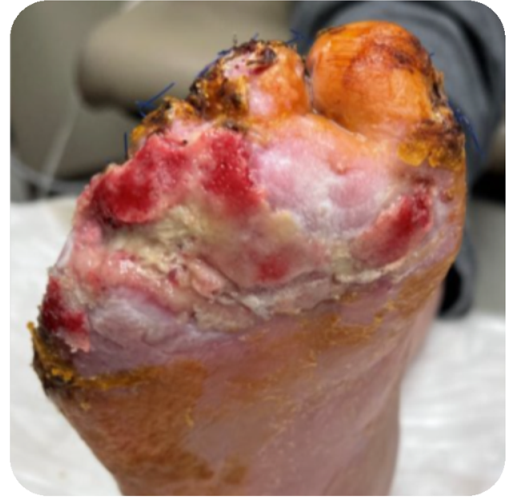 Pressor injury 3 weeks post BBSM application.
The matrix was secured and managed with simple dressings rather than negative pressure therapy. By three weeks post-placement, the BBSM was fully integrated, with healthy granulation and neodermis apparent across treated areas.
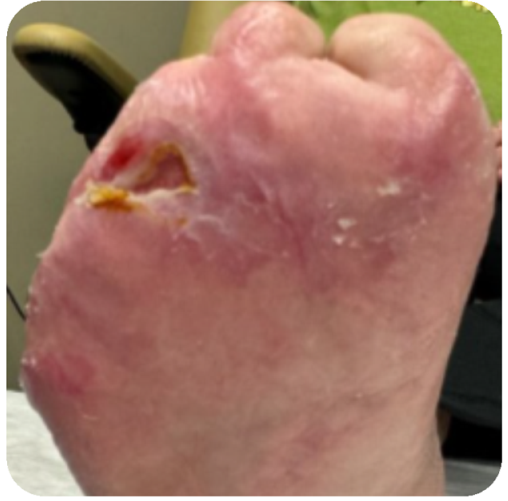 Pressor wound nine weeks post BBSM placement — near-complete healing.
By nine weeks following BBSM application, the plantar wounds and toe stumps were nearly healed with smooth contour. The patient achieved high functionality in both feet using orthotics and, crucially, healed through secondary intention without requiring skin grafting.
Why a Synthetic Bilayer Matrix Makes Sense in Pressor Injuries
Patients with severe septic shock often remain medically fragile for weeks to months—on dialysis, anticoagulation, or recovering from respiratory failure—making repeated anesthetics and donor-site harvesting risky. BBSM provides opportunity to temporize the wound, allowing dermis regeneration underneath protective membrane while clinicians focus on stabilizing organ systems.
Because fully synthetic and relatively tolerant of colonized wounds, BTM can remain in place longer than many biologic matrices, even amid bacterial load.
Practical Tips for Considering BBSM in Vasopressor-Related Foot Necrosis
- Before applying BBSM, ensure macrovascular inflow is adequate: evaluate pulses, duplex, or ankle-brachial index as indicated.
- Perform meticulous debridement achieving a clean, bleeding wound bed, removing all non-viable tissue and biofilm.
- Once placed, BBSM typically receives simple dressing management; monitor progressive "take" over 2–6 weeks.
- When integration completes, the sealing layer can be delaminated.
- Early involvement of orthotics, physiatry, and physical therapy is essential.
Bottom Line
Vasopressor-induced ischemia carries sobering amputation and mortality rates, and many survivors experience extensive tissue loss. This case demonstrates how a biodegradable bilayer synthetic matrix can salvage plantar tissue and toe stumps, achieving near-complete healing within nine weeks without skin grafting and with good functional outcome.
References
- CS-057: BBSM in pressor injuries. SAWC Fall 2025.
- NovoSorb BTM in burns and trauma reconstruction.
- BTM for colonized wounds in critically ill patients.
- Vasopressor-induced peripheral ischemia: epidemiology and outcomes.