
3D Xenograft for Stage 4 Pressure Ulcers: Case Series Outcomes
Two-patient case series evaluating porcine liver-derived 3D acellular xenograft for complex Stage-4 pressure ulcers with significant undermining.
Damon Ebanks
Medipyxis
Medical education note: This article is for clinicians and is not a substitute for patient-specific medical advice.
TL;DR (Clinician Quick Take)
A two-patient case series evaluated a three-dimensional acellular xenograft (porcine liver-derived; Miro3D® Wound Matrix) for complex Stage-4 coccygeal/sacral pressure ulcers with significant undermining that had failed standard care and other CAMPs (cellular/acellular/matrix-like products).
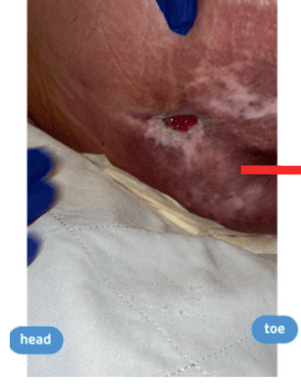
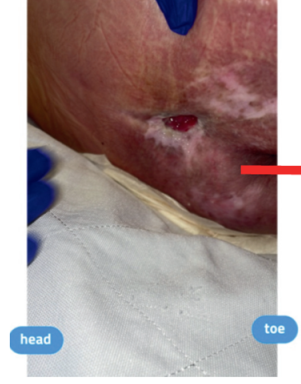 Case 1: 12-month coccyx ulcer with 2.1 cm undermining at presentation.
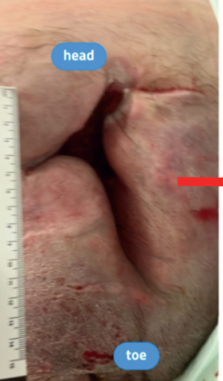 Case 2: 3-month sacral ulcer with 7 cm undermining at presentation.
Case 1 (12-month coccyx ulcer, 2.1 cm undermining): Near-complete closure in 48 days after 7 applications; 64% wound-volume reduction by week 4; 40% undermining reduction by week 4.
Case 2 (3-month sacral ulcer, 7 cm undermining): 67% percent-area reduction (PAR) and 71% undermining reduction within 90 days after 9 applications.
Signal: A 3D xenograft that conforms to undermined/tunneled spaces may help accelerate granulation, contraction, and closure in hard-to-heal pressure injuries as an adjunct when standard of care and prior CAMPs have stalled.
Why This Matters for Wound Teams
Deep Stage-4 pressure injuries with tunneling and undermining are notoriously resistant to closure because standard dressings don't reliably fill dead space or sustain a pro-healing microenvironment throughout the cavity. This poster series suggests that a porcine liver-derived, 3D acellular matrix can act as a volumetric scaffold supporting tissue regeneration and wound contraction where other modalities have been insufficient.
Product note: The xenograft referenced is Miro3D® Wound Matrix (Reprise Biomedical). Always follow manufacturer instructions and institutional policy.
Wound Healing Process
- Population: Two adults with chronic Stage-4 coccygeal/sacral ulcers and substantial undermining (2.1 cm and 7 cm). Both had failed standard of care plus antimicrobial gels and other CAMPs.
- Intervention: Xenograft applied as part of routine wound care; applications repeated over several weeks; dimensions, undermining, volume, and PAR tracked over time.
- Outcomes measured: Volume change, percent area reduction, undermining depth, and observed time to near-closure.
Headline Results
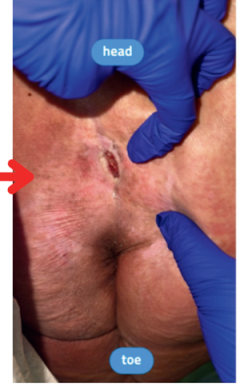 Case 1: near-complete closure by day 48 after 7 xenograft applications.
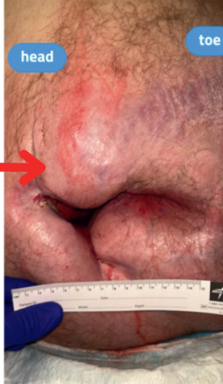 Case 2: 67% PAR and 71% undermining reduction by day 90 after 9 applications.
- Case 1: Near-complete closure by day 48 after 7 applications; −64% volume and −40% undermining by week 4.
- Case 2: 67% PAR and −71% undermining within 90 days after 9 applications.
The authors conclude that the xenograft promoted tissue regeneration, contraction, and enhanced healing in these complex ulcers.
Clinical Takeaways You Can Use
-
Think "volume," not just "surface." In undermined Stage-4 wounds, healing stalls when only managing the opening. A 3D matrix occupying dead space may help create contiguous granulation and reduce undermining as seen in both cases.
-
Use it as an adjunct, not a replacement. The xenograft was layered on top of standard of care, not instead of it. Keep doing the fundamentals: offloading/pressure redistribution, moisture balance, debridement as indicated, bioburden control, and nutrition.
-
Track the right metrics weekly. Don't rely on width×length alone. Follow percent-area reduction (PAR), volume estimates, and undermining depth to pick up early trajectory changes.
-
Expect a cadence of repeated applications. In this series it took 7–9 applications over approximately 7–13 weeks for major gains or near-closure. Build this into the plan and into payer documentation.
Where This Xenograft Might Fit
- Stage-4 coccygeal/sacral injuries with 2–7 cm undermining that haven't responded to standard of care and prior CAMPs.
- Chronic ulcers (3–12+ months) with persistent cavities where a conformable, 3D scaffold is needed to bridge granulation through dead space.
Clinical judgment rules: ensure adequate debridement, bioburden control, and reliable pressure redistribution before escalation.
Limitations
This is a small, two-patient case series; it doesn't control for confounders, report comparative outcomes, or detail adverse events. The authors call for larger studies to validate efficacy and refine patient selection. Use these results as hypothesis-generating signals, not definitive proof.
FAQ
What is the three-dimensional acellular xenograft used here?
A porcine liver–derived, 3D wound matrix (Miro3D®) designed to fill irregular cavities and support granulation. In this series, it was used adjunctively in two complex Stage-4 pressure ulcers.
How quickly did undermining and volume change?
- Case 1: 64% volume and 40% undermining reduction by week 4; near-closure by day 48 (7 applications).
- Case 2: 67% PAR and 71% undermining reduction by day 90 (9 applications).
Had other advanced products already been tried?
Yes. Both patients had received standard of care and other CAMPs without success prior to xenograft use.
Bottom Line
In deep, undermined Stage-4 pressure injuries that have stalled on standard of care and prior CAMPs, a porcine 3D acellular xenograft may help fill dead space, accelerate granulation, and reduce undermining with early signals of meaningful progress within 4–12 weeks in this small case series.
References
- Reprise Biomedical — Miro3D Wound Matrix. Reprise Bio
- FDA 510(k) K221520 — Miro3D Wound Matrix. FDA
- WoundSource — Miro3D Wound Matrix. WoundSource
- WoundReference — Miro3D overview. WoundReference
- EPUAP/NPIAP/PPPIA 2019 Guideline. International Guideline
- StatPearls — Pressure Ulcer. NCBI Bookshelf
- Jørgensen 2015 — Assess area & volume (systematic review). PMC
- Wounds-UK — How to measure a wound (PAR thresholds). Wounds UK