Super Absorbent Dressings + Two Layer Compression Heal Draining Leg Wounds

Management of Lower Extremity Wounds With Super‑Absorbent Dressings and Compression Wraps
Medical disclaimer: This content is for informational and educational purposes only and is not a substitute for professional medical advice, diagnosis, or treatment. Always follow your local protocols and the orders of the treating clinician.
Why heavily exudative lower‑extremity wounds are so hard to manage
Lower‑extremity wounds—especially venous leg ulcers—are common in older adults. Between 1.5 and 3 in 1,000 people have an active leg ulcer, and prevalence climbs to about 20 in 1,000 in those over age 80. These wounds are often chronic, painful, and recurrent, with major impact on mobility and quality of life. [1,2]
Many lower‑extremity wounds linked to venous insufficiency or edema are highly exudative. When exudate overwhelms the dressing, patients live with “wet legs,” foul odor, macerated periwound skin, and frequent leaks through clothing and compression wraps. This isn’t just unpleasant—it drives local inflammation, bacterial overgrowth, and delayed healing. [1,3]
For clinicians, the practical challenge is finding a combination of advanced primary dressings, super‑absorbent secondary dressings, and effective compression that can contain exudate, protect the surrounding skin, and still be wearable for days at a time. That’s the problem addressed in the case series “Management of Lower Extremity Wounds With Super‑Absorbent Dressings and Compression Wraps (CS‑045),” which followed seven complex patients over several weeks of care. [11]
Super‑absorbent dressings: why they matter in “wet” leg ulcers
Super‑absorbent polymer (SAP) dressings are designed with a high‑capacity core that locks in fluid, even under compression, helping to keep the wound surface moist but not overly wet. A recent systematic review found that super‑absorbent dressings can improve exudate management, reduce dressing change frequency, and may support healing when used as part of good overall wound care. [3]
In a multi‑center observational study, clinicians using a SAP dressing for highly exudative wounds reported better exudate control, less maceration, and high satisfaction from both clinicians and patients—especially in venous leg ulcers with heavy drainage. [4]
Earlier work with super‑absorbent hydropolymer dressings in exuding venous leg ulcers showed statistically significant advantages over standard care in terms of exudate control and patient comfort, again suggesting that “more absorbent” can translate to more stable local conditions for healing. [5]
Advanced primary dressings: ORC/collagen/silver and hydrofiber with silver
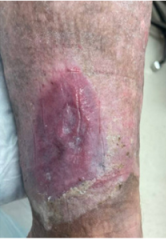
41 year old with right leg venous leg ulcer after 42 days of advanced primary dressing application

In the CS‑045 series, wounds were managed with advanced primary dressings: either an oxidized regenerated cellulose (ORC)/collagen/silver matrix or a hydrofiber with silver, both placed directly on the wound bed before the super‑absorbent and compression. [11]
Randomized and controlled studies show that ORC/collagen/silver dressings can help normalize the chronic wound micro‑environment—binding excess proteases, supporting a balanced moisture level, and providing broad antimicrobial coverage—which in turn is associated with faster healing in venous leg ulcers compared with standard care alone. [6,7]
A meta‑analysis of ORC/collagen and ORC/collagen/silver dressings across chronic wound types found improved rates of complete healing and reduced time to closure versus conventional dressings, further supporting their use as a primary layer under compression in complex leg wounds. [8]
Compression wraps: the non‑negotiable pillar
No matter how sophisticated the primary dressing is, venous and edema‑driven lower‑extremity wounds will not heal reliably without adequate compression. Cochrane‑based summaries and guideline reviews confirm that compression therapy significantly increases healing rates and reduces recurrence compared with no compression. [2,6]
Two‑layer compression systems such as Coban™ 2 have been directly compared to traditional four‑layer systems in randomized crossover trials. In one 81‑patient study, Coban 2 achieved similar healing but with less bandage slippage and higher patient preference, key factors in maintaining therapeutic pressure through daily activity. [9,10]
The CS‑045 protocol used a two‑layer compression wrap on top of the advanced primary and super‑absorbent secondary dressing, creating a combined approach: optimize the wound bed, capture exudate, and then address the underlying venous hypertension with sustained, comfortable compression. [11]
Inside the CS‑045 case series
Seven patients aged 41–88 presented with a mix of lower‑extremity wounds: skin breakdown from lymphedema blistering (1), fluid‑overload ulcer (1), venous leg ulcers (3), vasculitic lesion (1), and a traumatic ulcer (1). Most had significant comorbidities, including previous VLUs, lymphedema, obesity, diabetes, vascular insufficiency, and prior endovenous ablation—exactly the group where exudate control and compression are both difficult and essential. [11]
Each wound was treated with an ORC/collagen/silver or hydrofiber‑silver primary dressing, topped with a super‑absorbent secondary dressing, then secured with a two‑layer compression wrap. Dressing changes occurred one to two times per week depending on exudate volume. One patient also received an advanced elastomeric skin protectant on the periwound before dressing application to further reduce moisture‑related damage. [11]
Across the seven cases, clinicians observed increased granulation tissue, reduced wound area, and decreased exudate within 14–28 days of this combined regimen. Four of the seven wounds went on to complete healing within 46 days of presentation, while the remaining wounds continued to show progressive granulation and slough reduction under ongoing hydrofiber‑silver plus super‑absorbent therapy. [11]
The discussion from CS‑045 concludes that using advanced wound dressings alongside super‑absorbent secondary dressings and two‑layer compression resulted in complete healing in more than half the patients and improved wound‑bed quality in the rest—supporting this as a practical management plan for highly exudative lower‑extremity wounds. [11]
How this fits with the broader evidence
The CS‑045 results line up with larger studies showing that combining good exudate management with effective compression accelerates healing in venous and mixed‑etiology leg ulcers. Systematic reviews emphasize that super‑absorbent dressings can reduce maceration and dressing changes while creating a more stable environment for granulation. [3,5]
At the same time, trials of ORC/collagen/silver dressings suggest that addressing the biochemical load of the wound (excess proteases, bioburden) can tip stalled wounds back into a healing trajectory—especially when combined with consistent compression. [6,8]
Most importantly, compression trials such as the Coban 2 versus Profore crossover study show that if bandages slip or are uncomfortable, patients simply won’t keep them on, and therapeutic pressure is lost. Systems that stay in place with less bulk and better comfort are repeatedly preferred—and improved adherence is one of the strongest predictors of long‑term healing and recurrence prevention. [9,10]
Practical takeaways for clinicians
For a heavily exudative lower‑extremity wound, especially in the setting of venous insufficiency or lymphedema, a layered approach makes sense: use an active primary dressing (such as ORC/collagen/silver or hydrofiber‑silver) to condition the wound bed, add a high‑capacity super‑absorbent to manage fluid, and then apply evidence‑based compression once arterial status has been confirmed. [2,6]
Consider super‑absorbent dressings when standard foams or gauze are saturating before the next planned visit, when there is recurrent maceration under compression, or when patients report “constant leaking” despite otherwise adequate compression therapy. Observational and trial data suggest these dressings can extend wear time and reduce periwound damage in exactly these scenarios. [3,4]
When choosing a two‑layer compression system, look for published evidence on bandage slippage, patient preference, and ability to maintain target ankle pressures (around 40 mmHg for classic venous disease, as guided by your local protocols). Systems like Coban 2 have been studied with these endpoints and may help keep compression where you put it. [9,10]
Finally, track not only wound area but also exudate volume, dressing saturation, and periwound condition at each visit. Improvement in granulation and reduction in exudate over 2–4 weeks, like those reported in CS‑045, are strong signals that the dressing‑plus‑compression combination is working and worth continuing or scaling to similar patients. [3,11]
Bottom line
Heavily exudative lower‑extremity wounds—most often driven by venous disease, edema, or lymphedema—need more than “just another foam.” They need a coordinated plan: optimize the wound bed with advanced dressings, capture exudate with a truly super‑absorbent secondary layer, and correct venous hypertension with well‑tolerated, evidence‑based compression. [1,2]
The CS‑045 case series adds real‑world support for this strategy: seven complex patients treated with ORC/collagen‑ or hydrofiber‑silver dressings, super‑absorbent secondaries, and two‑layer compression showed rapid gains in granulation, fewer leaks, and more than half achieved full closure within about six weeks. Paired with the broader literature on super‑absorbent dressings, ORC/collagen/silver, and modern two‑layer wraps, this suggests that a “high‑capacity plus high‑quality compression” approach is a practical, research‑backed way to manage wet, difficult leg wounds. [3,11]
References
Nelson EA, Adderley U. Venous leg ulcers. BMJ Clinical Evidence. 2016;2016:1902. PubMed
Sunder M, Morbach C. Compression Therapy for Chronic Venous Ulcers. American Family Physician. 2024;109(1):61–63 (Cochrane for Clinicians summary). AAFP
Veličković VM, Geri C, et al. Superabsorbent wound dressings for the management of exuding wounds: a systematic review and quality assessment of clinical studies. International Wound Journal. 2024. PMC
Barrett S. An observational study of a superabsorbent polymer dressing in the management of exuding wounds. Journal of Wound Care. 2018;27(2):76–84. PubMed
Schulze HJ, Lane C, Charles H, et al. Evaluating a superabsorbent hydropolymer dressing for exuding venous leg ulcers. Journal of Wound Care. 2001;10(1):511–518.
Gottrup F, Cullen BM, Karlsmark T, et al. Randomized controlled trial on collagen/oxidized regenerated cellulose/silver treatment. Wound Repair and Regeneration. 2013;21(2):216–225. Wiley Online Library
Cullen BM, Gottrup F, Karlsmark T, et al. Randomized Controlled Trial Comparing Collagen/Oxidized Regenerated Cellulose/Silver to Standard of Care in the Management of Venous Leg Ulcers. Advances in Wound Care. 2017;6(11):1–10. PubMed
Zhang L, Jin J, Wang X, et al. Efficacy of Oxidized Regenerated Cellulose/Collagen Dressing for the Treatment of Chronic Wounds: A Systematic Review and Meta‑analysis. International Wound Journal. 2021;18(4):430–441. PMC
Moffatt CJ, Edwards L, Collier M, et al. A randomised controlled 8‑week crossover clinical evaluation of the 3M™ Coban™ 2 Layer Compression System versus Profore™ to evaluate the product performance in patients with venous leg ulcers. International Wound Journal. 2008;5(2):267–279. PubMed
Schuren J, Mohr K, Moffatt C. 3M™ Coban™ 2 Layer Compression Therapy System: learning about compression therapy. Journal of Wound Care. 2012;21(5 Suppl):1–15. PMC
Greenstein E. Management of Lower Extremity Wounds With Super‑Absorbent Dressings and Compression Wraps (CS‑045). Essentia Health case‑series poster, 2025 (PDF provided by user).