
Medipyxis vs Net Health: Which One Fits Mobile Wound Care Best in 2026?
Compare Net Health's WoundExpert + Tissue Analytics with Medipyxis' end-to-end referral-to-reimbursement workflow.
Caleb Ebanks
Medipyxis
Medipyxis vs Net Health: Which One Fits Mobile Wound Care Best in 2026?
When someone says "Net Health vs Medipyxis," they're often comparing two very different ideas of what the core system should be.
Net Health brings a specialized wound suite: a wound care EHR (WoundExpert) paired with AI wound imaging/analytics (Tissue Analytics). If your priority is wound documentation, imaging, and analytics inside clinical environments, that pairing can be very compelling.
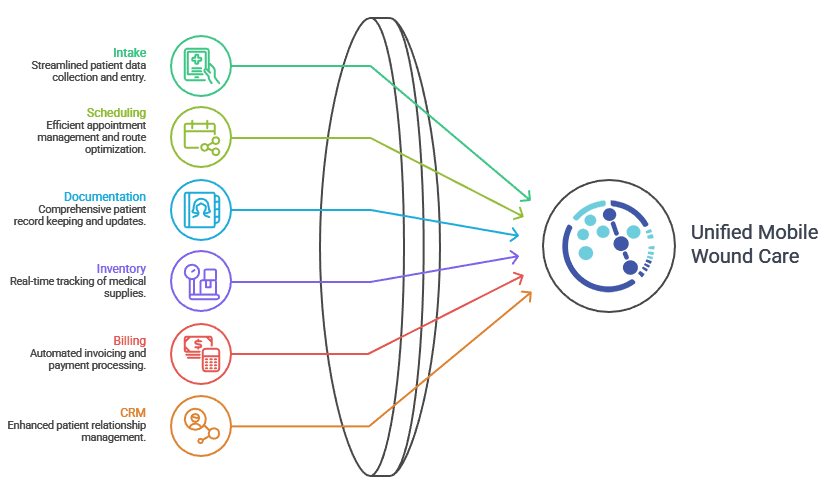
Medipyxis positions itself as an end-to-end operating system built for mobile wound care: intake & fax automation → routing & scheduling → documentation with compliance guardrails → inventory ERP + vendor portal → real-time billing capture → referral ROI visibility, all in one connected model.
So it's not really "feature vs feature."
It's closer to:
"Suite for wound clinical workflows" vs "Full mobile wound care operations system."
(Quick note: everything below reflects public product positioning and the way these platforms are commonly evaluated. Exact capabilities depend on configuration, integrations, and how your organization runs.)
The Quick Buyer-Fit Snapshot
Pick Net Health when you want a wound EHR + imaging/analytics suite
Net Health describes WoundExpert as a specialized wound care EHR that's trusted by 25,000+ facilities, built on a proprietary wound care database for benchmarking and reporting, and designed to integrate with other systems (including general EHRs).
Net Health describes Tissue Analytics as using machine learning and computer vision to segment/classify/measure wounds with standardized capture to support consistent assessments—including 3D wound imaging.
If your starting point is "we need stronger wound documentation + measurement + analytics," Net Health tends to show up as a natural shortlist option.
Pick Medipyxis when you need the full mobile wound care operating chain
Medipyxis doesn't just pitch documentation. It pitches the entire operating chain: referral intake, routing, scheduling, compliance guardrails, graft/inventory tracking, and billing capture—wrapped around wound care delivery.
If your pain is "we're doing too much work between referral and reimbursement," Medipyxis is built to live in that space.
What You're Really Comparing: "Scope of Responsibility"
Here's the simplest way to decide what you're actually shopping for:
Do we need best-in-class wound documentation + imaging + analytics… or do we need the system that runs the business of mobile wound care?
- Net Health's wound-care story is anchored in a specialized wound EHR and imaging/analytics suite.
- Medipyxis' story is anchored in end-to-end operational execution—intake, routing, inventory control, and billing workflows—alongside documentation.
The 7 Questions That Usually Settle Medipyxis vs Net Health
Instead of a long checklist, use these as "demo questions." They map to the places mobile wound care wins or breaks.
1) How do referrals turn into scheduled visits—fast?
If referrals are still coming in by fax/email, your bottleneck is rarely the clinical note. It's the messy front door.
Medipyxis emphasizes converting faxes/emails into structured intake, verifying insurance before scheduling, and recommending the right clinician to speed up scheduling without adding intake headcount.
Net Health emphasizes the wound EHR + documentation suite and integration with other systems; referral-to-visit automation isn't the headline of the WoundExpert positioning.
What this means in practice: If "speed to first visit" is your biggest lever, Medipyxis is designed to make intake part of the same workflow that drives scheduling/routing and downstream documentation and billing.
2) Is routing and scheduling a daily survival skill for you?
In mobile wound care, route efficiency is margin. It's also capacity. It's also sanity.
Medipyxis explicitly includes routing and scheduling as part of the "one connected data model" story.
Net Health markets WoundExpert as a specialized wound EHR that streamlines wound documentation and integrates well with other systems; routing optimization isn't positioned as the center of the suite.
What this means in practice: If your day gets decided by route math—facility windows, add-ons, urgent visits—Medipyxis is built to own that problem rather than expecting you to solve it elsewhere.
3) Is wound imaging/measurement your #1 buying driver?
If your evaluation starts with "show me the imaging and measurement workflow," Net Health can be a strong contender.
Tissue Analytics explicitly markets machine learning/computer vision wound measurement and standardized capture (lighting/distance/angle) to support consistent assessments, including 3D imaging.
Medipyxis positions itself as the mobile wound care OS; imaging may exist in the workflow depending on configuration, but the public differentiation is the operational chain.
How to interpret this: If measurement and imaging sophistication is the centerpiece of your purchase, Net Health deserves serious attention. If leadership is more worried about throughput, compliance, and operational drag, Medipyxis is speaking directly to those constraints.
4) Do you use grafts/advanced products—and do you need audit-ready traceability?
This is where mobile programs often feel the most pain: waste, expirations, missing lot numbers, and no clean chain-of-custody.
Medipyxis is very explicit here: a dedicated Graft & Advanced Products ERP, Medicare guardrails tied to LCD rules (configurable by region), and audit-ready reporting with traceability logs (who had it, who used it, which patient, when).
Net Health provides a wound EHR + imaging/analytics suite; if you need end-to-end inventory ERP workflows, you'd want to confirm what's native vs partner/integration-based in your planned setup.
What this means in practice: If advanced products are driving both revenue and audit exposure, Medipyxis is positioning that inventory governance as part of the core platform promise—not a side process.
5) How quickly does "note complete" become "claim ready"?
In mobile wound care, the most expensive phrase is: "We can't submit this yet."
Medipyxis markets real-time billing capture as part of the connected OS model (referral → route → visit → compliant documentation → billing capture).
Net Health describes WoundExpert as integrating clinical, financial, and regulatory tools and streamlining management/documentation, with interoperability as a strength.
What this means in practice: If your pain is billing lag and denial risk, Medipyxis is built around tightening the handoff so billing isn't doing "chart archaeology."
6) Do you want referral ROI and growth visibility inside the same system?
Mobile wound care growth is referral-driven. Leaders often want to know: which sources convert, which stall, and what's worth investing in.
Medipyxis publicly positions referral ROI visibility as part of the OS, and it lists BD/CRM right alongside intake, routing, documentation, billing, and graft ERP under the "one login, one source of truth" framing.
Net Health emphasizes specialized wound clinical management, documentation, imaging, analytics, and interoperability; BD/CRM ROI isn't the core theme of the wound suite.
What this means in practice: If your growth engine is referrals and your operating engine is mobile capacity, Medipyxis is designed to connect those two worlds.
7) Are you trying to replace tool sprawl with one operating model?
This is often the deciding factor that makes everything else click.
Medipyxis is explicit about consolidation: one system across intake, insurance/auth, routing/scheduling, documentation, billing/coding, graft ERP, and even HR/training + BD/CRM in its broader platform narrative.
Net Health offers a wound EHR and imaging/analytics suite with an emphasis on interoperability and integrating into existing systems.
What this means in practice: If your strategy is "one unified workflow from referral to reimbursement—with inventory traceability inside the same system," Medipyxis is built and marketed for that exact outcome. If your strategy is "specialized wound suite that plugs into our existing ecosystem," Net Health fits that philosophy.
Where Net Health Is a Strong Choice (The Fair View)
Net Health tends to be a strong candidate when:
- You want a specialized wound care EHR built around wound documentation and reporting workflows
- Imaging/measurement and analytics (Tissue Analytics) are a cornerstone capability
- Interoperability is central, including messaging around FHIR
If your organization is anchored in clinical environments where documentation and imaging consistency is the priority, that suite approach can be a very clean fit.
Why Medipyxis Often Wins for Mobile Wound Care Operators
If you're running mobile wound care, Medipyxis' biggest advantages aren't "another template." They're operational:
- Turning fax/email referrals into scheduled capacity (with intake automation + insurance verification + smart assignment)
- Routing and scheduling as a native workflow (not "handled somewhere else")
- Graft/advanced products tracking as an ERP-style workflow, with Medicare guardrails and audit-ready traceability
- A unified "one login, one source of truth" model across intake → visits → inventory → billing
That's what keeps mobile programs scalable without adding more coordinators, spreadsheets, and cleanup work.
FAQ
Is Net Health the same thing as a "mobile wound care operating system"?
Net Health positions its wound offering around WoundExpert (wound EHR) plus Tissue Analytics (AI imaging/analytics), with strong integration and interoperability messaging. Medipyxis positions itself as a full mobile wound care OS spanning intake, routing, documentation/compliance guardrails, inventory ERP, and billing capture.
What's the clearest Medipyxis advantage over Net Health?
For mobile wound care operators, it's the end-to-end operating chain—especially referral intake + routing/scheduling + graft ERP traceability + billing capture in one workflow.
Does Net Health offer AI wound imaging?
Yes—Tissue Analytics is marketed around machine learning and computer vision for wound segmentation/classification/measurement and standardized capture techniques, including 3D wound imaging.